
Tamil Nadu continues to witness intense political uncertainty after Governor Rajendra Vishwanath Arlekar refrained from inviting actor-turned-politician Vijay and his party, Tamilaga Vettri Kazhagam (TVK), to form the government despite the party emerging as the single-largest force in the state Assembly elections.
The unfolding constitutional and political deadlock has triggered sharp reactions from opposition parties, alliance leaders, and constitutional experts, with growing debate over whether the Governor should immediately invite the largest party to prove its majority on the Assembly floor.
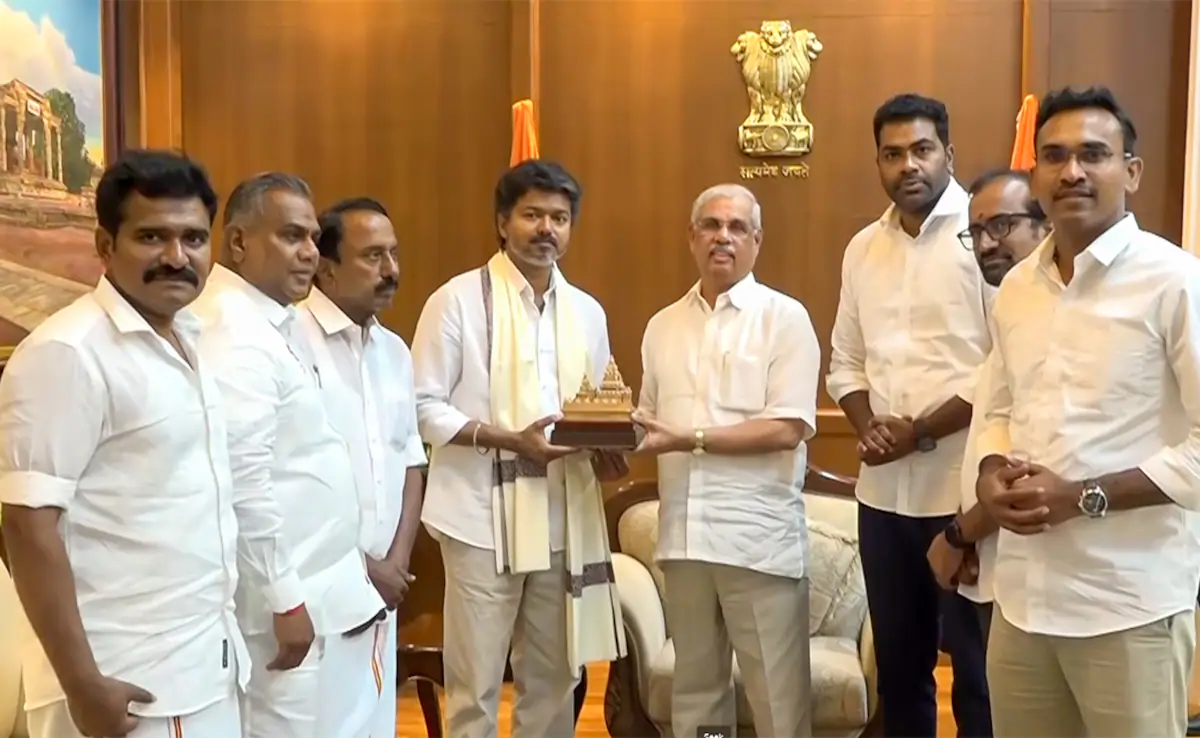
Vijay, who made a historic electoral debut through TVK, met the Governor for the second consecutive day in an effort to stake claim to form the government. However, Raj Bhavan reportedly maintained that the party must first demonstrate adequate numerical support before any formal invitation for government formation can be issued.
The delay has intensified speculation around possible political realignments and post-election negotiations among major regional parties.
The Tamil Nadu Assembly election delivered a fractured mandate, dramatically reshaping the state’s political landscape. TVK secured 108 seats in the 234-member Assembly, making it the single-largest party but leaving it 10 seats short of the majority mark of 118.
The Congress party extended support to Vijay’s camp, pushing the tally to 113. However, TVK still requires additional backing from smaller regional parties or independents to comfortably cross the halfway mark.
Political observers say the current situation has created one of the most unpredictable power struggles Tamil Nadu has witnessed in decades, particularly because the traditional dominance of the DMK and AIADMK has been challenged by a new political force led by Vijay.
According to official communication following Vijay’s meeting with the Governor, the state’s constitutional head stressed that majority support in the Legislative Assembly is essential before any government formation process can proceed. 
This stance has become the center of political controversy.
Several opposition leaders and constitutional experts argue that parliamentary convention generally requires the Governor to first invite the leader of the single-largest party and allow a floor test inside the Assembly rather than demanding proof of majority beforehand.
Supporters of TVK have alleged that the delay is politically motivated, while critics of the Governor’s position insist that constitutional norms must be followed transparently.
The Congress openly supported Vijay’s bid to form the government and criticized the Governor’s hesitation. Senior leaders argued that democratic conventions favor giving the largest party the first opportunity to prove its majority.
Leaders from Left parties and regional outfits also expressed concerns over the delay, with some stating that Tamil Nadu has never witnessed such a prolonged uncertainty after election results.
Meanwhile, the Viduthalai Chiruthaigal Katchi (VCK) and Left parties have held internal discussions to decide whether they should formally support TVK in order to prevent political instability in the state.
The backing of these smaller parties could become decisive in determining the next government.
The evolving political scenario has also fueled intense speculation about possible strategic moves involving the DMK and AIADMK.
Rumors of backchannel discussions and shifting alliances have dominated political circles, though both major Dravidian parties have publicly dismissed claims of a formal understanding.
AIADMK leaders have maintained that TVK currently lacks the numbers required to form the government, while DMK leaders have accused rival parties of destabilizing the political mandate delivered by voters.
Reports of legislators being moved to resorts and internal meetings among party leaders have further added to the atmosphere of uncertainty.
As the deadlock continued, supporters of Vijay and TVK staged protests outside Lok Bhavan demanding immediate invitation for government formation.
Police detained several protesters during demonstrations as security was tightened around the Governor’s residence amid rising political tension.
Party workers accused constitutional authorities of denying the democratic rights of the party that received the highest number of seats in the election.
The protests reflected the growing frustration among TVK supporters who believe the party should be given an opportunity to prove its strength through a floor test.
Legal experts and political analysts remain divided over the Governor’s approach.
Some constitutional scholars argue that the Governor has the authority to conduct a preliminary assessment of whether a party can command majority support before inviting it to form the government.
Others insist that established parliamentary convention and Supreme Court observations favor allowing the single-largest party to demonstrate majority on the floor of the House rather than through preconditions imposed at the Governor’s residence.
The ongoing debate has turned Tamil Nadu’s government formation process into a national constitutional discussion.
Regardless of the final outcome, Vijay’s emergence as a major political force has significantly altered Tamil Nadu’s political equations.
TVK’s impressive electoral performance has broken the long-standing dominance of traditional Dravidian parties and created a new center of political influence in the state.
Analysts believe the current developments could redefine coalition politics in Tamil Nadu for years to come, particularly if TVK succeeds in consolidating support from regional allies.
For now, the state remains in suspense as negotiations continue behind closed doors and the Governor awaits clarity on majority numbers before taking the next constitutional step.