
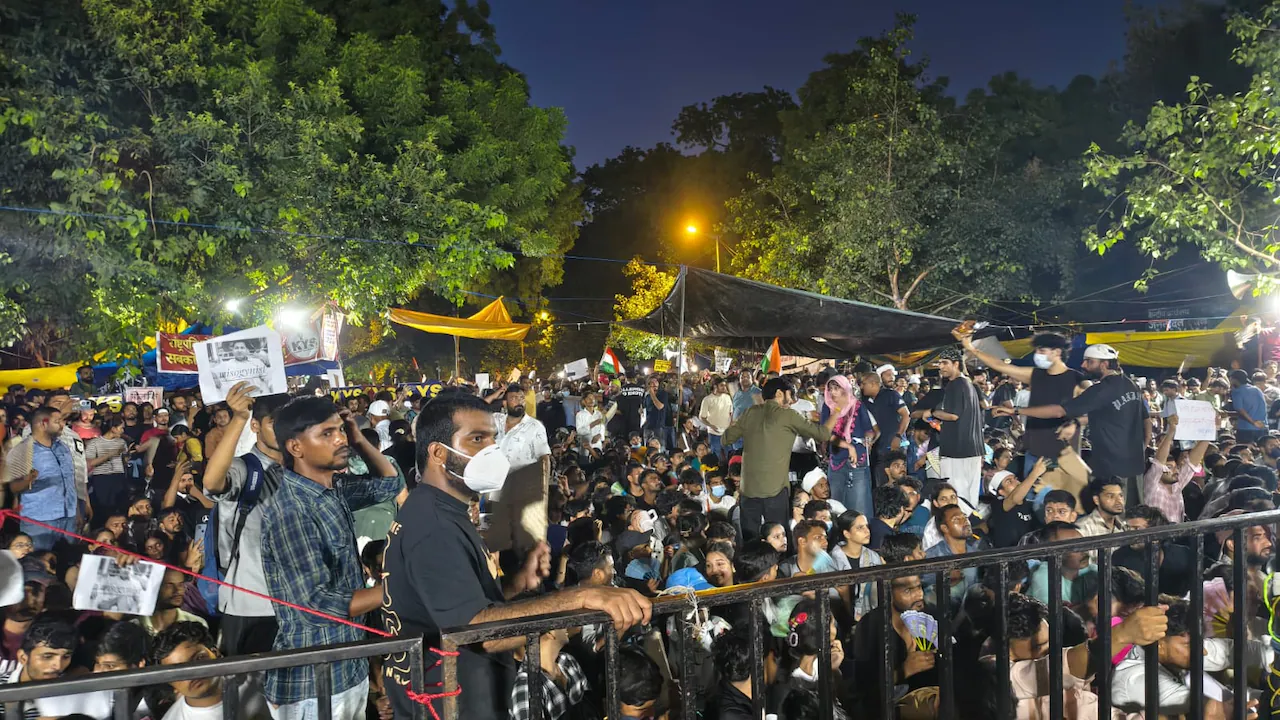
The legal battle over criminal cases registered against protesters associated with the Cockroach Janta Party (CJP) has widened, with Maharashtra, Assam, West Bengal and Bihar approaching the Supreme Court seeking permission to withdraw or quash cases arising from the protests held in July.
The development follows the Centre’s move to seek the quashing of 13 First Information Reports (FIRs) registered in Delhi in connection with the demonstrations. The latest applications by the four states have now brought the question of cases registered outside the national capital directly before the Supreme Court.
The matter assumes significance as CJP has been pressing the government to honour what it describes as assurances given at the time its 36-day agitation was called off on July 25. One of the key demands was the withdrawal of criminal cases against protesters.
Four states approach Supreme Court
The governments of Maharashtra, Assam, West Bengal and Bihar have separately approached the Supreme Court seeking permission to quash criminal proceedings arising from the CJP-led protests in their respective states.
Solicitor General Tushar Mehta informed a bench headed by Chief Justice of India Surya Kant that separate applications had been filed for the four states. The court agreed to consider the applications together, while asking the states to ensure that the pleas were free from procedural defects.
The applications are expected to be considered alongside the Centre’s request concerning the FIRs registered in Delhi.
The involvement of multiple states could significantly expand the scope of the proceedings before the Supreme Court. Instead of the issue being confined to cases filed in Delhi, the court may now have to consider how criminal proceedings arising from the nationwide protests should be dealt with across different jurisdictions.
Centre seeks withdrawal of 13 Delhi FIRs
On Monday, the Centre, through the Delhi Police, moved the Supreme Court seeking the quashing of 13 FIRs registered in connection with the protests held between July 20 and July 25.
The cases relate to incidents reported at Jantar Mantar and other locations in the national capital. The allegations in these FIRs include rioting, assault on police personnel, damage to public property and attempt to murder, apart from offences under provisions of the Bharatiya Nyaya Sanhita and the Prevention of Damage to Public Property Act.
The Centre has invoked the Supreme Court’s extraordinary powers under Article 142 of the Constitution to seek an end to the proceedings.
The government has said that it no longer wishes to pursue the 13 FIRs covered by its application.
However, the proposed withdrawal does not amount to a blanket closure of every criminal allegation linked to the protests.
Proposed fresh FIR against 2,873 people
Alongside its request to withdraw the 13 Delhi FIRs, the Centre has proposed registering a separate FIR against 2,873 individuals whose presence at the protest sites was allegedly identified and whose criminal backgrounds, according to the authorities, require further scrutiny.
The government has maintained that these individuals were prima facie reported to have serious criminal antecedents. Their individual roles in incidents involving bodily harm or destruction of property would be examined through a separate investigation.
The proposed FIR, therefore, would not automatically establish the guilt of those named. Rather, it would provide the investigating agency with a framework to determine whether individual participants were involved in specific offences.
The Centre has also indicated that no further FIRs would be registered in relation to the incidents covered by its application.
Supreme Court had drawn a distinction between protesters and serious offenders
The issue of criminal cases against protesters has been before the Supreme Court since July, when the court intervened following allegations of excessive use of force during the demonstrations.
The court had directed authorities not to take coercive action against student protesters who did not have criminal antecedents. At the same time, it made clear that protection would not extend to people with records involving grave and heinous offences.
The Supreme Court subsequently clarified that the expression “criminal antecedents” referred to serious offences and should not be interpreted as a blanket exclusion of protesters merely because of minor or unrelated cases.
The distinction is central to the current proceedings. While the government is seeking to bring several protest-related cases to an end, it has maintained that individuals accused of serious criminal conduct should not automatically receive the same benefit.
Article 142 and the court’s extraordinary powers
The Centre’s request has also brought Article 142 of the Constitution into focus.
Article 142 gives the Supreme Court broad powers to pass orders necessary to ensure complete justice in matters before it. The provision has been used by the court in exceptional circumstances where ordinary legal mechanisms may not adequately resolve a particular dispute.
In the present matter, the Centre has asked the Supreme Court to exercise this constitutional power to quash the 13 FIRs registered in Delhi.
The court’s eventual decision could have implications beyond the immediate cases. It may help determine how courts and governments should approach criminal proceedings arising from large-scale public protests, particularly where questions of students’ careers, freedom of expression and public order intersect.
July protests and clashes with security forces
The present proceedings stem from a prolonged CJP-led agitation that culminated in a march towards Parliament on July 20.
The authorities deployed Delhi Police and Rapid Action Force personnel to prevent protesters from proceeding towards Parliament. Police used measures including lathi charge and tear gas, while protesters alleged that excessive force was used against them.
Authorities, on the other hand, alleged that some protesters engaged in violence, attacked police personnel and damaged public property.
The conflicting allegations led to demands for an independent inquiry into the conduct of both protesters and law-enforcement personnel.
The Supreme Court subsequently moved towards establishing an independent mechanism to examine the competing claims.
Inquiry committee examines allegations of police excesses
The Supreme Court has constituted a high-powered committee headed by former Supreme Court judge Justice R Subhash Reddy to examine the events surrounding the July 20 protest.
The committee is expected to examine allegations concerning police action as well as the conduct of protesters.
The inquiry assumes importance because the dispute is not limited to whether criminal cases should be withdrawn. It also involves wider questions about the manner in which police forces respond to large public demonstrations and how the rights of peaceful protesters can be balanced against the government’s responsibility to maintain public order.
The court has previously emphasised the need to preserve evidence connected with the protests, including electronic and other material that could assist an impartial investigation.
CJP had objected to continued criminal proceedings
The withdrawal of the cases has been a major demand of the protest movement.
CJP has argued that the government had given assurances concerning the withdrawal of criminal cases when the agitation was brought to an end in July. The organisation subsequently objected when proceedings continued in different states.
The latest applications by Maharashtra, Assam, West Bengal and Bihar could therefore become important in determining whether the assurance concerning withdrawal of cases can be implemented consistently across the country.
The issue is particularly significant because criminal proceedings in different states are governed through separate investigative and prosecutorial mechanisms. A coordinated judicial approach may therefore be required if cases are to be withdrawn across multiple jurisdictions.
September 5 protest adds urgency
The developments have taken place against the backdrop of another proposed CJP protest march in Delhi on September 5.
The organisation has announced the march from India Gate to the Delhi Police headquarters, citing what it describes as the Centre’s failure to honour commitments made during the resolution of the earlier agitation.
The Supreme Court has declined to urgently stop the proposed march, while stressing that all parties must remain peaceful and act within the law.
The timing is significant because Delhi is also preparing for the upcoming BRICS summit, placing additional emphasis on security and public-order arrangements in the capital.
What lies ahead
The Supreme Court will now have to consider the Centre’s application concerning the 13 Delhi FIRs along with the requests submitted by the four states.
A key issue before the court will be whether cases arising from the protests can be withdrawn or quashed while retaining the ability to investigate individuals accused of serious offences.
The court may also have to balance several competing considerations: the right to peaceful protest, the future of students facing criminal proceedings, the government’s obligation to maintain public order and the need to ensure accountability where violence or serious criminal conduct is alleged.
The outcome could establish an important framework for dealing with criminal cases arising from large-scale student protests. It may also clarify the limits of government assurances regarding withdrawal of cases and the circumstances in which the Supreme Court can exercise its Article 142 powers to bring criminal proceedings to an end.
For now, the applications filed by Maharashtra, Assam, West Bengal and Bihar have widened the legal proceedings from a Delhi-specific dispute into a broader national issue concerning the treatment of protesters and criminal cases arising from public demonstrations.