
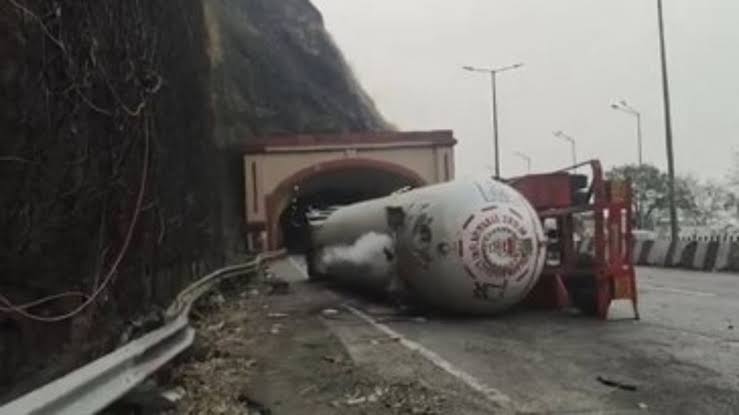
A 12.6-tonne liquefied petroleum gas (LPG) tanker overturned on the Delhi-Mumbai Expressway in Gujarat early Tuesday morning, disrupting traffic on the busy Vadodara-Bharuch stretch and prompting authorities to launch a precautionary emergency response.
The incident occurred at around 1 am near Saraswani village in the Padra area of Vadodara district, when the LPG tanker collided with a trailer and overturned on the expressway. The tanker was carrying a large quantity of highly combustible LPG, leading authorities to immediately restrict movement on the affected side of the road.
Although no LPG leakage was detected at the site, officials treated the situation as potentially hazardous because of the nature of the cargo. Police, highway authorities and firefighting personnel were deployed to secure the area and prevent any incident during the removal of the overturned vehicle.
Traffic Restrictions Put in Place
Following the accident, one side of the four-lane expressway was closed as a safety measure. Authorities continued to regulate traffic through the remaining available lane so that vehicles could move along the important corridor without creating additional risks near the tanker.
The accident caused traffic disruption on the Vadodara-Bharuch section, which is an important route for both passenger vehicles and heavy commercial traffic. Police personnel were positioned at the location to manage the movement of vehicles and ensure that traffic did not interfere with the specialised operation.
Officials said completely stopping traffic was not considered practical because of the strategic importance and high volume of vehicles using the expressway. Instead, motorists were carefully guided through the lane that remained operational.
Specialised LPG Transfer Operation
The immediate priority for authorities was to safely transfer the LPG from the overturned tanker into another tanker before attempting to remove the damaged vehicle.
Specialists from the LPG company reached the accident site to undertake the transfer operation. The process required careful handling because LPG is highly flammable and any leakage or ignition source could potentially create a serious emergency.
Authorities planned to first empty the overturned tanker under controlled conditions. Once the gas was safely transferred, the tanker could be lifted and removed from the expressway, allowing normal traffic movement to resume.
Vadodara police officials indicated that the operation was expected to take several hours and could continue into Tuesday afternoon, depending on the progress of the transfer and removal work.
Fire Teams Deployed as Precaution
Firefighting teams from Karjan and Padra were deployed shortly after the accident. Two fire tenders were positioned at the location and remained on standby throughout the operation.
Fire personnel said they received information about the accident at approximately 1 am and immediately moved to the site as a precautionary measure. Initial checks did not identify any leakage from the tanker.
The presence of fire tenders was considered important because of the potential danger associated with an LPG tanker accident. Emergency personnel were prepared to respond immediately if leakage, fire or another hazardous situation developed during the transfer process.
Police and Highway Authorities Coordinate Response
The police and highway authorities worked together to secure the accident site, control traffic and facilitate the safe transfer of LPG.
The response focused on maintaining a safe distance between moving vehicles and the overturned tanker while ensuring that the highway did not remain completely blocked for an extended period.
The incident also highlighted the logistical challenges involved in handling accidents involving vehicles carrying hazardous materials on major high-speed corridors. Unlike ordinary vehicle accidents, incidents involving LPG tankers require specialised procedures before the damaged vehicle can be moved.
Heavy Traffic on Vadodara-Bharuch Stretch
The Vadodara-Bharuch section of the Delhi-Mumbai Expressway carries substantial traffic every day, including passenger vehicles and heavy industrial transport.
According to highway officials, the stretch has been witnessing around 50,000 cars a day along with a significant volume of heavy industrial vehicles since it was opened to traffic.
The high traffic volume makes any major obstruction on the route particularly significant. Authorities therefore attempted to balance the need for immediate safety with the need to keep traffic moving through the available lane.
For motorists travelling through the affected stretch, the tanker operation meant slower movement and restrictions around the accident location. Traffic management measures were expected to remain in place until the tanker was safely emptied, lifted and removed.
No Leakage Reported So Far
One of the key factors preventing the accident from developing into a larger emergency was the absence of any reported LPG leakage from the tanker.
Fire officials inspecting the vehicle did not identify leakage points during their initial assessment. Nevertheless, emergency teams remained at the site because the tanker was still carrying combustible gas and had to be handled carefully.
Authorities maintained safety precautions throughout the operation, with police controlling vehicle movement and firefighting personnel remaining ready to respond to any emergency.
The incident serves as a reminder of the risks associated with transporting hazardous materials along high-speed highways, particularly on heavily used routes connecting major industrial and commercial centres.
Traffic movement is expected to return to normal after the LPG transfer is completed and the overturned tanker is removed from the expressway.