
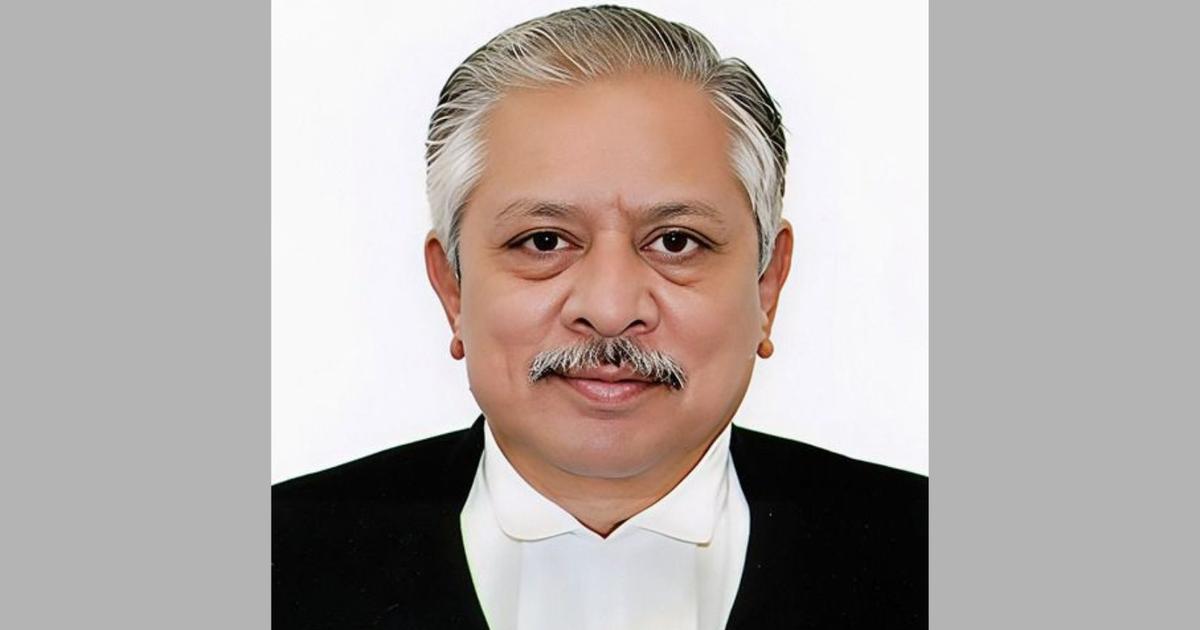
A rare and serious controversy has emerged within the higher judiciary after Supreme Court Justice Sandeep Mehta sought the immediate transfer of Rajasthan High Court Acting Chief Justice Sanjeev Prakash Sharma, alleging misuse of administrative and roster powers, favouritism, nepotism and conduct that, according to him, raised questions about judicial integrity.
In three letters addressed to Chief Justice of India Surya Kant on August 2, 10 and 17, Justice Mehta urged the Supreme Court collegium to appoint a Chief Justice from another High Court to Rajasthan. He argued that continued inaction could damage the functioning and credibility of the institution.
The allegations are significant because they have been made by a sitting Supreme Court judge against a sitting High Court judge. Justice Mehta, who previously served on the Rajasthan High Court, said he had received complaints about Justice Sharma’s functioning and had earlier brought several concerns to the attention of the CJI.
Allegations of selective case listings
At the centre of Justice Mehta’s complaint is the allegation that cases were selectively withdrawn from other benches and transferred to the court headed by Justice Sharma.
Justice Mehta claimed that matters already listed before other benches were, in certain instances, moved to Justice Sharma’s court without sufficient justification. He described the alleged practice as a misuse of the Chief Justice’s authority as the master of the roster.
According to Justice Mehta, he had previously raised concerns about such case transfers with the CJI. He said he was initially asked to provide details of the cases but was later told that there was no need to formally put the allegations in writing and that appropriate action would be taken.
However, Justice Mehta said that his request for the appointment of a Chief Justice from another state had not received a positive response.
Udaipur land dispute cited in complaint
Justice Mehta’s August 10 letter referred to a batch of appeals involving valuable land in Udaipur. He alleged that these matters were shifted to a bench headed by Justice Sharma at the Jaipur seat even though Justice Sharma had previously held that cases falling within the jurisdiction of the Jodhpur principal seat should be heard there.
The Supreme Court judge also raised questions about the lawyers involved in the matter. He alleged that senior advocate Kamlakar Sharma was appearing for one of the parties and claimed that Justice Sharma had supported the elevation of the senior advocate’s daughter-in-law as a judge of the Rajasthan High Court.
These claims form part of Justice Mehta’s broader allegation that influential lawyers and litigants were receiving preferential treatment. However, the allegations remain claims made in correspondence and do not by themselves establish wrongdoing.
Mining case raises questions over registry and delay
Another matter highlighted by Justice Mehta involved mining businessman Meghraj Singh, who had challenged an order passed by a single judge exercising criminal jurisdiction.
Justice Mehta argued that the order under challenge was not ordinarily open to a special appeal. He nevertheless alleged that the High Court registry registered the case as a Special Appeal Writ and listed it before the bench headed by Justice Sharma.
According to the complaint, the bench subsequently condoned a delay of 457 days at the initial stage of the proceedings, issued notice and stayed a direction contained in the single judge’s order.
Justice Mehta also drew attention to the lawyer representing the petitioner, Sandeep Singh Shekhawat, whom he alleged had been associated with Justice Sharma during the latter’s years as a practising advocate.
Justice Mehta characterised these circumstances as evidence of alleged misuse of judicial and administrative authority in matters involving wealthy or influential parties.
Concerns over High Court administration
The allegations were not limited to judicial case management. Justice Mehta also questioned several administrative decisions taken during Justice Sharma’s tenure as acting Chief Justice.
One issue concerned a newly constructed 40-court building for the Jodhpur District Court (Metro). Justice Mehta claimed that the facility had been operationally ready for approximately a year but that its inauguration was put on hold after Justice Sharma visited the premises and ordered extensive infrastructure-related changes.
He questioned the decision because several courts in the Jodhpur Metro judgeship were reportedly functioning from rented buildings.
The facility was eventually inaugurated by CJI Surya Kant on August 15 after, according to Justice Mehta’s account, he and Supreme Court Justice Vijay Bishnoi requested the CJI to intervene.
Jaipur conference becomes another point of dispute
Justice Mehta also raised concerns about the administration of the Rajasthan High Court during an international conference held in Jaipur between July 31 and August 2.
He alleged that judges from the Jodhpur principal seat were nominated to attend the conference, resulting in the principal seat having no functional court for two working days. He further claimed that approximately 20 to 22 district judges were nominated to attend, leaving their respective districts without their senior-most judicial officers.
Justice Mehta questioned the decision in view of the substantial backlog of cases before the judiciary.
He also alleged that the Rajasthan government spent around ₹80 lakh from the public exchequer on the event, which he said was largely organised by lawyers’ organisations.
Dispute over senior advocate designations
Another allegation concerned a Full Court meeting held on July 31.
Justice Mehta claimed that the meeting was convened to consider the designation of around 96 advocates as senior advocates without sufficient prior discussion or a uniform set of criteria.
According to his account, the proposal ultimately did not go through after other judges objected.
The allegation was presented by Justice Mehta as another example of what he regarded as excessive or unilateral administrative decision-making.
Claims of pressure on fellow judges
Justice Mehta’s letters also contained allegations concerning the treatment of other members of the judiciary.
He referred to a message purportedly sent by Rajasthan High Court judge Justice Uma Shankar Vyas to fellow judges. Justice Mehta said the message expressed concern over alleged vindictive conduct involving Justice Vyas’s wife, Nandini Vyas, a senior officer in the district judiciary.
He also claimed that several Rajasthan High Court judges had approached him during his visits to the state and expressed concerns about Justice Sharma’s conduct.
Among the allegations was that judges had allegedly been threatened with transfers or other retaliatory action. Justice Mehta further claimed that Justice Sharma had portrayed himself as having close ties with the CJI.
These allegations have not been judicially established and remain part of the dispute between the judges.
Background of Justice Sanjeev Prakash Sharma
Justice Sanjeev Prakash Sharma was appointed to the Rajasthan High Court in November 2016. He was transferred to the Patna High Court in January 2022 and subsequently moved to the Punjab and Haryana High Court after his request to return to Rajasthan on health grounds was not accepted by the Supreme Court collegium in March 2023.
The collegium later recommended his repatriation to Rajasthan in May 2025.
Justice S Shriram became Chief Justice of the Rajasthan High Court in July 2025 but left office in September of the same year. Justice Sharma subsequently took over as acting Chief Justice and continued in that role for more than 10 months.
His prolonged tenure as acting Chief Justice has become an important part of Justice Mehta’s argument for appointing a regular Chief Justice from outside Rajasthan.
Justice Mehta’s judicial background
Justice Sandeep Mehta himself has a long association with the Rajasthan judiciary. He was appointed as a judge of the Rajasthan High Court in May 2011.
He later became Chief Justice of the Gauhati High Court in February 2023 before being elevated to the Supreme Court in November that year.
His intervention in the Rajasthan High Court controversy is therefore particularly notable because of his previous position within the same court.
A serious institutional controversy
The dispute has raised broader questions about judicial administration, the powers exercised by High Court Chief Justices and the mechanisms available for addressing complaints against sitting judges.
Justice Mehta has repeatedly called for Justice Sharma to be transferred out of Rajasthan and for a Chief Justice from another High Court to be appointed in his place. He argued that the controversy could adversely affect the institution if left unresolved.
At the same time, allegations contained in correspondence between judges should not be treated as established findings of misconduct unless they are independently examined and substantiated through the appropriate institutional process.
The controversy therefore places the Supreme Court collegium and the wider judicial administration in a sensitive position. Any decision concerning Justice Sharma’s future is likely to be closely watched because it involves allegations of judicial conduct, administrative authority, case allocation and institutional governance.
The matter also highlights the importance of transparent procedures in the functioning of the higher judiciary, particularly when allegations concern the exercise of powers that can directly influence the listing and administration of cases.
For now, Justice Mehta’s demand is for an immediate institutional intervention, including the appointment of a Chief Justice from outside Rajasthan and the transfer of Justice Sharma. The allegations, however, remain allegations and their validity would ultimately depend on examination through the appropriate judicial and administrative mechanisms.