
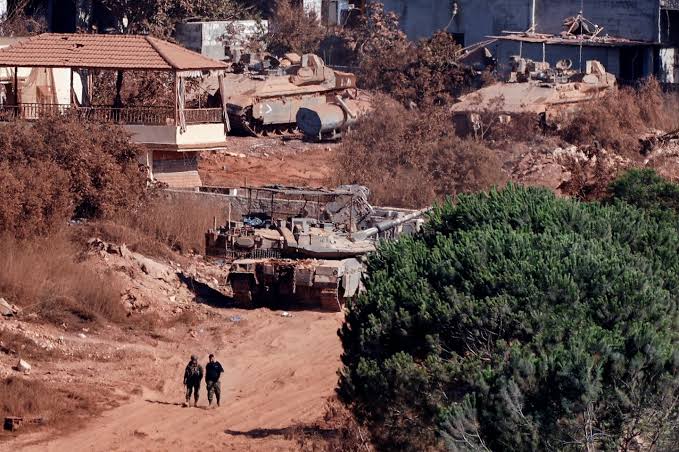
BEIRUT — At least seven people were killed and three others injured after an Israeli airstrike struck a house on the outskirts of Ansar in southern Lebanon early Saturday, marking one of the deadliest attacks in the region since a fragile truce between Israel and Hezbollah came into effect.
The strike destroyed the targeted building near the town of Zrariyeh in the Nabatieh district, according to Lebanese state media. Emergency responders and civil defence teams were continuing to clear the rubble and search for victims following the attack.
The injured were taken to hospitals in Nabatieh for treatment, while rescue workers remained at the scene to determine whether additional victims were trapped beneath the debris.
The attack has heightened concerns over the stability of the ceasefire arrangement between Israel and Hezbollah. Although the truce has reduced the scale of fighting compared with earlier phases of the conflict, Israeli military operations have continued in parts of southern Lebanon.
Strike Hits Home Near Ansar
The airstrike took place in the early hours of Saturday and targeted a residential building located on the outskirts of Ansar.
The impact completely destroyed the house, leaving a large amount of rubble at the site. Rescue teams faced the difficult task of searching through the debris for survivors and recovering the bodies of those killed.
Three people were reported wounded in the attack and transported to medical facilities in Nabatieh.
The circumstances surrounding the identities of the victims were not immediately available. Lebanese authorities continued their assessment of the damage and casualty figures as rescue operations progressed.
The location of the attack has also drawn attention because of its distance from the immediate Israel-Lebanon border. Lebanese state media described it as the deepest Israeli airstrike inside Lebanon since the ceasefire took effect.
Additional Israeli Strikes Reported
The attack on Ansar was followed by reports of additional Israeli military activity across parts of southern Lebanon.
Israeli warplanes carried out strikes around the strategic Ali al-Taher hill near Nabatieh al-Fawqa, according to Lebanese reports. The elevated area has strategic importance because of its position overlooking surrounding communities and routes.
Other parts of southern Lebanon also came under Israeli military pressure. Reports indicated that Israeli forces carried out attacks and demolitions in and around Bint Jbeil and nearby villages.
The latest operations demonstrate that the ceasefire has not brought an end to military activity in the region. Instead, southern Lebanon has continued to experience periodic airstrikes, demolitions and other military actions.
Ceasefire Faces New Pressure
The deaths in Ansar represent a major setback for efforts to maintain the current reduction in hostilities.
A ceasefire between Israel and Hezbollah came into effect on June 20 following a prolonged period of fighting. A framework agreement announced several days later was intended to establish a broader path toward Israeli withdrawal from southern Lebanon and the eventual disarmament of Hezbollah.
However, significant disagreements remain.
Hezbollah has rejected direct negotiations with Israel and has not accepted the terms of the framework. The group continues to maintain its position that Lebanon’s security and sovereignty must be addressed before any major concessions are made.
Israel, meanwhile, has continued military operations in southern Lebanon, saying they are necessary to prevent Hezbollah from rebuilding its military infrastructure and threatening Israeli communities.
The continuing attacks have therefore exposed the limitations of the current ceasefire, which has reduced large-scale fighting but has failed to completely halt military operations.
Southern Lebanon Remains Highly Volatile
Communities across southern Lebanon continue to face significant uncertainty. Many residents have been displaced by the conflict, while homes, roads, agricultural land and other infrastructure have suffered extensive damage.
The latest attack has raised fresh fears among residents who had hoped the ceasefire would allow them to return to normal life.
The destruction of a residential building and the deaths of seven people also underline the continuing humanitarian risks associated with military operations in populated areas.
For Lebanon’s government, the renewed violence presents another challenge as it attempts to strengthen state authority and address the question of armed groups operating outside the control of the central government.
Wider Conflict Continues to Cast a Shadow
The latest escalation is part of a broader conflict that has repeatedly drawn Lebanon into wider regional tensions.
The current phase of fighting intensified after Hezbollah launched rockets toward Israel on March 2, following the start of major US and Israeli military operations against Iran. Israel subsequently expanded its campaign against Hezbollah, carrying out extensive airstrikes and ground operations in southern Lebanon.
Thousands of people have been killed in Lebanon since the escalation began, with civilians accounting for a large share of the casualties. Israeli military personnel and civilians have also been killed during the conflict.
Although the intensity of fighting has declined since the June arrangements, the continuing attacks demonstrate that the underlying dispute remains unresolved.
Diplomatic Efforts Face Difficulties
Diplomatic efforts have continued alongside the military confrontation. Israel and Lebanon have held several rounds of discussions aimed at reducing tensions and establishing longer-term security arrangements.
Seven rounds of talks have reportedly taken place, with the latest meeting held in Rome earlier this month.
The negotiations face several difficult issues, including Israeli military positions in southern Lebanon, Hezbollah’s weapons, the authority of the Lebanese state and guarantees for the security of communities on both sides of the border.
The absence of Hezbollah from the formal framework has further complicated efforts to translate political agreements into lasting security arrangements on the ground.
Risk of Further Escalation
The deadly strike near Ansar could increase pressure on both sides and create additional risks for the fragile ceasefire.
For Israel, continued attacks are linked to concerns over Hezbollah’s military capabilities and activities in southern Lebanon. For Lebanon, the strikes are viewed as a continuing violation of its territory and a major obstacle to stability.
The situation also presents a challenge for international mediators seeking to prevent the conflict from escalating again.
The immediate priority for Lebanese emergency teams remains the recovery of victims and assistance to those wounded in the attack. Beyond the immediate humanitarian response, however, the incident has once again raised questions about whether the current ceasefire can survive without a broader political settlement.
As military operations continue in parts of southern Lebanon, the deadly strike in Ansar serves as a stark reminder that the region remains far from a lasting peace. The seven deaths and destruction of a home have added another tragic chapter to a conflict in which diplomatic agreements have so far failed to fully end hostilities.