
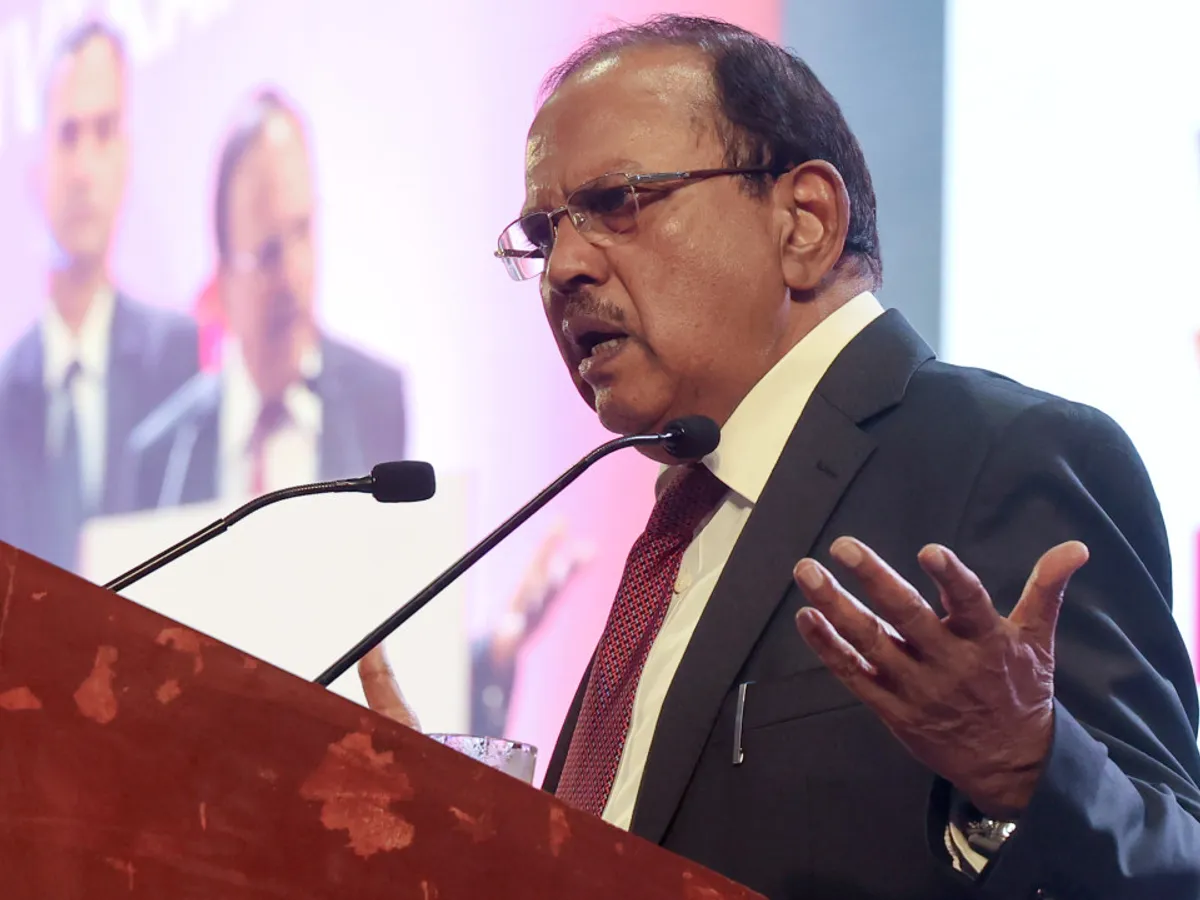
National Security Adviser Ajit Doval has provided a detailed account of the decision-making that preceded Operation Sindoor, recalling that Prime Minister Narendra Modi’s immediate priority after the Pahalgam terror attack was to establish who was responsible.
In his first major interview since the military operation, Doval described the sequence of events following the April 22, 2025, attack in Pahalgam, Jammu and Kashmir, in which 26 people were killed. According to Doval, Modi returned early from Saudi Arabia after the attack and sought an immediate briefing on the incident and the identities of those behind it.
Doval recalled that a meeting was held at the airport after the prime minister’s return. The first priority, he said, was to establish the facts and determine the perpetrators. Modi wanted the security establishment to identify those responsible without delay.
The NSA said the intelligence agencies were able to make progress quickly and establish the information needed for the government to assess the situation. The intelligence assessment subsequently became an important component of the planning for India’s military response.
Modi sought immediate clarity on the perpetrators
Doval’s account highlights the importance placed by the government on establishing responsibility for the Pahalgam attack before determining the nature and scope of any response.
The NSA said Modi first wanted the facts surrounding the attack and then specifically asked who had carried it out and who was responsible. Doval credited India’s intelligence agencies with producing the required information within a short period.
The emphasis on attribution was significant because the government had to determine not only the immediate perpetrators but also the wider terror infrastructure and support networks connected to the attack.
The Pahalgam assault had a major impact on India’s security calculations. The attack targeted tourists in the popular south Kashmir destination and resulted in the deaths of 26 people. It was subsequently followed by a sharp escalation in tensions between India and Pakistan.
How Operation Sindoor was planned
According to Doval, India’s objective was eventually defined around striking terror infrastructure associated with the Pahalgam attack. The operation was designed to target what Indian authorities identified as enemy camps and facilities connected to terrorism.
Operation Sindoor began in the early hours of May 7, 2025, when Indian armed forces carried out precision strikes against multiple terror infrastructure sites in Pakistan and Pakistan-occupied Kashmir.
The operation represented a significant escalation in India’s response to cross-border terrorism. Rather than limiting the response to conventional diplomatic measures, India used military force against targets it described as terrorist infrastructure.
Doval said the objective was also intended to send a wider message to Pakistan’s military establishment. India wanted Pakistan to understand that continued support for terrorism, or failure to take effective action against terrorist groups, would not be treated as acceptable.
India’s response expanded as tensions escalated
The initial strikes were followed by military actions from Pakistan and subsequent counter-actions by India. What began as a targeted response therefore developed into a broader military confrontation between the two nuclear-armed neighbours.
The confrontation continued for approximately 88 hours before India and Pakistan reached an understanding on May 10, bringing the immediate hostilities to an end.
Doval’s remarks suggest that Indian decision-makers had prepared for the possibility that the initial operation could trigger a wider confrontation. The government’s approach, according to the NSA, was based on the principle that national sovereignty and security could require India to accept substantial risks.
He stressed that India’s willingness to maintain restraint should not be interpreted as an inability or unwillingness to respond forcefully when its security interests are threatened.
‘Operation Sindoor is alive’
Doval also addressed the broader significance of Operation Sindoor beyond the military action conducted in May 2025.
He said that when Prime Minister Modi describes Operation Sindoor as still being alive, the implication is that India’s campaign against terrorism is considered unfinished. According to the NSA, the fight would continue until the terrorist threat is eliminated.
The statement places Operation Sindoor within a larger counterterrorism framework rather than viewing it solely as a short military engagement between India and Pakistan.
Doval further indicated that India would be prepared to continue taking measures necessary to safeguard its sovereignty. His remarks reflected the government’s stated position that the country would not accept terrorism as an instrument of pressure against India.
Intelligence played a crucial role
One of the key elements of Doval’s account was the role of intelligence in the decision-making process.
Before military action could be authorised, authorities needed information regarding the perpetrators, their networks and the locations of relevant terror infrastructure. Doval said intelligence agencies performed an important role in helping the government reach conclusions quickly following the Pahalgam attack.
The sequence described by the NSA underlines how intelligence gathering, attribution and military planning were closely connected in the period between the April attack and the May operation.
For a military response to be effective, identifying appropriate targets and establishing their connection with terrorist activity was critical. The information gathered by intelligence agencies therefore became central to the operational planning.
A broader message on India’s security policy
Doval’s remarks also offered insight into how India’s national security establishment views the balance between restraint and retaliation.
India has traditionally maintained that it exercises restraint in the face of security challenges, particularly because of the risks associated with conflict between two nuclear-armed countries. However, Doval argued that restraint should not be interpreted as weakness.
His comments suggested that India considers itself willing to accept risks when national sovereignty and security are at stake. The message was directed not only at Pakistan but also at the wider international community.
The operation therefore had both a military and strategic dimension. Alongside the immediate objective of targeting terror infrastructure, India sought to communicate that major terrorist attacks could lead to direct and potentially far-reaching consequences.
Operation Sindoor and the continuing counterterrorism debate
The revelations from Doval come as attention returns to the events surrounding Operation Sindoor and the decisions taken by India’s political, military and intelligence leadership.
The operation has since become an important reference point in discussions about India’s evolving counterterrorism strategy and its approach to cross-border attacks.
Doval’s account provides a rare insight into the early stages of that process, particularly the emphasis on identifying those responsible for the Pahalgam attack and rapidly converting intelligence assessments into strategic decisions.
His comments also underline the government’s position that the confrontation with terrorism cannot be considered permanently resolved by a single military operation. Instead, Operation Sindoor is presented as part of a continuing national security response.
The account offers a glimpse into the sequence that connected the Pahalgam attack, the intelligence effort to identify its perpetrators and the subsequent military action. It also reinforces the message that India intends to retain the ability to respond forcefully when it considers its sovereignty and national security to be under threat.