
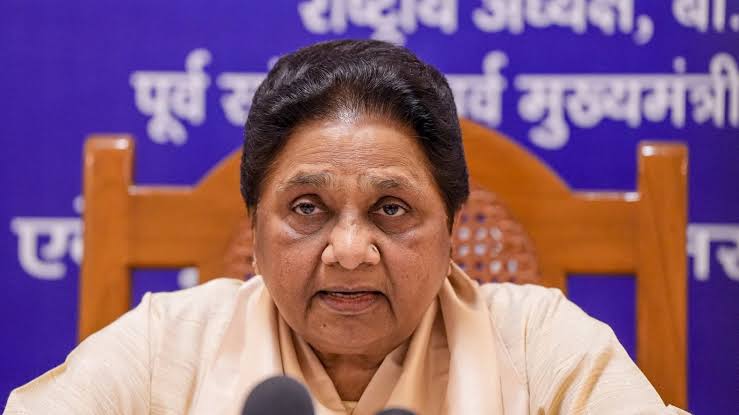
Bahujan Samaj Party (BSP) president Mayawati has strongly condemned the alleged “purification” of a stage in Haldwani after Congress president Mallikarjun Kharge addressed a public gathering there, describing the episode as deeply disturbing and reflective of caste-based prejudice.
Mayawati demanded immediate and strict legal action against those responsible, describing them as “casteist and feudal elements”. Her reaction came a day after the issue was raised in Parliament by Kharge, who alleged that the stage at Ramlila Maidan was subjected to a purification ritual following his public meeting.
The controversy has triggered a wider political debate over caste discrimination, social equality and the treatment of Dalit leaders in public life.
Kharge, a prominent Dalit leader and Congress president, had addressed a gathering at Ramlila Maidan in Haldwani on August 8. Two days later, the alleged purification activity at the same venue became a political issue after Kharge raised it in the Rajya Sabha.
Mayawati said the incident was unacceptable and urged the Uttarakhand government to take action without delay if the allegations are established.
Mayawati Calls Incident ‘Highly Condemnable’
In her reaction, Mayawati described the alleged incident as highly condemnable and concerning. She argued that any action undertaken to symbolically “purify” a public stage after a Dalit leader had addressed a gathering raises serious questions about caste attitudes and social discrimination.
The BSP chief called upon the state authorities to identify those responsible and proceed against them under applicable laws.
Her intervention is significant because the BSP has traditionally made the fight against caste discrimination and the protection of Dalit rights a central part of its political agenda. Mayawati has repeatedly argued that social equality cannot be achieved unless caste-based discrimination is confronted at both institutional and social levels.
She also urged the head of the Rashtriya Swayamsevak Sangh (RSS) to take serious note of the episode. Mayawati linked the controversy to the larger debate surrounding reservation and the political discussion over whether economically stronger sections among Dalits should continue receiving reservation benefits.
Kharge Raises Haldwani Issue in Rajya Sabha
The controversy intensified after Mallikarjun Kharge raised the matter in the Rajya Sabha.
Kharge alleged that people associated with the Bharatiya Janata Party (BJP) had carried out the purification exercise at the venue after his speech. He objected strongly to the reported act and argued that it reflected the continuing problem of untouchability and caste discrimination.
Kharge sought strict action against those responsible and demanded that the individuals involved be prosecuted under laws dealing with untouchability.
The allegation immediately became a political flashpoint, with the Congress using the incident to question the social attitudes of those allegedly involved, while the BJP maintained that such practices were not acceptable.
Union minister J P Nadda also condemned the alleged incident and assured that the matter would be looked into.
The government’s response has added an official dimension to the controversy, with the circumstances surrounding the alleged purification now requiring examination to establish who organised the activity and whether any political organisation or individuals were directly involved.
Haldwani Controversy Fuels Caste Debate
The episode has become more significant because of Kharge’s identity as a Dalit leader.
For critics of the alleged ritual, the issue is not simply about what happened at a political venue after a public meeting. They argue that a purification exercise linked to the caste identity of a person would carry a deeper social meaning, particularly in a country where caste discrimination and untouchability have historically resulted in widespread exclusion.
The Constitution of India guarantees equality and prohibits untouchability. Consequently, allegations of discriminatory practices in public spaces can have implications that extend beyond political rivalry.
The controversy has therefore revived discussions about whether caste-based attitudes continue to influence social and political interactions despite constitutional safeguards and decades of legislation aimed at preventing discrimination.
At the same time, the specific allegations surrounding the Haldwani incident need to be established through an appropriate inquiry. Political claims and counterclaims cannot, by themselves, determine individual responsibility.
Mayawati Targets ‘Casteist and Feudal’ Attitudes
Mayawati’s strongest criticism was directed at what she described as casteist and feudal elements.
Her demand for strict action reflects the BSP’s longstanding political position that incidents involving caste discrimination should be dealt with firmly rather than being dismissed as isolated controversies.
The former Uttar Pradesh chief minister also sought wider attention to the issue by asking the RSS leadership to take cognisance of the incident. Her remarks connected the Haldwani controversy with ongoing national discussions over reservation, Dalit representation and the social advancement of historically disadvantaged communities.
The BSP has consistently sought to establish itself as a political voice for Dalits and other marginalised sections. Mayawati’s intervention therefore also places the Haldwani controversy within the broader political contest over who represents Dalit interests in Indian politics.
BJP-Congress Political Tensions Rise
The controversy comes at a time when political relations between the Congress and BJP remain sharply contested over questions of caste, reservation and social justice.
Congress leaders have highlighted the alleged purification as evidence of continuing caste prejudice, while the BJP’s response has focused on condemning the alleged act and indicating that the matter should be investigated.
The distinction between an individual’s alleged action and the official position of a political party is likely to remain an important part of the debate.
Determining whether BJP-linked individuals actually participated in or organised the alleged ritual will require verification. Until such facts are established, the allegations remain subject to investigation.
Nevertheless, the political impact has already been significant, with the issue being raised in Parliament and subsequently drawing reactions from opposition leaders and other political figures.
Mayawati Also Reacts to Sukhbir Singh Badal Attack
Mayawati also expressed concern over the attack on Shiromani Akali Dal chief Sukhbir Singh Badal in Nanded, Maharashtra.
Badal was reportedly attacked with a kirpan at a gurdwara and suffered an injury to his hand. The alleged attacker was taken into custody following the incident.
Mayawati described the attack as deeply distressing and called upon the Central and Maharashtra governments to treat the matter seriously.
She demanded strict legal action against those responsible, emphasising the need for authorities to respond firmly to incidents involving violence.
Her comments on the Badal attack came alongside her criticism of the Haldwani controversy, with the BSP chief calling for strong governmental action in both cases.
Wider Implications for Dalit Representation
The Haldwani controversy has once again placed the question of Dalit dignity at the centre of political discussion.
Kharge’s position as Congress president and Leader of the Opposition in the Rajya Sabha gives the incident additional political significance. His decision to raise the matter in Parliament transformed what could have remained a local controversy into a national political issue.
For Dalit organisations and political leaders, allegations involving symbolic purification can evoke longstanding concerns about social exclusion and the persistence of caste hierarchies.
For political parties, such controversies can also become a test of their commitment to equality and social justice.
Mayawati’s demand for strict action indicates that the BSP intends to use the controversy to highlight what it sees as continuing caste-based discrimination and the need for stronger enforcement of legal protections.
Investigation Likely to Determine Next Course
The immediate focus will now be on establishing the facts surrounding the alleged purification at Ramlila Maidan.
Authorities will need to determine who organised the activity, who participated in it, what exactly was carried out at the venue and whether the act was motivated by Kharge’s caste identity.
The findings will be important in determining whether legal action is warranted and against whom.
The controversy is also likely to continue politically, particularly as opposition parties debate caste discrimination and the ruling establishment responds to allegations involving individuals allegedly connected with the BJP.
For Mayawati, the episode represents another opportunity to underline the BSP’s core political message: that social equality and dignity must be protected irrespective of caste.
The Haldwani dispute has consequently moved beyond a disagreement over a political event. It has become part of a broader national conversation about caste prejudice, constitutional equality, Dalit dignity and the responsibilities of political and social institutions in addressing discrimination.