
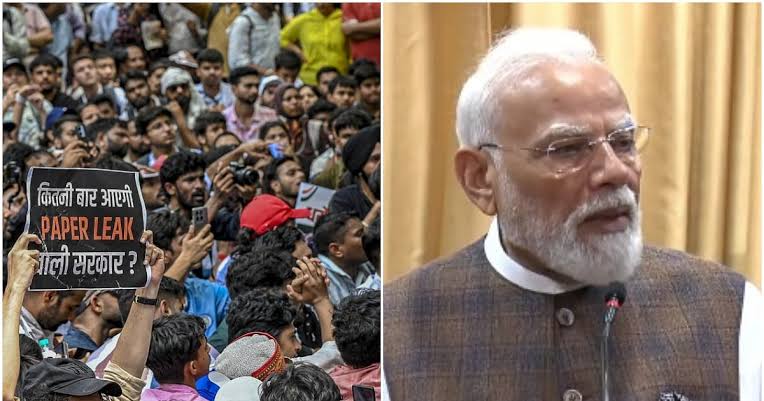
The Cockroach Janata Party (CJP), led by Abhijeet Dipke, has reiterated its demand for the resignation of Union Education Minister Dharmendra Pradhan following Prime Minister Narendra Modi’s response to the ongoing controversy over alleged examination paper leaks.
The organisation’s latest reaction came after Prime Minister Modi addressed concerns surrounding the integrity of competitive examinations and highlighted the government’s plans to take strict action against those involved in paper leak cases. The Prime Minister also stressed the need to protect the future of students and announced measures aimed at ensuring quicker legal action against individuals found responsible for such offences.
However, the CJP has maintained that the government’s proposed measures do not adequately address the issue of political and administrative accountability. The organisation has continued to call for Pradhan’s resignation, arguing that responsibility must also be fixed at the level of those overseeing the country’s examination system.
CJP reiterates key demand
Responding to the Prime Minister’s remarks, Abhijeet Dipke and the CJP reiterated their demand that Dharmendra Pradhan step down from his position as Education Minister.
The organisation’s position is that the controversy surrounding examination irregularities cannot be resolved solely through criminal investigations or the creation of fast-track courts. It has argued that the government must also address questions concerning the functioning and supervision of the examination system.
The renewed demand has added to the political pressure surrounding the issue, which has already triggered criticism, protests and a wider debate over the credibility of India’s competitive examinations.
The CJP’s response suggests that it does not consider the government’s announcement of legal measures sufficient to end the controversy. Instead, the organisation has continued to focus on ministerial accountability and has called for concrete action at the political level.
PM Modi highlights action against paper leaks
Prime Minister Narendra Modi’s remarks focused on the government’s commitment to protecting students and maintaining the integrity of examinations.
The Prime Minister stressed that young people should not have their careers and aspirations affected by examination-related malpractice. The government has indicated that strict action should be taken against those who deliberately compromise the examination process.
As part of its response, the government has proposed measures to speed up legal proceedings in cases involving paper leaks. The use of fast-track courts is intended to ensure that investigations and trials are completed more quickly and that those found guilty receive appropriate punishment.
The government has also emphasised the importance of strengthening examination systems and preventing incidents that could undermine students’ confidence in major competitive tests.
Despite these assurances, critics continue to argue that stronger accountability is required to restore trust among students and their families.
Political dispute intensifies
The disagreement between the government and groups opposing its handling of the controversy has turned the examination issue into a significant political matter.
While the government has highlighted its plans for investigation, prosecution and institutional reforms, critics have continued to demand greater accountability from those responsible for managing the education and examination system.
The CJP’s decision to repeat its demand for Pradhan’s resignation following the Prime Minister’s remarks demonstrates that the political dispute remains unresolved.
The organisation has positioned the resignation demand as an important step towards addressing concerns surrounding the examination system. It has also maintained that students deserve assurances that the authorities will take responsibility for any administrative failures that may have contributed to the controversy.
Students at the centre of the controversy
The issue has raised serious concerns among students preparing for highly competitive examinations. For many aspirants, examinations such as NEET represent years of preparation and determine access to professional education and future career opportunities.
Allegations of question paper leaks or other irregularities can therefore have a major impact on students. Even when only a limited number of candidates are allegedly involved in wrongdoing, the resulting uncertainty can affect the confidence of a much larger student population.
Students and their families have increasingly demanded a transparent and secure examination process. They have also sought timely investigations and strict punishment for anyone found guilty of compromising examination procedures.
The controversy has consequently extended beyond a single examination and has become part of a broader discussion about the need to modernise examination security and strengthen institutional safeguards.
Fast-track courts proposed to ensure quicker justice
The government’s proposal to use fast-track courts in paper leak cases is intended to accelerate judicial proceedings and ensure that offenders do not escape accountability because of lengthy legal processes.
Supporters of the move believe that faster trials could act as a deterrent against examination fraud and send a strong message to individuals involved in organised malpractice.
However, the CJP has continued to argue that legal action alone cannot resolve all concerns surrounding the controversy. The organisation believes that the government must also examine whether there were administrative failures and determine who should be held responsible for them.
This difference in approach has become a central part of the ongoing debate. While the government has focused on punishment and legal action against alleged offenders, the CJP has continued to emphasise political accountability.
Examination integrity remains a major concern
The controversy has once again highlighted the importance of maintaining transparency and fairness in India’s examination system.
Competitive examinations are extremely important for millions of students across the country. Candidates invest significant amounts of time, money and effort in preparing for these tests, often under intense pressure. Any allegation of malpractice can therefore create widespread anxiety and uncertainty.
Ensuring the security of question papers, preventing unauthorised access to examination materials and maintaining strict monitoring mechanisms are essential to preserving public confidence.
At the same time, authorities face the challenge of ensuring that investigations into alleged irregularities are conducted fairly and transparently. Students affected by controversies surrounding examinations also expect timely decisions so that their academic and professional plans are not disrupted indefinitely.
CJP maintains pressure on government
By reiterating its demand for Dharmendra Pradhan’s resignation, the CJP has made clear that it intends to continue pressing the government on the issue.
The Prime Minister’s announcement of fast-track legal proceedings may provide one response to allegations of examination malpractice, but the political debate over accountability is likely to continue.
The coming period will be crucial for the government as it seeks to restore confidence in the examination system and demonstrate that allegations of paper leaks and irregularities are being addressed effectively.
For students, however, the central concern remains the same: ensuring that competitive examinations are conducted fairly, securely and transparently. The resolution of the controversy will depend not only on legal action against those accused of wrongdoing but also on the government’s ability to strengthen examination procedures and rebuild trust among students and the wider public.