
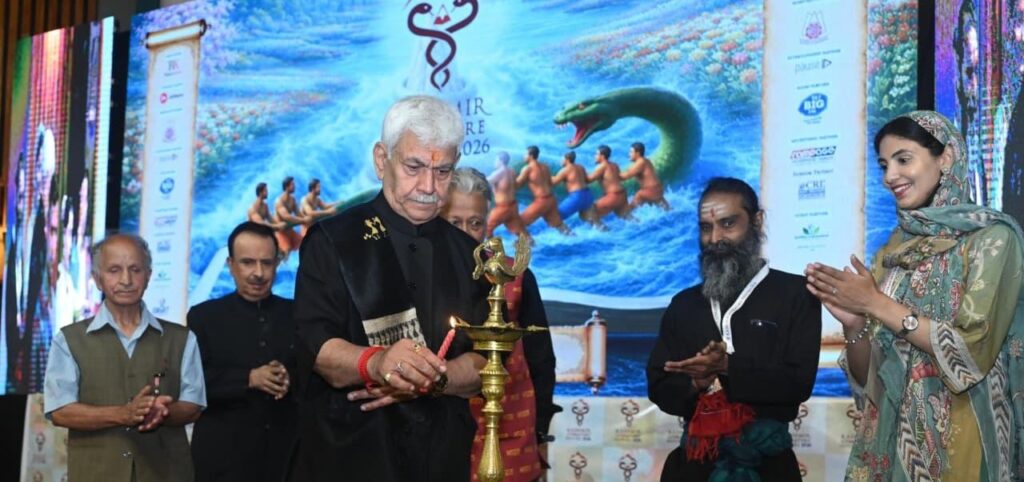
Srinagar, May 30: Lieutenant Governor Manoj Sinha on Friday inaugurated the third edition of the Kashmir Literature Festival in Srinagar and called upon writers, intellectuals, and creative thinkers to play a proactive role in shaping a positive national discourse through literature and storytelling.
Addressing participants at the literary gathering, Sinha emphasized the enduring influence of writers in society, stating that literature has the power not only to reflect public sentiment but also to inspire change and shape the course of civilizations. He noted that a writer’s impact extends beyond words and is deeply connected to the aspirations, values, and experiences of people.
Call to Challenge Distorted Historical Narratives
During his address, the Lieutenant Governor stressed the need to eliminate lingering colonial-era perspectives and ensure that India’s history and contemporary identity are represented accurately on the global stage. He expressed concern that historical narratives about India have often been shaped by external interpretations, leading to distortions and omissions.
According to Sinha, writers bear a significant responsibility in correcting such misconceptions and presenting factual accounts to audiences around the world. He urged literary voices to contribute to a more balanced understanding of India’s civilizational journey and cultural heritage.
Highlighting India’s Ancient Contributions
The Lieutenant Governor underscored India’s historical significance as a center of learning, philosophy, culture, and economic prosperity. Referring to the country’s ancient traditions, he said that India played a pivotal role in advancing human civilization through its contributions to science, mathematics, astronomy, medicine, and knowledge systems.
He argued that India’s intellectual and cultural achievements have had a lasting influence on global development and should receive greater recognition in historical discourse. Sinha maintained that the country’s rich legacy provides an important foundation for understanding both its past and present achievements.
Need to Restore and Communicate Historical Truths
Sinha emphasized the importance of preserving historical records and ensuring that accurate information reaches all sections of society. He observed that while earlier generations meticulously documented knowledge and transmitted it across centuries, modern India gradually lost the habit of recording and communicating its own historical narrative.
As a result, he said, several aspects of India’s traditional knowledge systems, scientific advancements, and cultural achievements have often been overlooked or attributed elsewhere. He described such claims as unfounded and called for greater scholarly efforts to document and promote India’s contributions to the world.
Role of Literature in Public Awareness
The Lieutenant Governor noted that literature can serve as a powerful medium for making complex historical, scientific, and cultural subjects accessible to the general public. He encouraged writers to present the achievements of India’s great thinkers, scholars, innovators, and visionaries in simple and engaging language so that younger generations can better understand their significance.
He further remarked that literature has the capacity to bridge the gap between academic research and public understanding, helping society appreciate the depth of India’s intellectual traditions.
India’s Scientific and Cultural Legacy
Highlighting the country’s historical achievements, Sinha said that India had established itself as a scientific civilization long before many regions of the world developed similar traditions. He asserted that several global advancements in knowledge and learning were influenced by ideas and discoveries that originated in India.
The Lieutenant Governor also pointed to India’s contributions in fields such as literature, art, architecture, and scientific inquiry, arguing that these achievements deserve wider acknowledgment in international historical narratives.
Connecting India’s Past With Its Future
While focusing on history, Sinha also linked India’s heritage to its contemporary progress. He said the country’s story is not confined to its past but continues to evolve through its economic growth, technological advancements, and global influence.
Referring to India’s current development trajectory, he highlighted the nation’s emergence as one of the world’s leading economies and reiterated the vision of achieving developed nation status by 2047. He said a renewed sense of pride in the country’s heritage is gaining momentum across society and can serve as a strong foundation for future progress.
Writers Can Shape Civilizations
Concluding his address, the Lieutenant Governor called upon writers, scholars, and thinkers to contribute to building a confident and informed national narrative rooted in historical understanding and cultural awareness. He stressed that the objective should not be self-glorification but the presentation of facts, achievements, and experiences in a meaningful and responsible manner.
Sinha said that literature remains one of the most powerful tools for influencing public thought and preserving collective memory. He urged participants at the festival to recognize the transformative role of writers in society, asserting that their work has the potential to shape not only public opinion but also the future direction of civilizations.
The third edition of the Kashmir Literature Festival brought together authors, intellectuals, literary enthusiasts, and cultural figures, providing a platform for discussions on literature, history, culture, and contemporary issues while highlighting the growing significance of literary engagement in the region.