
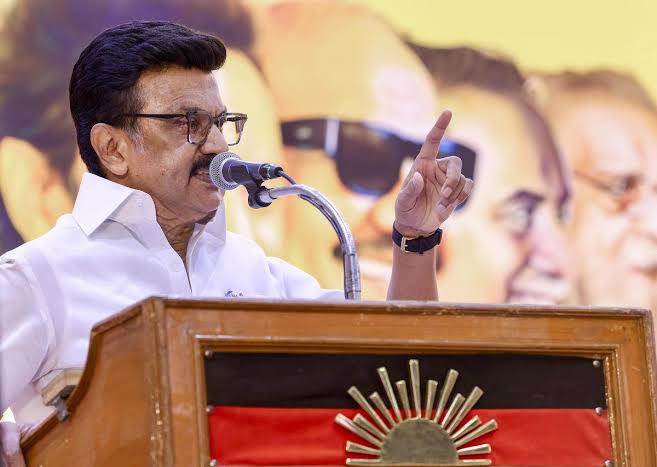
The Madras High Court on Thursday dismissed a petition filed by DMK president and former Tamil Nadu chief minister MK Stalin challenging the election victory of Tamilaga Vettri Kazhagam (TVK) candidate V. S. Babu from the Kolathur Assembly constituency in the 2026 Tamil Nadu elections.
Stalin had approached the court seeking the cancellation of Babu’s election and requested that the votes recorded in the constituency be subjected to further verification, including the counting of Voter Verifiable Paper Audit Trail (VVPAT) slips. He had also sought to be declared the elected candidate from Kolathur.
The High Court, however, held that the petition was not maintainable in the form in which it had been filed. The court indicated that a challenge to the validity of an election must be pursued through the appropriate statutory mechanism prescribed under election law.
Stalin questioned Kolathur election result
The legal challenge followed Stalin’s defeat in Kolathur, a constituency he had represented since 2011. In the 2026 Assembly election, TVK’s V. S. Babu defeated Stalin by 8,795 votes.
Babu secured 82,997 votes, while Stalin received 74,202 votes. The result represented a major political setback for Stalin, who had previously won the constituency in three consecutive Assembly elections.
Following the result, Stalin questioned aspects of the election process and raised concerns regarding the functioning and verification of electronic voting machines.
His petition alleged irregularities involving EVMs and referred to discrepancies observed during the post-counting verification process. Stalin’s side argued that these issues justified additional scrutiny of the votes and sought counting of VVPAT slips.
Court rejects writ route
A major issue before the High Court was whether Stalin could use a writ petition to challenge the election result.
The respondents argued that election disputes are governed by a specific legal framework and that a candidate seeking to invalidate an election must file an election petition in accordance with the provisions of the Representation of the People Act.
The court accepted the objection regarding maintainability and dismissed Stalin’s plea.
The ruling is important because the court’s decision was primarily concerned with the legal route adopted to challenge the election. The dismissal does not by itself amount to a finding that every allegation made by Stalin regarding the EVMs or verification process was false.
Instead, the court made it clear that an election result cannot be challenged through an inappropriate legal proceeding when the law provides a specific mechanism for raising such disputes.
EVM and VVPAT verification at centre of dispute
The petition had brought the issue of EVM and VVPAT verification into focus.
Stalin’s legal team had raised concerns about alleged malfunctioning, mismatches and discrepancies involving different components of the electronic voting system during the post-counting verification process.
The petition also referred to the verification of a number of EVM sets and alleged delays in carrying out the process.
The issue became significant because post-election verification is intended to provide an additional layer of scrutiny to the electronic voting process. Stalin’s side argued that the alleged irregularities warranted further examination and that VVPAT slips should be counted to establish whether the electronic results accurately reflected the votes cast.
The Election Commission’s position, however, was that such grievances could not be used to bypass the statutory procedure governing election disputes.
Babu’s victory remains unaffected
With the High Court dismissing Stalin’s writ petition, Babu’s victory from Kolathur remains undisturbed by this particular proceeding.
Babu’s win was one of the notable outcomes of the 2026 Tamil Nadu Assembly election, particularly because he defeated a sitting chief minister and long-time representative of the constituency.
For more than a decade, Kolathur had been closely associated with Stalin’s electoral career. His defeat therefore attracted considerable attention and became one of the most closely watched results of the election.
The 8,795-vote margin also gave TVK an important victory in Chennai and demonstrated the electoral impact of the new political force led by actor-turned-politician Vijay.
Political significance of Stalin’s defeat
Stalin’s defeat in Kolathur carries significance beyond the constituency itself.
The DMK leader had built a strong electoral record in the seat since 2011. His loss came during an election that significantly altered Tamil Nadu’s political landscape, with TVK emerging as a major force.
For the DMK, the Kolathur result was particularly sensitive because Stalin was not only the party’s president but had also served as chief minister before the election.
The subsequent legal challenge was therefore closely watched as it had the potential to affect both the constituency’s representation and the political narrative surrounding Stalin’s defeat.
The High Court’s dismissal means that Stalin’s attempt to overturn the result through the present writ proceedings has failed.
What the judgment means
The judgment reinforces the principle that election disputes must generally be brought through the procedure specifically established by election law.
A candidate who believes that an election has been affected by irregularities cannot necessarily seek judicial intervention through any available proceeding. The law lays down particular procedures for challenging the validity of an election, including the appropriate forum and manner in which such a challenge must be made.
For Stalin, the immediate consequence is that his plea seeking to invalidate Babu’s election and obtain a declaration in his own favour has been dismissed.
For Babu, the ruling provides legal relief against the challenge brought through the writ proceedings and leaves his electoral victory intact in this case.
The dispute also highlights the continuing importance of EVM and VVPAT verification in electoral litigation. While concerns about voting technology can become the subject of legal scrutiny, candidates must follow the statutory process when seeking to overturn a declared election result.
The Kolathur contest is likely to remain politically significant as Tamil Nadu’s new electoral landscape takes shape. For now, however, the Madras High Court’s decision leaves V. S. Babu’s victory over MK Stalin standing.