
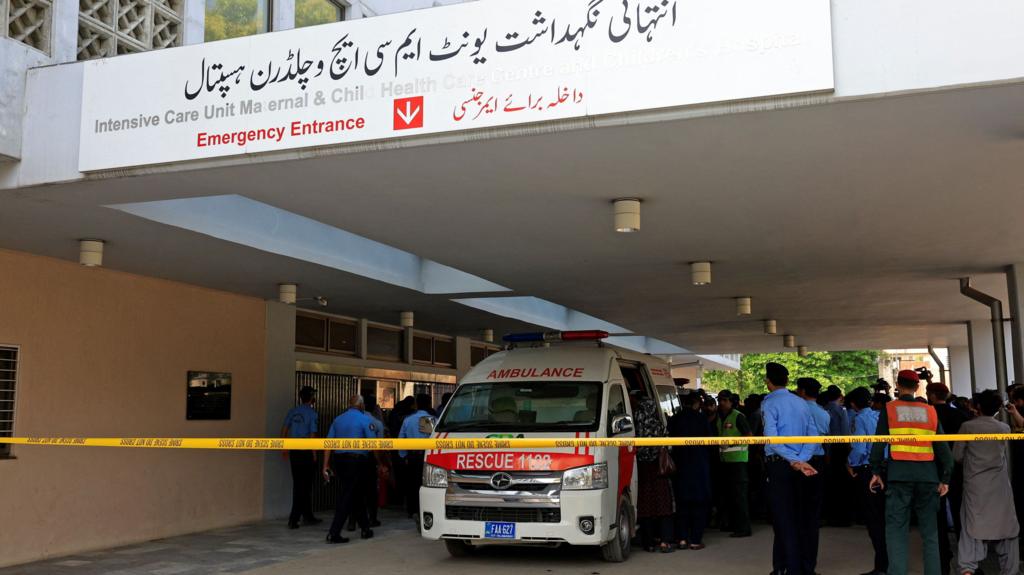
A devastating fire at a government hospital in Pakistan’s capital Islamabad killed at least 14 newborn babies on Wednesday, August 26, in one of the country’s most tragic recent hospital incidents.
The blaze broke out in the Mother and Child Health Ward at the Pakistan Institute of Medical Sciences (PIMS), a major public healthcare facility in Islamabad. The fire was reported shortly before 7 a.m. local time on the third floor of the hospital, where newborns were being treated in a nursery.
According to officials, the nursery housed around 15 newborn babies when the fire erupted. One infant was rescued, while the remaining babies died in the incident. Some reports put the number of infants present at 16 and the death toll at 15, reflecting conflicting early figures as authorities continued to assess the situation. Official accounts at the time confirmed at least 14 newborn deaths.
Fire breaks out in newborn care area
The incident unfolded during the morning hours when the hospital was operating normally. The fire quickly spread through the section of the ward where vulnerable newborns were receiving medical care.
Emergency teams were alerted shortly before 7 a.m., following which firefighters, rescue personnel, police officials and other emergency responders rushed to the hospital. Firefighters managed to bring the blaze under control, while cooling operations continued inside the affected area.
The newborns were particularly vulnerable because they were receiving specialised medical treatment and could not be evacuated independently. The situation therefore required hospital staff and emergency responders to carry out an urgent rescue operation under extremely difficult conditions.
Initial reports indicated that the fire may have been linked to a malfunction involving the hospital’s air-conditioning system. Some accounts suggested that an air-conditioning compressor may have exploded or developed a serious technical fault. However, authorities had not conclusively established the cause at the time of the initial reports, and a formal investigation was ordered.
Investigation ordered into deaths
Pakistan Prime Minister Shehbaz Sharif expressed grief over the deaths and directed authorities to investigate the circumstances surrounding the fire.
The investigation is expected to examine how the blaze began, how quickly it spread, whether fire detection and suppression systems were functioning properly and whether adequate emergency procedures were in place for evacuating newborns from the ward.
Authorities are also expected to determine whether any administrative or operational lapses contributed to the scale of the tragedy. Any evidence of negligence could lead to action against those found responsible.
The affected ward was secured as emergency personnel continued their operations. Officials also began assessing the condition of the hospital and the circumstances that allowed the fire to cause such extensive loss of life.
Questions over hospital safety
The deaths have renewed concerns about fire safety and emergency preparedness in Pakistan’s public hospitals, many of which operate under significant pressure because of high patient numbers and limited resources.
Hospitals treating newborns require particularly stringent safety arrangements because infants in neonatal and maternity wards often depend on incubators, ventilators, oxygen supplies and other life-support equipment. A fire in such an environment can become extremely dangerous within minutes.
The Islamabad tragedy is likely to raise questions about whether public healthcare facilities are being subjected to regular fire-safety inspections and whether emergency systems are capable of responding quickly to fires in specialised medical units.
The incident also highlights the importance of maintaining electrical systems, air-conditioning equipment, medical devices and other infrastructure in high-risk hospital areas. Even a relatively small technical malfunction can have catastrophic consequences when it occurs in a crowded ward containing patients who cannot be moved without assistance.
Families face devastating loss
The deaths have caused profound grief among families whose newborn children were receiving treatment at the hospital.
For parents, maternity and neonatal wards are places associated with hope and the expectation of bringing a child home after treatment. The sudden loss of multiple newborn lives in a fire has therefore created a deeply distressing situation for families as well as medical workers.
Authorities are expected to provide further information as investigators establish the precise sequence of events and determine how the victims died.
The tragedy has also prompted renewed discussion about the need for stronger safety standards in hospitals, particularly in neonatal and maternity units where patients are among the least capable of protecting themselves during emergencies.
One of the deadliest recent hospital fires
The Islamabad fire comes against the backdrop of repeated concerns over fire safety in Pakistan, where deadly fires have previously occurred in commercial buildings, factories and other public facilities.
Such incidents have frequently been linked to inadequate safety measures, poor enforcement of building regulations, faulty electrical systems and insufficient emergency preparedness.
The latest tragedy is particularly grave because the victims were newborn babies who depended entirely on hospital staff and emergency systems for their safety.
As the investigation progresses, authorities will have to establish whether the fire was an unavoidable accident caused by an equipment failure or whether preventable shortcomings contributed to the deaths.
The findings could determine whether changes are required in hospital fire-safety protocols, equipment maintenance, emergency evacuation procedures and accountability mechanisms across public healthcare facilities.
For now, the focus remains on establishing the exact cause of the blaze, accounting for all patients who were in the affected ward and determining responsibility for the loss of so many newborn lives.