
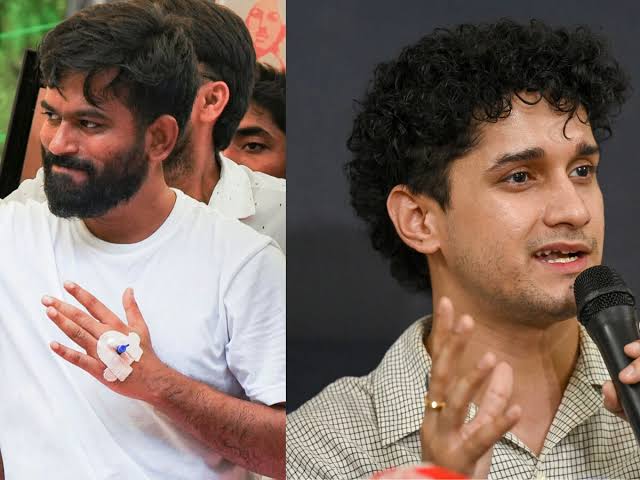
The Cockroach Janta Party (CJP) has come under the spotlight following allegations that two of its prominent leaders were assaulted in separate incidents in Jaipur, with founder Abhijeet Dipke making a light-hearted remark that chief spokesperson Saurav Das could be “next” to face an attack.
Dipke made the comment while speaking in an interview alongside Das and CJP co-convenor Ashutosh Ranka. Referring to the alleged attacks on himself and Ranka, Dipke joked that the group had already seen two of its members being beaten and that Das was the only prominent member yet to face such an incident.
The remark, made in a lighter vein, comes against the backdrop of growing political friction surrounding the youth-led organisation and its activities. The CJP emerged as a prominent voice during a prolonged student movement in Delhi and has continued to attract attention over its criticism of the government and its campaign on education-related issues.
Dipke recalls alleged Jaipur attack
Dipke was reportedly attacked in Jaipur in June while he was preparing to address a gathering of protesters. According to his account, he was being carried on the shoulders of supporters when individuals in the crowd allegedly grabbed his scarf, slapped him and attempted to pull him down.
Videos purportedly showing the incident circulated widely, bringing renewed attention to tensions surrounding CJP activities.
Dipke subsequently alleged that people associated with the Rashtriya Swayamsevak Sangh were behind the attack. He claimed the incident was intended to divert attention from the issues being raised by students.
The allegation, however, has remained disputed, and the political affiliations of those involved have been a matter of contention.
Ashutosh Ranka alleges attack on CJP team
The latest controversy followed another alleged assault involving CJP co-convenor Ashutosh Ranka and members of the organisation.
Ranka said he and other CJP volunteers were travelling in Jaipur to inspect a government school in the Bagru Assembly constituency when their team was allegedly confronted and attacked.
According to Ranka, the incident resulted in injuries to members of the group, with one volunteer allegedly suffering a fractured arm.
Ranka alleged that workers associated with the ruling Bharatiya Janata Party were involved in the confrontation. The BJP has rejected the allegation.
A video purportedly linked to the incident showed a group of people confronting members of the CJP team. Slogans were also reportedly heard during the confrontation.
The competing claims have added another layer to an already politically charged situation, with both sides offering different accounts of what led to the confrontation.
Dipke’s remark about Saurav Das
Against this backdrop, Dipke made the remark about Das being the “next” person in line to be assaulted.
“We are the kind of people who come back after getting beaten up,” Dipke said while discussing the incidents involving CJP members. He referred to himself and Ranka before turning towards Das and jokingly suggesting that his turn could come next.
The comment appeared to be an attempt to inject humour into a serious discussion about the alleged attacks. However, it also highlighted the increasingly confrontational environment surrounding the CJP and its leading figures.
Das has emerged as one of the most visible faces of the movement, frequently speaking publicly on student concerns, government policies and the organisation’s demands.
CJP’s growing political profile
The CJP began as a satirical youth initiative but rapidly evolved into a broader protest platform during the student agitation over examination-related issues and demands for accountability.
The organisation’s activities gained national attention as thousands of students and supporters participated in demonstrations. Its leadership subsequently engaged with government representatives over demands connected to education and student welfare.
Dipke, Das and Ranka became some of the most recognisable figures associated with the movement.
Although the organisation has repeatedly maintained that it is focused on public issues rather than conventional electoral politics, its growing visibility has placed its leaders at the centre of political debates.
The CJP has also sought to expand its activities beyond its original protest campaign, with its leadership discussing ways to connect with citizens across different parts of the country and develop an agenda focused on issues such as education, unemployment, transparency and accountability.
Allegations and counter-allegations intensify
The latest incidents involving CJP members have also underscored the increasingly polarised political environment in which the organisation is operating.
The allegations of physical attacks have been accompanied by counter-claims from political opponents. While CJP leaders have accused individuals linked to the ruling establishment of targeting their members, BJP figures have rejected the accusations and alleged that political opponents could be involved.
Such competing claims have made it difficult to establish a complete picture of the incidents without an independent investigation and corroboration of the allegations.
For the CJP leadership, however, the incidents have reinforced concerns about the safety of its members and supporters.
Das remains a prominent CJP voice
Saurav Das has been one of the organisation’s most prominent public representatives. He has repeatedly spoken about student-related issues and challenged the government’s handling of cases connected with protests.
In recent weeks, Das has also faced controversies and security concerns of his own. He had earlier alleged that individuals identifying themselves as YouTubers and journalists had gathered outside his residence and entered the premises, raising concerns about the safety and privacy of his family.
Those claims further intensified scrutiny around the CJP spokesperson and the environment surrounding the movement.
Das has continued to remain publicly active despite the controversies, arguing that the organisation’s central focus should remain on issues affecting young people and students.
A movement under increasing scrutiny
The latest allegations come at a significant stage for the CJP. What initially began as a satirical online initiative has developed into a youth-oriented movement with a substantial public profile.
Its leaders now face the challenge of maintaining momentum while dealing with political opposition, allegations of misconduct, security concerns and growing scrutiny of their activities.
The incidents involving Dipke and Ranka have brought the safety of CJP organisers into focus, while Dipke’s joke about Das potentially being “next” has drawn attention to the unusual circumstances surrounding the group’s leadership.
For now, the CJP continues to position itself as a platform representing youth concerns rather than a conventional political party. But as its influence grows, its leaders are likely to remain under close public and political scrutiny.
The competing allegations surrounding the Jaipur incidents are also likely to keep the controversy alive, particularly as questions remain over who was responsible for the alleged attacks and what triggered the confrontations.
As the organisation moves forward, the manner in which its leadership responds to these incidents could have a bearing on its wider public image and its efforts to build support among young people across the country.