

Asian stock markets traded mixed on Tuesday as investors assessed the latest escalation in US economic pressure on Iran, while oil prices remained relatively stable after a sharp decline in the previous session. Market participants were also looking ahead to several potentially significant economic and corporate developments in the United States later this week.
The latest moves reflected a cautious mood across global financial markets. Investors are weighing geopolitical risks in the Middle East against expectations surrounding US interest rates, inflation, technology earnings and developments in the bond market.
Asian markets show mixed performance
Major Asian equity markets moved in different directions during Tuesday’s trading session.
Japan’s Nikkei 225 gained around 0.5%, while South Korea’s Kospi recovered from early losses to rise approximately 0.7%. Technology stocks attracted renewed buying interest after recent declines, with investors looking for opportunities in companies that had come under pressure during the summer’s market volatility.
SoftBank Group was among the notable gainers in Japan, advancing about 2.3%.
Elsewhere, Hong Kong’s Hang Seng Index remained largely unchanged, while China’s Shanghai Composite edged up around 0.1%. Australia’s S&P/ASX 200 gained approximately 0.7%, while Taiwan’s Taiex advanced close to 0.9%.
India’s Sensex, in contrast, slipped around 0.1%, highlighting the mixed nature of regional trading.
The divergent performance indicated that investors were not responding to geopolitical developments with broad-based selling. Instead, markets appeared to be reacting selectively to individual sectors, corporate developments and expectations for the global economy.
US increases economic pressure on Iran
A major factor influencing investor sentiment was the latest move by Washington to intensify economic pressure on Tehran.
US Treasury Secretary Scott Bessent announced fresh sanctions targeting Iran and warned that countries and businesses continuing commercial relationships with the Islamic Republic could face consequences.
The latest measures have increased uncertainty for companies and financial institutions involved in trade with Iran. Investors are particularly focused on whether Washington will move beyond the newly announced restrictions and impose broader secondary sanctions against foreign entities.
The response from financial markets has so far been relatively measured. Rather than triggering a sustained surge in oil prices, the announcement was followed by a decline in crude prices in the previous session.
That reaction suggests that some investors may be interpreting the increased economic pressure as potentially creating an opportunity for diplomatic de-escalation, even though the possibility of further tensions remains.
Oil prices remain closely watched
Crude oil prices remained a central focus for investors because of the continuing uncertainty surrounding Iran and the wider Middle East.
Brent crude was trading around $90 per barrel, while US benchmark crude remained near $85 per barrel after both benchmarks declined by more than 2% during the previous session.
Oil prices have fluctuated sharply in recent weeks as traders have attempted to assess the potential impact of geopolitical developments on global supplies and shipping routes.
Iran’s importance to the global energy market means that any major disruption to production, exports or transportation could quickly affect crude prices. The Strait of Hormuz is particularly important because of its role in the movement of energy supplies from the Persian Gulf.
For oil-consuming economies, a prolonged rise in crude prices could increase transportation and manufacturing costs and contribute to renewed inflationary pressure.
At the same time, expectations of reduced tensions or a possible diplomatic breakthrough could ease concerns about supply disruptions and put downward pressure on prices.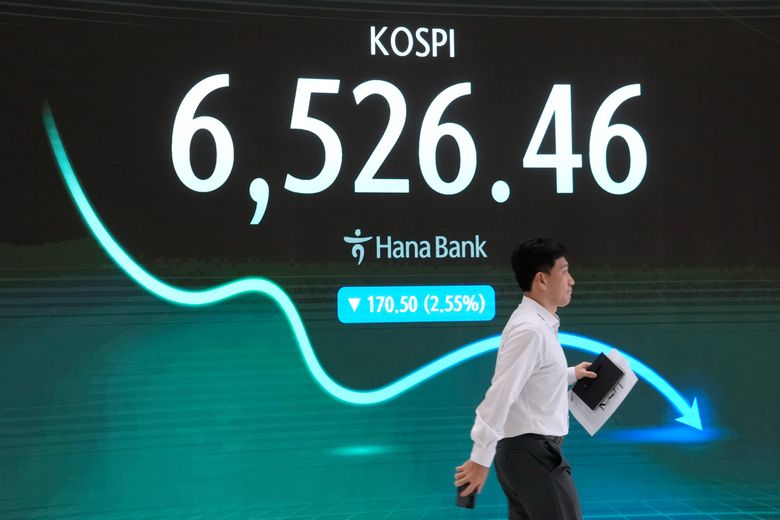
Wall Street ends on a mixed note
The cautious mood in Asia followed a mixed session in US markets.
The S&P 500 fell around 0.3%, moving further away from its record level reached earlier in August. The Dow Jones Industrial Average gained about 0.3%, while the Nasdaq Composite declined approximately 0.8%.
Technology stocks were among the biggest sources of pressure on the Nasdaq.
Nvidia fell roughly 2.9% ahead of its quarterly earnings announcement, which is expected to be one of the most closely watched corporate events of the week.
The chipmaker has emerged as one of the biggest beneficiaries of the global artificial intelligence boom. Its upcoming results are therefore expected to provide investors with important information about demand for advanced chips and the sustainability of massive spending on AI infrastructure.
Investors are particularly interested in whether the rapid growth seen across the AI sector can continue at its current pace and whether companies are beginning to face questions over valuations and profitability.
Nvidia earnings in focus
Nvidia’s upcoming earnings report could have a significant influence on technology stocks worldwide.
The company has become a key indicator of investor confidence in the artificial intelligence sector. Strong revenue growth and an upbeat outlook could support technology markets, while disappointing results or weaker guidance could intensify concerns that valuations have moved too far ahead of underlying earnings.
The broader technology sector has already experienced substantial volatility as investors debate whether the AI investment boom can generate sufficient long-term returns.
This makes the company’s earnings announcement particularly important at a time when markets are already dealing with uncertainty over interest rates, bond yields and geopolitical risks.
US interest-rate outlook remains important
Monetary policy is another major issue for global investors this week.
Markets are awaiting signals on the future direction of US interest rates, particularly as inflation remains an important concern for policymakers.
Federal Reserve Chair Kevin Warsh is scheduled to speak at the Jackson Hole economic symposium later this week. Investors are expected to examine his comments closely for indications about the central bank’s approach to inflation, interest rates and monetary policy.
Any indication that interest rates could remain elevated for longer may increase pressure on technology and other growth-oriented stocks. Conversely, signals suggesting a more accommodative monetary policy could support equities and other risk-sensitive assets.
The outlook for US interest rates also has implications for the dollar, emerging-market currencies and global capital flows.
Bond market developments provide some relief
The US Treasury market has also remained under close observation.
Recent concerns about government borrowing, inflation and longer-term Treasury yields have contributed to volatility across financial markets. However, some pressure eased after reports that the Treasury could use its cash resources to support increased debt buybacks.
Lower yields can provide some relief to equity markets because they reduce the relative attractiveness of bonds and can improve financial conditions.
However, concerns over the scale of US government debt and persistent inflation risks remain important factors for investors.
Dollar strengthens amid geopolitical uncertainty
The US dollar also remained supported as investors assessed the potential consequences of the latest sanctions on Iran.
The prospect of additional restrictions on countries and financial institutions doing business with Tehran could increase demand for the dollar because of its central role in international trade and the global financial system.
Currency markets are therefore closely watching how foreign governments, banks and companies respond to Washington’s pressure campaign.
A stronger dollar can have mixed consequences for global markets. It may provide support to US investors but can create additional pressure for emerging-market economies that have significant dollar-denominated liabilities or import costs.
Geopolitical risks remain a major market factor
The developments surrounding Iran demonstrate how quickly geopolitical events can affect global financial markets.
The Middle East remains strategically important for the global energy system, meaning any major escalation could have consequences extending well beyond the region.
A disruption to oil supplies or shipping through key waterways could push crude prices substantially higher. Such a development could increase inflationary pressures at a time when central banks are attempting to maintain price stability.
Conversely, any progress toward easing tensions could reduce the geopolitical premium embedded in oil prices and provide some relief to investors.
For now, markets appear to be taking a wait-and-watch approach.
Investors face several market-moving events
The remainder of the week is expected to bring several developments capable of influencing investor sentiment.
Nvidia’s earnings will be closely watched by technology investors, while upcoming US inflation data could influence expectations for monetary policy. The Federal Reserve’s economic policy signals will also be important for bond and currency markets.
At the same time, developments involving Iran and the broader Middle East situation could continue to affect oil prices and global risk sentiment.
These factors are arriving against a backdrop of elevated equity valuations and continuing uncertainty over the global economic outlook.
Outlook for Asian markets
Asian markets are likely to remain sensitive to movements in oil prices, US interest-rate expectations and developments in the Middle East.
The relatively mixed performance seen on Tuesday suggests that investors remain cautious but are not yet adopting a broadly defensive stance. Technology shares continue to attract interest following recent declines, while energy and other sectors remain closely tied to geopolitical developments.
The direction of crude prices could become particularly important for major oil-importing economies. A sustained increase in energy costs could affect inflation, corporate profitability and consumer spending, while a continued decline in oil prices could offer some relief to businesses and households.
For investors, the combination of geopolitical uncertainty, monetary-policy expectations and major technology earnings means volatility is likely to remain a feature of global markets in the near term.