
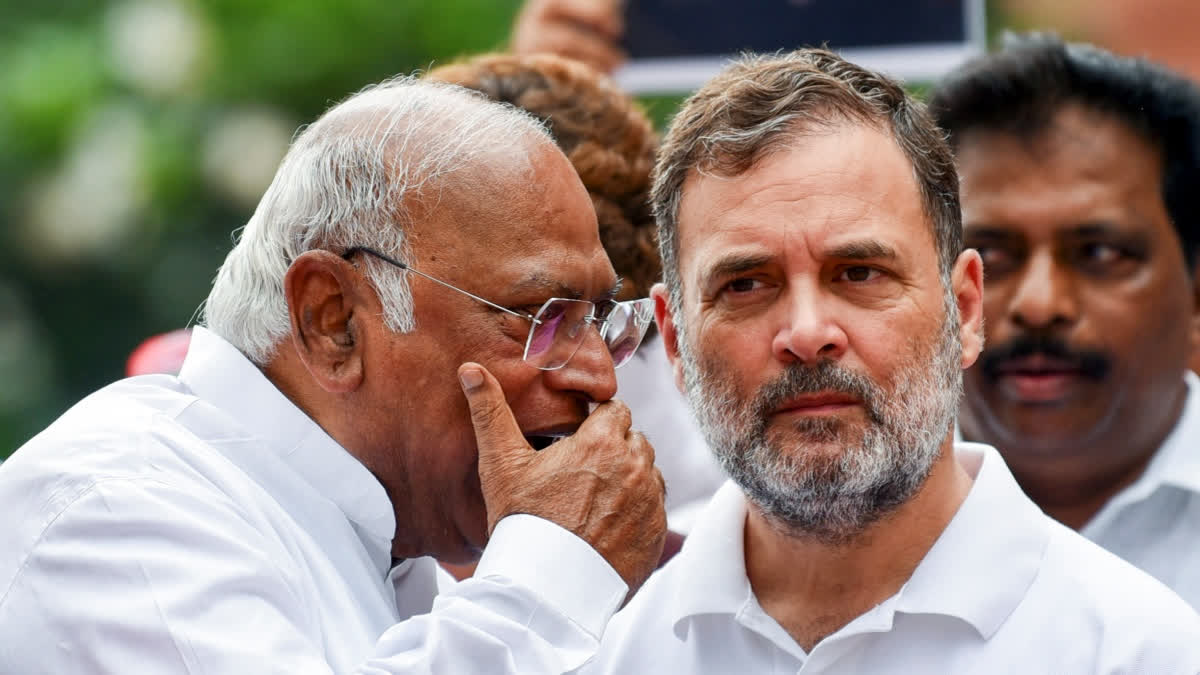
Congress leaders Rahul Gandhi and Mallikarjun Kharge were absent from the official Independence Day celebrations at the Red Fort on Saturday, where Prime Minister Narendra Modi addressed the nation. Their decision to skip the ceremony for the second consecutive year has revived the controversy over the treatment and seating of opposition leaders at major government functions.
Gandhi, the Leader of Opposition in the Lok Sabha, and Kharge, the Congress president and Leader of Opposition in the Rajya Sabha, did not attend the traditional ceremony despite the importance attached to the event. No detailed public explanation was issued by the Congress leadership for their absence, although the decision has been widely linked to the continuing disagreement over protocol and seating arrangements at official functions.
Seating controversy remains at the centre of dispute
The disagreement can be traced to the Independence Day ceremony in 2024, when Gandhi was seated several rows behind senior government leaders. The arrangement attracted strong criticism from the Congress, which argued that the Leader of Opposition should receive a prominent position at an important constitutional and national event.
The government side had explained that the seating plan was adjusted to accommodate India’s Olympic medal winners and other distinguished guests in prominent positions. However, the Congress maintained that Gandhi’s constitutional status should have been given greater consideration.
The controversy subsequently became part of a wider dispute between the ruling BJP and the Congress over the treatment of opposition leaders at government programmes.
Gandhi and Kharge were again absent from the Red Fort celebrations in 2025, and their absence this year has further reinforced the perception of an unresolved protocol dispute.
Rahul Gandhi’s constitutional position
As Leader of Opposition in the Lok Sabha, Rahul Gandhi holds a constitutional and parliamentary position that carries significant official precedence. The Leader of Opposition is recognised as an important parliamentary function and is expected to participate in major national and constitutional occasions.
The government had indicated ahead of this year’s Independence Day celebrations that Gandhi had been invited to the Red Fort ceremony and would be seated according to the established order of precedence. The stated arrangement placed him immediately after Union Cabinet ministers.
Despite this clarification regarding seating arrangements, Gandhi did not attend the ceremony.
The development has therefore raised questions about whether the previous disagreement over protocol continues to influence the Congress leadership’s approach to official national events.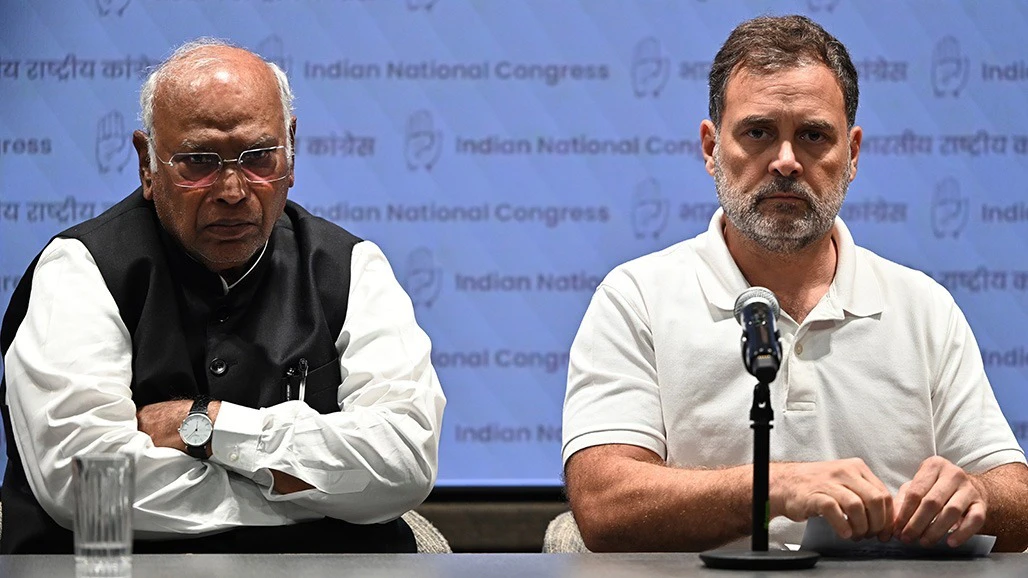
BJP attacks Congress leaders
The absence of the two senior Congress leaders immediately became a political issue.
BJP spokesperson Pradeep Bhandari criticised Gandhi and Kharge for not attending the Independence Day ceremony and sought to connect their absence with Prime Minister Narendra Modi’s remarks about what he described as “dimaagi Naxals” in his Independence Day speech.
Modi, during his address from the Red Fort, said that India had made substantial progress in combating armed Naxalism but warned that ideological elements could continue to promote unrest and violence. He argued that such elements needed to be identified and isolated.
The BJP spokesperson used the prime minister’s remarks to attack the opposition leaders, portraying their decision to stay away from the national ceremony as politically motivated.
Giriraj Singh calls absence a ‘childish act’
Union minister Giriraj Singh also criticised Gandhi and Kharge over their absence.
Singh described the decision as a “childish act” and argued that the two leaders, because of the constitutional offices they occupy, should have attended the Independence Day ceremony.
He said that national occasions such as Independence Day should be treated differently from routine political disagreements. According to Singh, refusing to attend an official national celebration could affect how the public views opposition leaders.
The Union minister also referred to former prime minister Atal Bihari Vajpayee, noting that Vajpayee had participated in Independence Day celebrations even when he was in the opposition.
Singh’s remarks reflected the BJP’s argument that national occasions should be kept separate from political disputes and that leaders across party lines should participate in events marking India’s independence.
Congress responds to ‘dimaagi Naxals’ remarks
Congress general secretary Jairam Ramesh responded to Prime Minister Modi’s remarks, accusing him of repeatedly using terms such as “urban Naxals” and “dimaagi Naxals” against political opponents and critics.
Ramesh argued that the prime minister’s language reflected political frustration and questioned the government’s approach to individuals who disagree with its policies.
The Congress response shifted the focus from the absence of Gandhi and Kharge to the broader political debate surrounding Modi’s Independence Day address.
The exchange between the two parties demonstrated how the annual national celebration has once again become a backdrop for political confrontation.
Congress leaders mark Independence Day separately
Although Gandhi and Kharge did not attend the Red Fort ceremony, both senior Congress leaders marked Independence Day and spoke about the significance of India’s freedom struggle and democratic values.
The Congress leadership has consistently maintained that Independence Day is an occasion to remember the sacrifices of freedom fighters and reaffirm commitments to democracy, justice, equality and constitutional principles.
Kharge, in his Independence Day remarks, invoked the contributions of Mahatma Gandhi, Jawaharlal Nehru and other leaders of the freedom movement. He also highlighted the Congress party’s historical role in India’s freedom struggle and nation-building.
Gandhi similarly emphasised the importance of protecting the values associated with India’s independence and the responsibilities that accompany freedom.
A continuing political and protocol dispute
The latest episode highlights a larger disagreement over the role and recognition of opposition leaders at official government events.
For the Congress, seating arrangements are not merely ceremonial matters. The party has argued that the Leader of Opposition occupies an important constitutional position and should receive appropriate protocol at national functions.
The BJP, on the other hand, has criticised the Congress leaders for allowing political disagreements to influence their participation in national events.
The controversy also reflects the increasingly adversarial relationship between the ruling party and the opposition. Questions involving parliamentary privileges, protocol, institutional independence and representation have frequently become points of political confrontation.
Independence Day ceremony continues amid political tensions
Prime Minister Modi’s Independence Day address at the Red Fort remained the central national event, with the prime minister discussing India’s development, security challenges and the country’s future.
However, the absence of Gandhi and Kharge ensured that political debate surrounding the ceremony extended beyond the prime minister’s speech.
With the Congress leaders skipping the Red Fort event for the second consecutive year, the dispute over protocol has now become a recurring feature of Independence Day politics.
While the government has indicated that seating arrangements would follow established precedence, the Congress’s continued absence suggests that differences between the opposition and the government over the treatment of its senior leaders remain unresolved.
The episode ultimately underscores the delicate balance between political differences and participation in national ceremonies. As India’s political contest remains sharply divided, even ceremonial questions such as seating arrangements can become symbols of a much broader dispute over institutional respect, parliamentary status and the relationship between the government and opposition.