
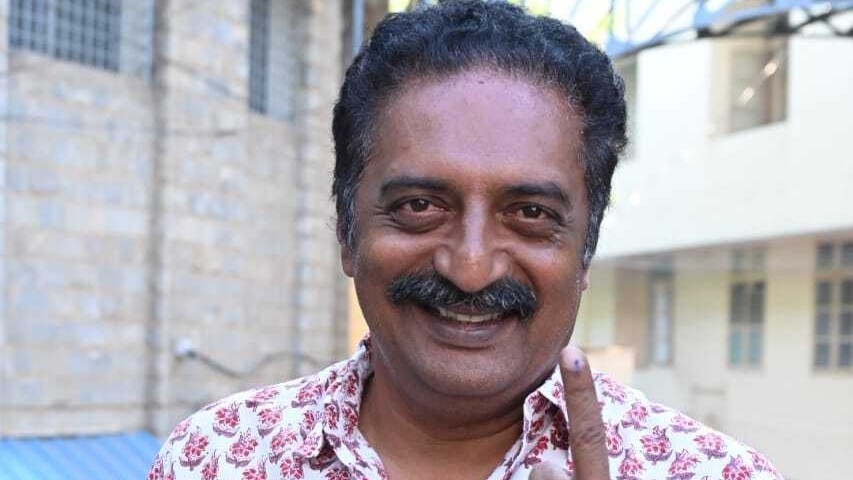
Actor and former Lok Sabha candidate Prakash Raj has claimed that his name has been removed from the electoral roll in Bengaluru during Karnataka’s ongoing Special Intensive Revision (SIR) of voter lists, prompting him to question the process and the documentation required to restore his voting rights.
Raj raised the issue through a video posted on social media, describing the development as surprising and questioning how a person who has longstanding connections with the constituency could find his name missing from the voters’ list.
The actor said he was born and brought up in the constituency and had spent important years of his life there, including his school and college education. He also recalled his association with theatre in Bengaluru, stressing that his connection with the city and constituency was not recent.
Reacting to the alleged deletion, Raj questioned what documents he would now have to produce to establish his eligibility as a voter. In a pointed remark, he asked what paperwork would be required to have his name restored to the electoral roll.
Prakash Raj questions deletion of voter name
Raj said he was among the voters whose names had allegedly been affected during the SIR exercise in Bengaluru. He expressed disbelief over his name being absent from the electoral roll despite his long-standing association with the constituency.
Calling the situation a “joke”, the actor questioned the basis on which his name had been removed and said he intended to find out the procedure for getting his voter details restored.
His comments have drawn attention to the larger issue of voter-list verification and the importance of ensuring that eligible citizens are not inadvertently excluded during electoral roll revisions.
Raj has previously been involved in electoral politics. He contested the 2019 Lok Sabha election from the Bengaluru Central constituency as an independent candidate. His political involvement has also included frequent public comments on democratic rights, governance and political accountability.
‘What documents will I have to show?’
One of the central points raised by Raj was the documentation required to reclaim his place on the electoral roll.
Questioning the process, he asked what papers citizens would have to provide to prove their eligibility if their names were removed during the revision exercise. His remarks reflected concern over the possibility that genuine voters could face difficulties if their names were omitted from electoral records.
Raj also indicated that he would personally examine the process and determine what steps he needed to take to get his voter identification and electoral registration restored.
The actor framed the issue in broader democratic terms, questioning whether administrative powers could prevent citizens from exercising their political rights.
He argued that while authorities may have the power to determine electoral eligibility according to established procedures, citizens ultimately retain the democratic power to influence political outcomes through their votes.
Karnataka’s Special Intensive Revision
The controversy comes as Karnataka is undertaking a Special Intensive Revision of its electoral rolls. The exercise is aimed at reviewing and updating voter records, including identifying eligible voters and addressing discrepancies in electoral data.
As part of the process, the publication schedule for Karnataka’s draft electoral roll has been revised. The draft roll is now scheduled to be published on August 24, while the final electoral roll is expected to be released on October 27.
The revision follows directions issued by the Election Commission of India, with October 1, 2026, continuing to be the qualifying date for the electoral roll revision.
The exercise has increased public attention on the accuracy of voter lists, particularly over questions surrounding the inclusion and deletion of names. Electoral roll revisions are intended to improve the accuracy of voter records, but the process also requires safeguards to ensure that eligible voters are not unintentionally left out.
Why voter-list revisions matter
Electoral rolls form the foundation of the voting process because only citizens whose names appear on the relevant voter list can ordinarily exercise their franchise at an election.
The removal of an eligible voter’s name can therefore have significant consequences, particularly if the individual is unaware of the deletion until they attempt to vote or verify their electoral information.
Raj’s claim has consequently brought renewed focus to the need for transparency in the voter-list revision process and accessible mechanisms through which citizens can check their electoral status and raise objections or seek corrections where necessary.
For voters whose names are missing from revised electoral rolls, the ability to understand the applicable procedure and submit the required documents can become particularly important.
Prakash Raj’s wider political commentary
The voter-list issue is not the only political matter on which Raj has spoken out recently. The actor has also reacted to events in Jharkhand involving student protesters and the use of force to disperse a demonstration near the state legislative assembly in Ranchi.
Responding to footage from the protest, Raj criticised the reported use of tear gas and a lathi charge against demonstrators. He said such actions would not end the concerns of protesters and argued that excessive use of power could instead undermine those exercising it.
His latest comments on the Bengaluru electoral roll similarly centre on questions of democratic participation and citizens’ political rights.
For now, Raj has indicated that he intends to determine the official procedure for restoring his name to the electoral roll. The Election Commission’s revised schedule means that the voter-list revision process remains ongoing, and further changes to electoral records are expected before the final roll is published in October.
The immediate issue raised by Raj is therefore both personal and part of a broader electoral question: how efficiently and transparently can eligible voters whose names are missing from the revised rolls have their records checked and restored?