
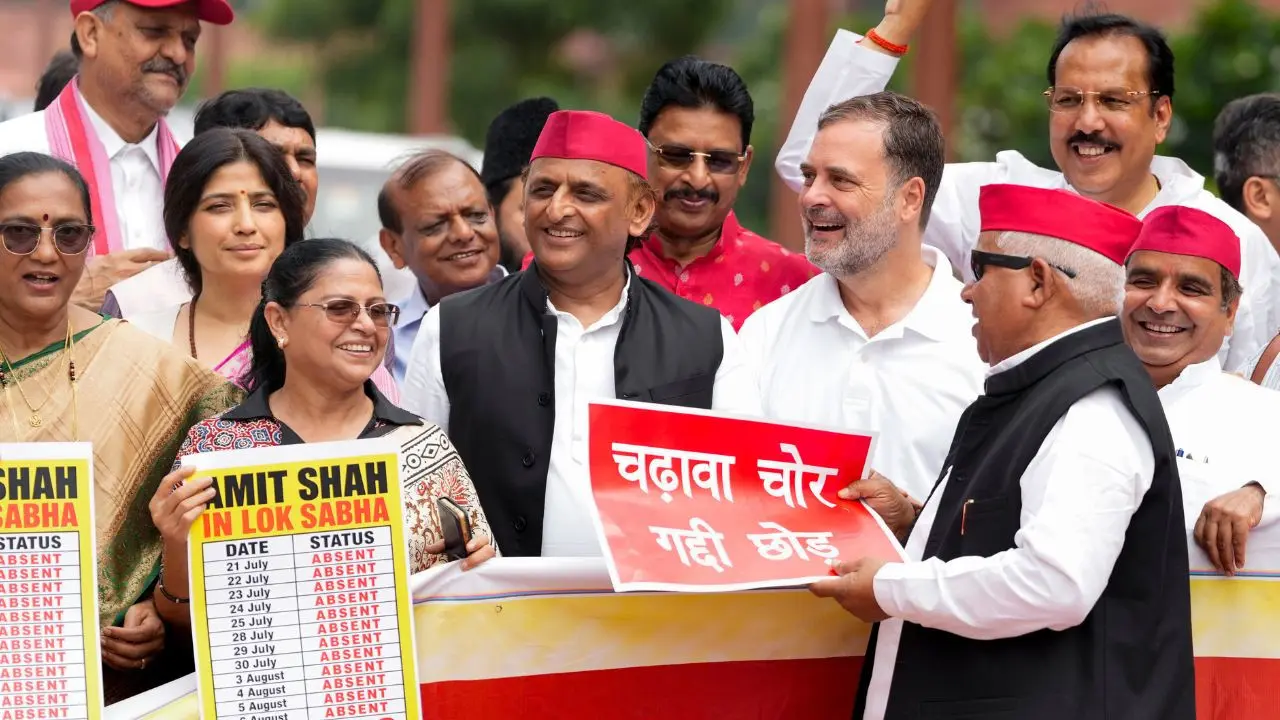
The Monsoon Session of Parliament has entered another contentious phase, with protests by the Opposition and the ruling National Democratic Alliance (NDA) increasingly dominating proceedings. On Tuesday, NDA lawmakers staged a counter-protest inside the Parliament complex, turning the ongoing political confrontation into a direct face-off between the two sides.
The latest developments came after days of disruptions over several issues, including the alleged use of force against protesters during the Cockroach Janata Party’s (CJP) march towards Parliament, the alleged irregularities surrounding the NEET examination, and allegations concerning donations to the Ram Temple in Ayodhya.
The Opposition has continued to demand answers from Union Home Minister Amit Shah over the police action during the July 20 protest. At the same time, the ruling alliance has accused Opposition leaders of avoiding a discussion on alleged police action against student protesters in Jharkhand.
Opposition keeps pressure on government
The Opposition’s protests have been continuing since the beginning of the Monsoon Session on July 20. Congress leader Rahul Gandhi and other Opposition MPs have repeatedly raised questions over the police response to protesters in central Delhi.
The Opposition has sought a statement from Home Minister Amit Shah regarding allegations that police used measures including lathi charges, tear gas, shock batons and pellet guns while dealing with demonstrators.
The issue has remained politically sensitive, with Opposition leaders arguing that the government’s response to the protest requires discussion on the floor of Parliament.
The protests subsequently expanded beyond the CJP march, with Opposition parties bringing other issues into the political confrontation. These included the NEET controversy and allegations surrounding the handling of donations associated with the Ram Temple.
Ram Temple donation issue becomes a major flashpoint
The alleged irregularities involving Ram Temple donations have emerged as another major point of confrontation between the government and Opposition parties.
During one of the protests, Opposition MPs staged a symbolic demonstration outside Parliament. They placed donation boxes near the Makar Dwar and performed a skit intended to depict their allegations of donation misappropriation.
The demonstration showed how the Opposition has increasingly relied on symbolic political protests to draw public attention to issues it wants debated in Parliament.
The allegations surrounding the temple donations remain politically contentious, and the Opposition has sought greater scrutiny and accountability over the matter.
The issue has also generated legal and political repercussions, with complaints and cases reportedly following the controversial protest demonstration.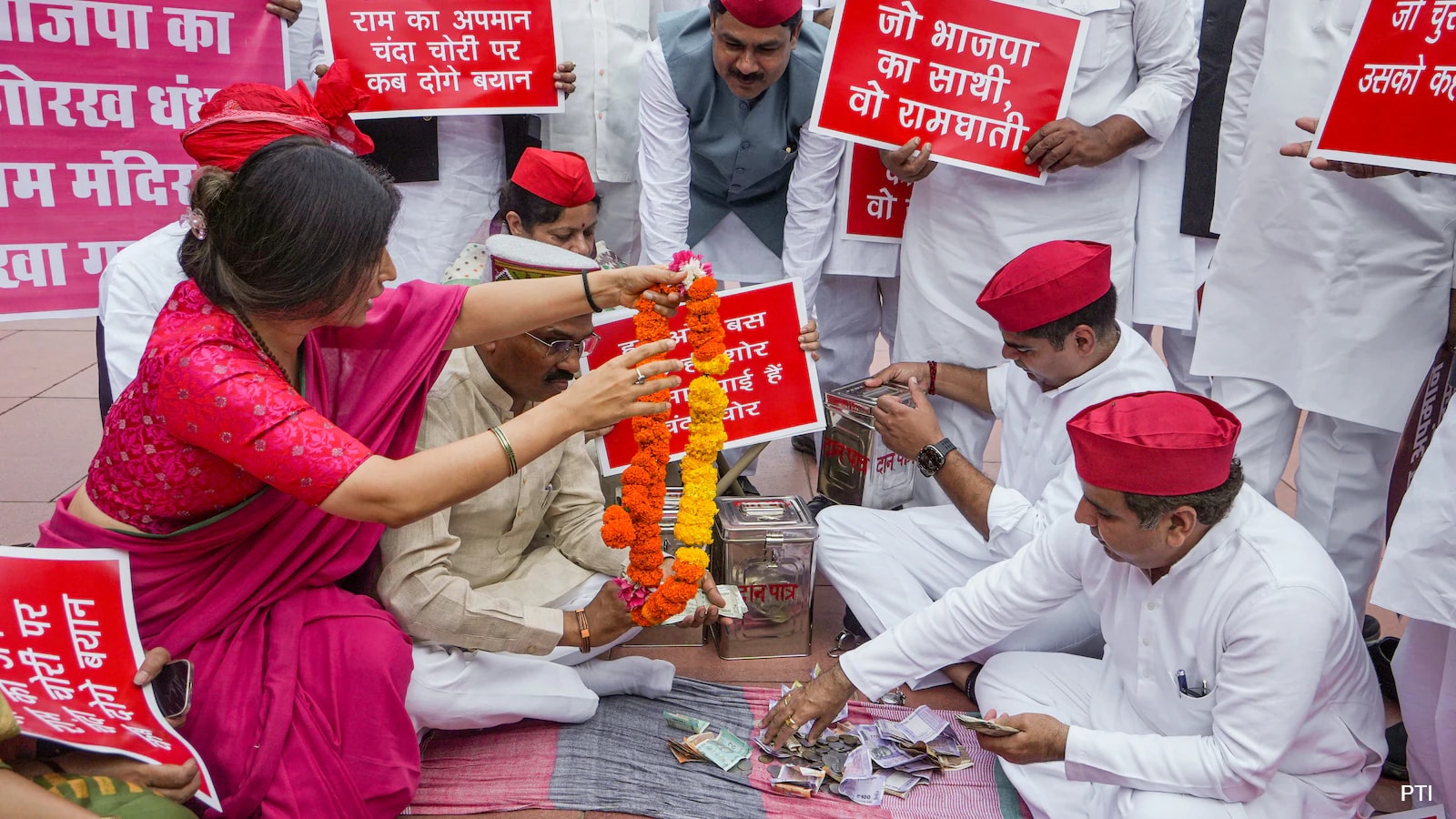
NDA launches counter-protest
While Opposition MPs continued their demonstrations, NDA lawmakers staged their own protest on Tuesday.
Several ruling alliance MPs moved towards the Makar Dwar carrying placards targeting Rahul Gandhi and the Opposition. Their protest focused primarily on alleged police action against students and job aspirants in Jharkhand.
The NDA accused the Opposition of selectively raising concerns over police action in Delhi while remaining silent about alleged police action against protesters in Jharkhand.
Placards displayed by BJP lawmakers called on Rahul Gandhi to respond to allegations of lathi-charge against students in the state.
BJP MP Anurag Thakur also questioned why Gandhi had not addressed the issue in Parliament and argued that the Congress leader should respond to allegations concerning the treatment of student protesters.
Jharkhand protests become part of Parliament’s political battle
The Jharkhand issue has added another layer to the confrontation between the government and Opposition.
BJP lawmakers have sought to highlight alleged police action against job aspirants and students in Ranchi. They have specifically targeted Rahul Gandhi because the Congress is part of the political alliance led by the Jharkhand Mukti Morcha government in the state.
The ruling alliance’s decision to raise the issue in Parliament represents a broader effort to turn the Opposition’s criticism of police action into a wider debate over the treatment of protesters across different states.
The NDA has argued that if the Opposition wants Parliament to discuss police action against protesters in Delhi, it should also be willing to debate similar allegations involving protesters elsewhere.
Parliament proceedings remain disrupted
The continuing protests have affected the functioning of both Houses during the Monsoon Session.
The session has witnessed repeated slogan-shouting, demonstrations and adjournments. Although several important legislative measures have moved through Parliament, political confrontations have repeatedly interrupted normal proceedings.
The situation has created a sharp divide between the government’s legislative agenda and the Opposition’s demand for discussions on issues it considers urgent.
Parliamentary Affairs Minister Kiren Rijiju has indicated that the government is prepared to respond to questions raised by the Opposition, including concerns involving the Home Ministry.
However, the Opposition’s insistence on raising its demands through protests has continued to create tension inside and outside the Houses.
Rahul Gandhi and Amit Shah at the centre of confrontation
The political dispute has increasingly centred on Rahul Gandhi and Amit Shah.
Opposition MPs have demanded that the Home Minister explain the police response during the July 20 CJP march. Their criticism has focused on the alleged use of force and the manner in which protesters were prevented from reaching Parliament.
The NDA, meanwhile, has turned its criticism towards Rahul Gandhi, accusing him of avoiding a debate on police action against students in Jharkhand.
The competing demonstrations reflect the broader political strategy of both camps: the Opposition is attempting to keep pressure on the government over issues it considers matters of public accountability, while the ruling alliance is seeking to shift attention towards the Opposition’s record and its response to protests in states governed by its political allies.
A session increasingly dominated by confrontation
The Monsoon Session was expected to provide Parliament with an opportunity to debate legislation and several major national issues. Instead, protests have become one of its defining features.
The confrontation over the CJP march, the NEET controversy, the Ram Temple donation allegations and the Jharkhand student protests has created multiple points of friction between the government and Opposition.
The latest NDA counter-protest demonstrates that the political contest is no longer limited to Opposition demonstrations. The ruling alliance has also adopted a more visible protest strategy within the Parliament complex.
With both sides accusing the other of avoiding substantive debate, the remaining proceedings are likely to remain politically charged. The challenge for Parliament will be to move beyond competing demonstrations and ensure that contentious public issues are addressed through structured debate and parliamentary scrutiny.
For now, protests, slogans and counter-protests continue to overshadow the legislative business, making the Monsoon Session one of the more politically confrontational sessions in recent times.