
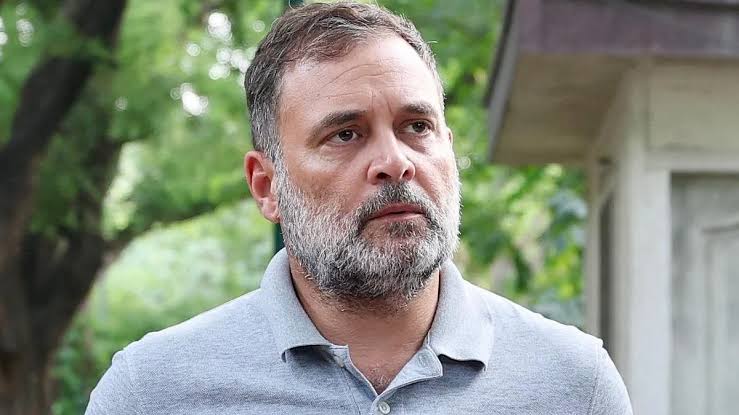
A political confrontation erupted in the Lok Sabha on Wednesday after Leader of Opposition Rahul Gandhi alleged that Union Home Minister Amit Shah had ordered the use of force against students during protests linked to the National Eligibility-cum-Entrance Test (NEET). The claim, made during a parliamentary debate, immediately triggered a strong reaction from the Bharatiya Janata Party (BJP), which demanded that the Congress leader provide evidence to substantiate his allegation.
The exchange added to the political tension in the House during the ongoing Monsoon Session of Parliament, with the Opposition raising concerns over the handling of student protests and the government defending its position on law and order. The BJP’s demand for proof turned the discussion into a broader political confrontation, with the allegation becoming the central point of contention.
Rahul Gandhi made the remarks while participating in a debate concerning the government’s proposed measures to address examination irregularities and paper leaks. The issue of competitive examination reforms has remained politically sensitive, particularly after widespread concerns over alleged irregularities in major entrance examinations.
According to Rahul Gandhi’s remarks in the House, the government’s approach towards protesting students had involved the use of force. He specifically alleged that Amit Shah had directed such action during the NEET-related protests. The allegation was not accompanied by publicly established evidence during the speech, prompting an immediate challenge from the treasury benches.
BJP Seeks Proof of Rahul Gandhi’s Claim
The BJP strongly objected to Rahul Gandhi’s statement and sought evidence to support the allegation against the Union Home Minister. The ruling party’s response reflected the larger political divide between the government and the Opposition over the handling of student demonstrations and examination-related controversies.
The BJP’s demand for proof placed the focus on the evidentiary basis of the allegation. In parliamentary debates, particularly when serious accusations are made against senior constitutional or government functionaries, claims can become the subject of intense political scrutiny. The incident therefore quickly moved beyond the immediate issue of student protests and became a wider confrontation between the ruling party and the Opposition.
The exchange also highlighted the increasingly combative nature of parliamentary proceedings, where allegations made by Opposition leaders frequently draw strong counterclaims from the government benches. Wednesday’s confrontation was another example of how contentious political issues can disrupt proceedings and dominate discussions in the House.
NEET Protests at the Centre of Political Debate
The controversy surrounding the NEET examination has been a major issue in India’s political discourse, with students and opposition parties repeatedly raising concerns over alleged irregularities, examination security and the credibility of the country’s competitive examination system.
For students preparing for medical entrance examinations, the NEET process represents a crucial step towards securing admission to medical colleges. Any allegation of paper leaks, examination malpractice or administrative failure can therefore have serious consequences for thousands of candidates and their families.
The issue has also generated demands for stronger safeguards, greater transparency and more effective mechanisms to prevent examination-related fraud. The political debate has consequently extended beyond individual examination incidents to questions about institutional accountability and the protection of students’ interests.
Rahul Gandhi’s remarks in the Lok Sabha came against this backdrop. By linking the government’s response to student protests with the alleged involvement of the Home Minister, he brought the conduct of law enforcement agencies and the government’s approach to demonstrations into the parliamentary debate. 
Debate Over Use of Force Against Protesters
The allegation also revived a broader discussion about the use of force during public demonstrations. Student protests can often present significant challenges for law enforcement agencies, particularly when large gatherings take place in major cities or around government institutions.
While authorities are responsible for maintaining public order, the use of force against protesters remains a politically and socially sensitive issue. Opposition parties have frequently argued that peaceful demonstrations should be handled through dialogue and restraint, while governments have maintained that law enforcement agencies must act when public order is threatened.
The Lok Sabha confrontation reflected this broader disagreement. Rahul Gandhi’s allegation placed the government’s handling of student demonstrations under scrutiny, while the BJP’s response focused on the need for documentary or factual evidence before such a serious charge could be accepted.
The dispute therefore raised two separate but connected questions: how authorities responded to student protests and whether the Union Home Minister personally issued any direction concerning the use of force. The latter became the immediate focus of the BJP’s demand for proof.
Anti-Paper Leak Measures Add Political Context
The confrontation took place during a debate over legislation and government measures aimed at tackling paper leaks and irregularities in competitive examinations. The issue has gained considerable importance amid repeated concerns about the integrity of recruitment and entrance examinations.
The proposed measures are intended to strengthen accountability and deter malpractice in examinations. However, the parliamentary debate has also provided the Opposition with an opportunity to question the government’s broader record on examination administration and the treatment of students who protest against alleged irregularities.
Rahul Gandhi used the debate to raise concerns about the government’s handling of student grievances. His remarks sought to connect the issue of examination reforms with the experiences of students who have taken to the streets to demand transparency and accountability.
The BJP, however, shifted the focus towards the specific allegation involving Amit Shah, arguing that such a claim should be backed by evidence.
Political Battle Intensifies in Parliament
The latest clash is indicative of the increasingly adversarial political environment inside Parliament. The government and Opposition have repeatedly faced off over issues ranging from examination reforms and student protests to governance and public accountability.
For the Congress and other Opposition parties, allegations concerning the treatment of protesting students form part of a broader argument that the government must be more responsive to public grievances. For the BJP, the demand for proof reflects its position that serious allegations against senior ministers should not be made without supporting evidence.
The dispute is also likely to remain politically significant because it involves two of the country’s most prominent political figures: Rahul Gandhi, the Leader of Opposition in the Lok Sabha, and Amit Shah, the Union Home Minister.
Any further evidence or clarification concerning the allegation could influence the political debate in the days ahead. Until then, the controversy remains centred on Rahul Gandhi’s claim and the BJP’s demand that it be substantiated.
A Larger Debate Over Student Rights and Accountability
Beyond the immediate political confrontation, the episode has brought renewed attention to the concerns of students facing uncertainty over competitive examinations. The integrity of national-level entrance and recruitment tests is critical not only for individual candidates but also for public confidence in India’s education and selection systems.
Students and their families invest considerable time, money and effort in preparing for these examinations. Allegations of irregularities can therefore create widespread anxiety and raise questions about fairness and equal opportunity.
The controversy in Parliament highlights the need for a transparent discussion about examination security, grievance redressal and the conduct of protests. It also underscores the importance of distinguishing between political allegations and verified facts when serious claims are made in public forums.
As the Monsoon Session continues, the confrontation over Rahul Gandhi’s allegation is likely to remain part of the wider political debate surrounding examination reforms and student concerns. The BJP’s demand for proof has placed the onus on the Opposition to substantiate its charge, while the Congress is expected to continue pressing the government on issues related to student protests and accountability.
The episode ultimately demonstrates how questions surrounding examinations and student welfare have evolved into a significant political battleground. With both sides taking sharply different positions, the debate over the government’s response to student protests is likely to continue both inside and outside Parliament.