
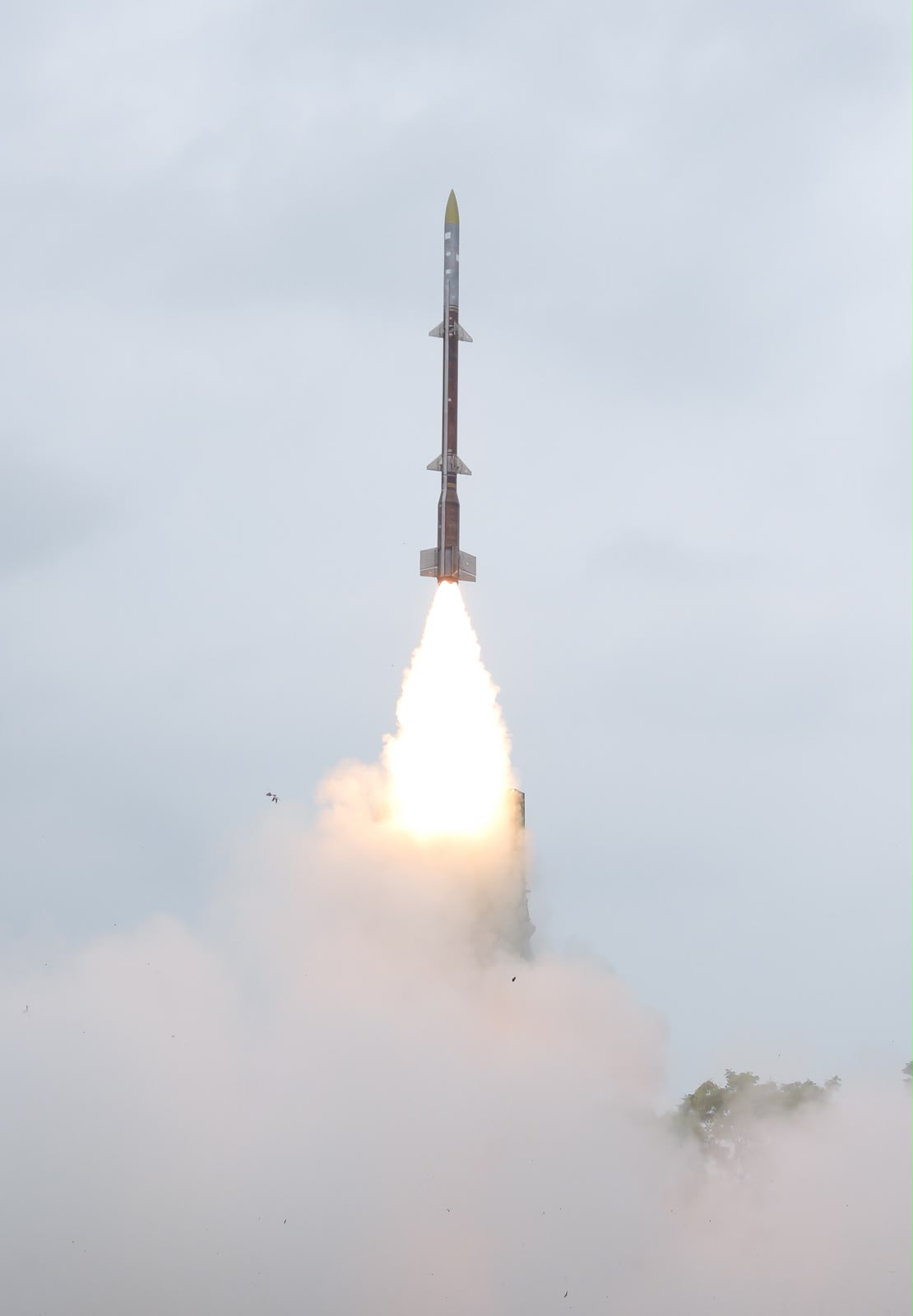
India has achieved a significant milestone in its efforts to strengthen its air defence capabilities with the first test of the indigenously developed Kusha long-range surface-to-air missile system. The system, designed to detect and intercept a range of aerial threats at distances extending up to 350 kilometres, successfully completed its maiden flight test on Thursday.
The test represents an important step in India’s effort to develop advanced, domestically produced air defence technologies and reduce dependence on foreign systems. Once fully developed, tested and inducted into operational service, Kusha is expected to add a powerful long-range layer to the country’s existing multi-tier air defence network.
The test was conducted by the Defence Research and Development Organisation (DRDO) from APJ Abdul Kalam Island off the Odisha coast. According to defence officials, the system was tested against an electronic target designed to replicate a high-speed, high-altitude aerial threat. The missile successfully intercepted the simulated target during the trial, demonstrating the system’s ability to engage challenging threats under test conditions.
Officials familiar with the programme said the Kusha system is intended to operate within a range band of approximately 150 to 350 kilometres. The system is expected to undergo further development and testing before it becomes operational, with deployment anticipated within the next three to four years.
The Kusha programme is being developed as a comprehensive air defence system rather than as a standalone missile. Its architecture includes missiles, surveillance and tracking radars, and a command-and-control network designed to work together to identify, track and engage hostile targets. Various DRDO laboratories, along with Indian industry partners, have contributed to the development of different components of the system.
The system is intended to provide protection against a broad spectrum of aerial threats. These include fighter aircraft, enemy missiles, unmanned aerial vehicles and other large airborne platforms. Its long engagement range could allow Indian defence forces to respond to threats at considerable distances, potentially improving the ability to protect critical military installations, strategic assets and other sensitive locations.
The successful test has also been viewed as an important development in India’s broader push towards self-reliance in defence production. Developing a sophisticated long-range surface-to-air missile system requires expertise in missile technology, radar systems, electronic warfare, target tracking and integrated command networks. The successful demonstration of the Kusha system therefore reflects the growing capabilities of India’s domestic defence research and industrial ecosystem.
Defence Minister Rajnath Singh described the successful flight test as a major achievement in the development of India’s long-range air defence capabilities. He said the programme demonstrated the country’s growing technological strength and could help reduce dependence on imported systems in the future.
The development of Kusha comes at a time when modern militaries are increasingly focusing on layered air defence systems capable of responding to different kinds of threats. The rapid growth of unmanned aerial systems, cruise missiles, aircraft and other precision weapons has made advanced detection and interception technologies a key component of national security planning.
India already operates several air defence systems with varying ranges and capabilities. Among the most advanced systems in the country’s arsenal is the Russian-origin S-400, which provides long-range protection against aircraft and other aerial threats. India has also deployed systems such as Akash and other short- and medium-range air defence platforms, creating multiple layers of protection.
The indigenous Kusha system is expected to complement these existing capabilities rather than immediately replace them. Its planned long-range engagement capability could eventually provide another layer of protection, particularly against threats that need to be detected and neutralised at significant distances from their intended targets.
The country’s dependence on imported defence equipment has been a longstanding concern, particularly in areas involving advanced missile and air defence technologies. The development of Kusha is therefore significant not only from a military perspective but also from the standpoint of defence manufacturing and technological self-reliance.
The programme is likely to undergo additional trials before final induction. These future stages will be important for assessing the system’s performance under different operational conditions and against various categories of targets. The integration of missiles, radars and command systems will also be crucial to ensuring that the complete platform can function effectively as a coordinated air defence network.
The first successful test nevertheless marks an important beginning for the programme. As India continues to modernise its armed forces and expand its domestic defence production capabilities, systems such as Kusha are expected to play an increasingly important role in strengthening the country’s strategic preparedness.
With a planned engagement range of up to 350 kilometres, the Kusha long-range air defence system has the potential to become a key component of India’s future air defence architecture. Its successful development and eventual induction could enhance the country’s ability to detect, track and counter a wide variety of aerial threats while advancing the broader objective of building a more self-reliant defence ecosystem.