
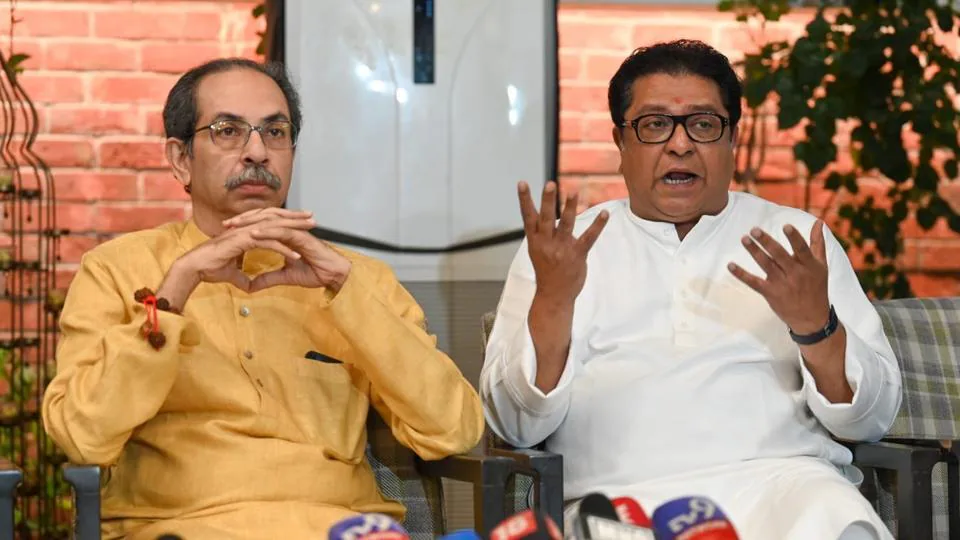
Shiv Sena (UBT) chief Uddhav Thackeray and Maharashtra Navnirman Sena (MNS) president Raj Thackeray have announced a joint public march in Mumbai on July 26, marking a significant moment of political unity between the two Thackeray cousins. The leaders have also extended invitations to Congress leaders and Nationalist Congress Party (Sharadchandra Pawar) chief Sharad Pawar to participate in the proposed demonstration.
The march, described as a “United March,” is scheduled to begin at Shivaji Park and proceed towards the Siddhivinayak Temple in Mumbai. The announcement was made during a joint press conference held at Raj Thackeray’s residence on Thursday.
The development assumes political significance as Uddhav and Raj Thackeray have been pursuing separate political paths for years. Their decision to appear together and organise a joint march is being viewed as an important attempt to bring different opposition groups together around a common cause.
Raj Thackeray said the march would be conducted under the national flag, with participants expected to carry the Tricolour rather than flags representing individual political parties. The decision to avoid party flags appears intended to present the event as a broader public mobilisation rather than a programme centred exclusively on any one political organisation.
The MNS chief also criticised the central government over its handling of recent student protests, alleging that peaceful demonstrations had been dealt with through excessive force. He questioned the government’s approach towards protesters and argued that political authorities should remain accountable when public anger rises over major issues.
Raj Thackeray also referred to the political history of the Bharatiya Janata Party, recalling a period when the party was in opposition and regularly raised public issues through protests and demanded accountability from those in power. He cited the resignation of then Maharashtra home minister R. R. Patil following criticism over the handling of security concerns after the 26/11 Mumbai terror attacks as an example of political accountability.
His remarks came amid criticism of the central government’s response to the ongoing protests. Raj Thackeray argued that the government was displaying what he described as an “arrogance of power” and questioned whether the response was appropriate in a democratic system.
Uddhav Thackeray, meanwhile, said he had spoken with Congress leader Rahul Gandhi as well as Maharashtra Congress chief Harshwardhan Sapkal about the proposed march. He also invited Sharad Pawar to participate in the July 26 programme, signalling an effort to broaden the political participation in the event.
Uddhav further stepped up his criticism of the central government, saying that public sentiment had moved beyond demands for the resignation of Union Education Minister Dharmendra Pradhan. According to him, the issue had now reached a stage where people were seeking a broader political change.
The joint appearance of the Thackeray cousins is particularly noteworthy in the context of Maharashtra’s changing political landscape. The two leaders have historically represented separate political formations, with their parties competing for influence among Marathi-speaking voters and within the state’s regional political space.
The proposed march could therefore have implications beyond the immediate issue that prompted the mobilisation. By bringing the two Thackeray-led parties together on a common platform and inviting Congress and Sharad Pawar’s faction of the NCP to participate, the initiative could potentially strengthen coordination among opposition parties in Maharashtra.
The decision to hold the march under the national flag, rather than party symbols, is also likely to attract attention. It suggests an attempt to position the event as a collective expression of public sentiment and to encourage participation beyond traditional party boundaries.
The participation of Congress leaders and Sharad Pawar, if confirmed, would further expand the political significance of the gathering. It could provide a common platform for opposition parties at a time when Maharashtra politics remains marked by organisational splits, shifting alliances and intense competition among rival political groups.
For now, the July 26 march represents a rare public display of unity between Uddhav and Raj Thackeray. The event will be closely watched for the scale of participation, the response from other opposition parties and the political messaging that emerges from the gathering.
The march could also serve as an important test of whether the recent rapprochement between the Thackeray cousins can translate into sustained political cooperation. While the two leaders have come together for this particular programme, the longer-term implications of their coordination remain uncertain.
With Congress and Sharad Pawar also being invited, the July 26 event has the potential to become a larger opposition mobilisation in Mumbai. Its political impact will depend not only on who joins the march but also on whether the initiative leads to further coordination among parties that have otherwise operated through separate organisational and political structures.
As preparations for the march continue, attention is now focused on the response of Congress leaders, Sharad Pawar and other opposition figures. The event is expected to provide a clearer picture of the emerging political equation in Maharashtra and whether the Thackeray brothers’ joint appearance marks the beginning of a broader effort to build opposition unity.