
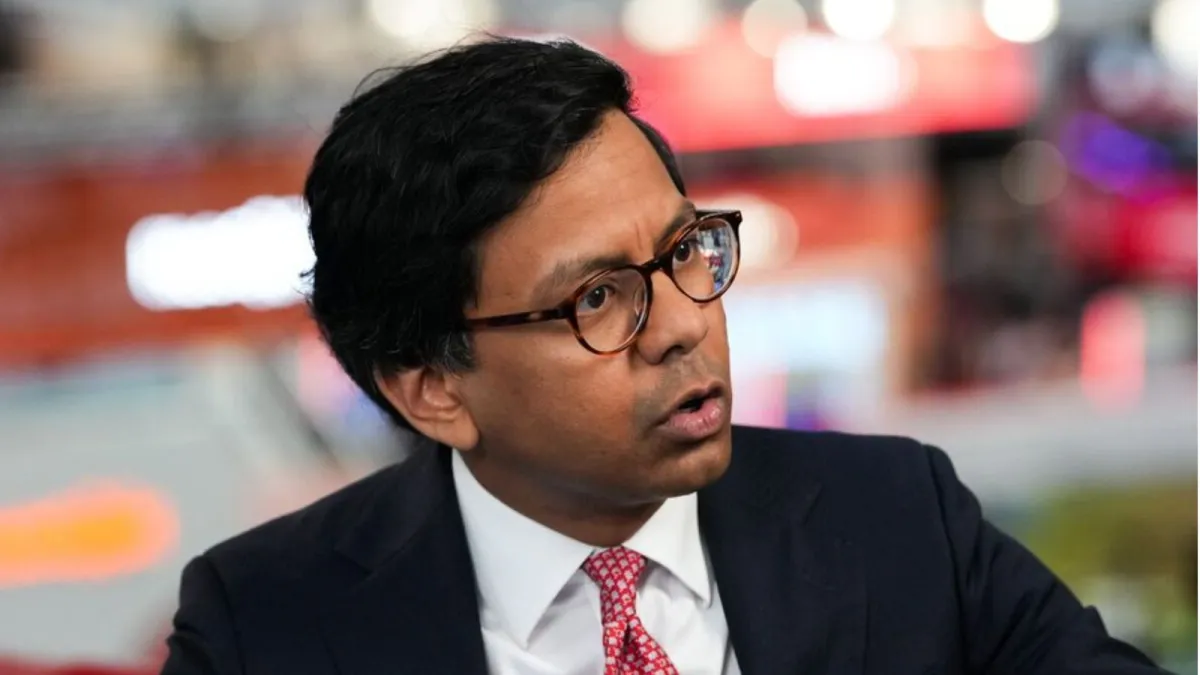
Indian-origin British lawmaker Kanishka Narayan has retained his position as the United Kingdom’s Minister of State for Artificial Intelligence, emerging as a key figure in the country’s efforts to shape policy around one of the fastest-changing areas of technology.
Narayan’s continuation in the AI portfolio comes as the new British government begins assembling its ministerial team under Prime Minister Andy Burnham. His appointment is particularly significant because it places an Indian-born politician at the centre of the UK government’s work on artificial intelligence, a field that is increasingly influencing economic growth, public services, national security, employment and digital regulation.
Narayan was born in Bihar and moved to Cardiff as a child. His political journey has since taken him to the UK Parliament, where he represents the Vale of Glamorgan. He has also achieved a notable place in Welsh political history, having become the first ethnic minority MP elected from Wales.
His background combines public policy, economics and business education. Narayan studied Philosophy, Politics and Economics at the University of Oxford before completing a Master of Business Administration at Stanford University. This academic experience has given him a broad foundation in economics, governance and technology-related policy, areas that are increasingly interconnected as governments attempt to manage the rapid expansion of artificial intelligence.
Kanishka Narayan’s role in the new UK government
Narayan has been retained as Minister of State for AI as Prime Minister Andy Burnham forms his new government. His continued presence in the ministerial team indicates that artificial intelligence remains an important policy priority for the British administration.
The AI portfolio carries growing importance as governments around the world grapple with the opportunities and risks created by rapidly developing technologies. Artificial intelligence is now being used across industries ranging from healthcare and finance to education, manufacturing and public administration. At the same time, governments are facing questions over data protection, employment disruption, misinformation, cybersecurity and the responsible use of automated systems.
As Minister of State for AI, Narayan is expected to play a role in developing and implementing government policy in this area. His responsibilities are likely to involve discussions around innovation, technology adoption and the wider regulatory environment required to ensure that AI development is both economically productive and socially responsible.
His retention also provides continuity at a time when the wider British political landscape is undergoing a significant change.
From Bihar to British politics
Narayan’s personal journey has attracted attention because of his Indian origins and his rise within British public life. Born in Bihar, he moved to Cardiff during childhood and later built his political career in the United Kingdom.
His election as the first ethnic minority MP from Wales marked an important moment in the country’s political representation. His career has also highlighted the growing role of politicians from diverse backgrounds in British public life.
Representing the Vale of Glamorgan in Parliament, Narayan has developed a profile that combines local representation with national policy responsibilities. His appointment to the AI ministerial role has further expanded that profile, placing him in a position connected to a major strategic issue facing the UK.
The growing importance of artificial intelligence means that the role extends beyond technology policy alone. Decisions made by governments on AI can influence businesses, workers, researchers, educational institutions and ordinary citizens. The minister responsible for the portfolio therefore has to navigate the balance between encouraging innovation and addressing concerns over the social and economic consequences of new technologies. 
Education and professional background
Narayan’s academic qualifications have contributed to his public profile. His undergraduate education at the University of Oxford focused on Philosophy, Politics and Economics, a multidisciplinary field that examines the relationship between political institutions, economic systems and society.
He later earned an MBA from Stanford University, one of the world’s leading institutions for business and innovation. The combination of his academic background and political experience gives him exposure to both policy-making and the business environment in which technological development takes place.
This background is particularly relevant to the AI portfolio, where governments must work with businesses, researchers and technology organisations while also considering the wider public interest.
The UK, like many other major economies, is seeking to strengthen its position in the global technology race. Artificial intelligence has become an important part of national economic strategies, with governments looking at ways to encourage investment and innovation while establishing safeguards around the use of advanced technology.
AI policy becomes a growing priority
The decision to retain Narayan comes at a time when artificial intelligence is becoming increasingly central to government policy across the world.
The rapid growth of generative AI tools has intensified debates about how technology should be governed. Governments are examining issues such as the impact of AI on employment, the protection of personal data, the spread of false information and the potential misuse of automated systems.
At the same time, policymakers are under pressure to avoid excessive regulation that could discourage technological innovation or put their countries at a competitive disadvantage.
For the UK government, the challenge is to create an environment where companies and researchers can develop new technologies while ensuring that AI systems are deployed safely and responsibly.
Narayan’s role is therefore expected to sit at the intersection of technology, business, economic policy and public administration. His work could have implications for how the UK approaches AI adoption in government services and how it positions itself in the international competition to become a leader in artificial intelligence.
A wider reshuffle under Andy Burnham
Narayan’s retention is part of a broader process of government formation under Prime Minister Andy Burnham. The new administration includes a mix of experienced political figures and ministers who have previously served in senior government positions.
The emerging team includes John Healey as Chancellor, Louise Haigh as Chancellor of the Duchy of Lancaster and Ed Miliband as Foreign Secretary. Shabana Mahmood has been appointed Home Secretary, while Wes Streeting takes charge of defence and Yvette Cooper becomes Health Secretary.
Other senior appointments include Lucy Powell as Education Secretary, Pat McFadden as Work and Pensions Secretary, Angela Rayner as Housing Secretary and Jonathan Reynolds as Business and Trade Secretary.
The government has also appointed Bridget Phillipson as Equalities Minister, Lisa Nandy as Culture Secretary and Miatta Fahnbulleh as Energy Secretary. Alex Norris has been named Justice Secretary, while Heidi Alexander takes responsibility for transport and Angela Eagle becomes Environment Secretary.
Within this broader ministerial structure, Narayan’s position as Minister of State for AI reflects the government’s focus on technology as a distinct and strategically important policy area.
Why Narayan’s appointment matters
Narayan’s continued role is notable for two reasons. First, it reinforces the growing political importance of artificial intelligence in Britain. Second, it represents the rise of an Indian-origin politician to a significant position within the UK government.
His story also reflects the increasingly international nature of British politics. Having been born in India and raised in Wales, Narayan’s career spans different cultural and geographic experiences. His rise from a childhood in Cardiff to the UK Parliament and then to a ministerial position demonstrates the changing composition of British political leadership.
For the UK, the AI ministry represents an important component of its approach to the technology-driven economy. For Narayan, retaining the portfolio provides an opportunity to continue working on a policy area that could shape Britain’s economic and social landscape for years to come.
As artificial intelligence becomes more deeply integrated into everyday life, the decisions taken by governments today will influence how the technology is developed and used in the future. Narayan’s role places him among the policymakers tasked with addressing that challenge while helping the UK remain competitive in an increasingly technology-focused global economy.
His appointment is therefore more than a personal milestone. It is also a reflection of the growing prominence of artificial intelligence in national policymaking and the changing face of political leadership in Britain.