
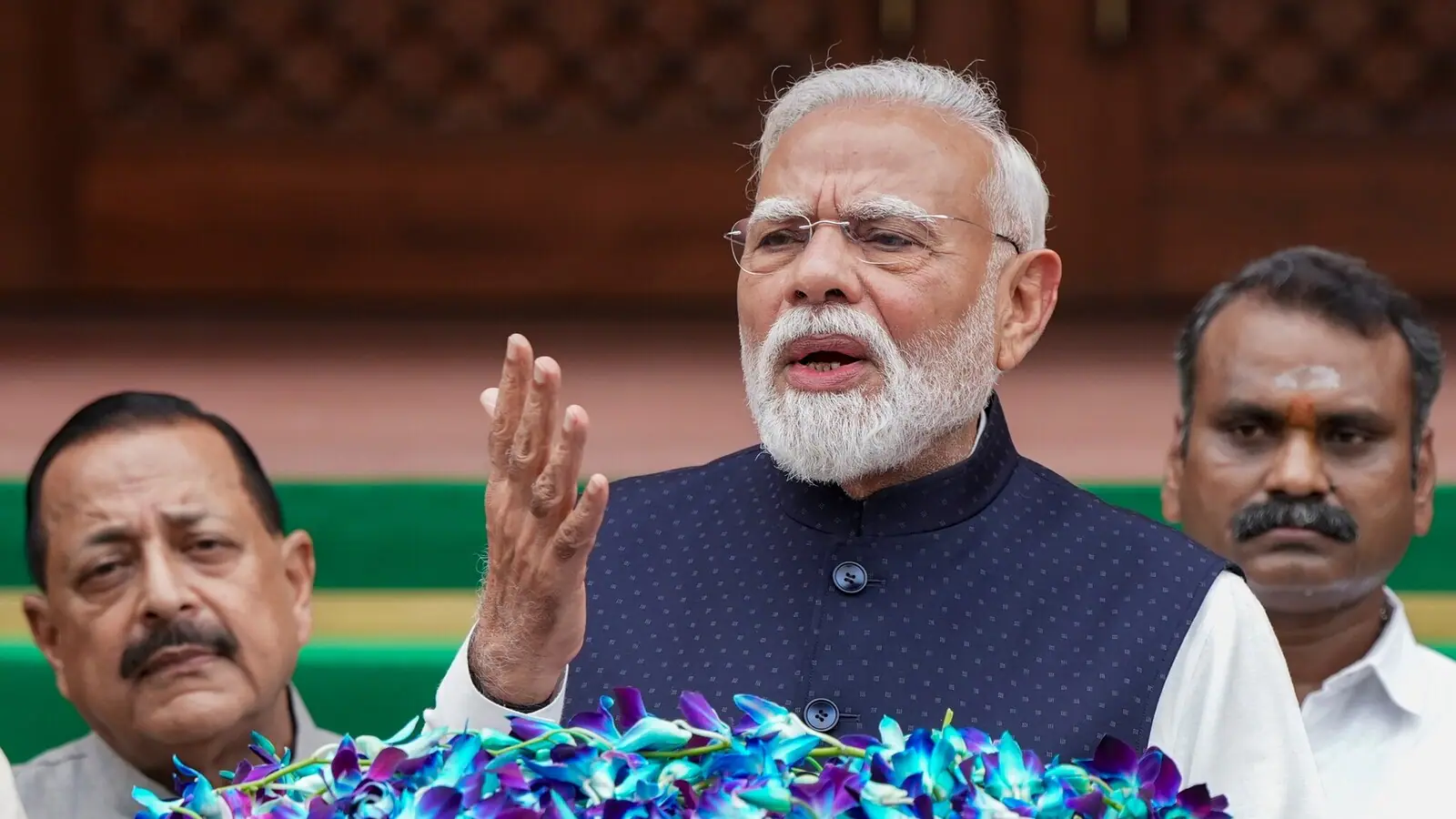
Prime Minister Narendra Modi on Tuesday highlighted India’s reported 7.7% economic growth rate and urged political parties to ensure that parliamentary discussions during the Monsoon Session remain grounded in facts. In his customary remarks before the commencement of the session, Modi said India’s economic performance reflected the strength and resilience of the country’s economy while appealing for constructive debate on issues of national importance.
The Prime Minister’s comments came as Parliament prepared to begin another crucial session, with the government and Opposition expected to raise a range of political, economic and public-interest issues. Modi’s pre-session address focused on India’s growth trajectory, the importance of parliamentary debate and the need to maintain democratic standards while discussing matters before the two Houses.
Highlighting the latest growth figures, Modi said the 7.7% growth rate was an encouraging indicator of India’s economic momentum. The figure comes amid continuing global economic uncertainties and challenges affecting several major economies. The Prime Minister presented the growth performance as evidence of the country’s ability to sustain economic activity despite external pressures.
Modi also used his remarks to emphasise the importance of facts in public and parliamentary discourse. Referring to the possibility of heated political exchanges during the session, he said there should be no “chaos” when discussions are based on facts. His comments appeared to underline the government’s preference for substantive debate and evidence-based arguments rather than disruptions or allegations unsupported by data.
The Prime Minister’s remarks set the tone for the Monsoon Session, which is expected to witness intense political discussions between the ruling side and the Opposition. Parliament sessions often become a platform for competing political narratives, with the government seeking to highlight its policy achievements and the Opposition raising questions about governance, the economy and issues affecting citizens.
The emphasis on economic growth was particularly significant. A growth rate of 7.7% places India among the world’s faster-growing major economies and provides the government with an opportunity to showcase the country’s economic performance. For the administration, strong growth figures are an important component of its broader argument that structural reforms and policy initiatives have strengthened India’s economic foundations. 
However, economic growth figures are also likely to remain a subject of political debate. While the government is expected to point to the headline growth rate as a sign of economic resilience, Opposition parties may focus on issues such as employment, inflation, income inequality and the distribution of economic gains. These contrasting perspectives are likely to shape discussions both inside and outside Parliament during the session.
Modi’s call for fact-based debate also comes against the backdrop of repeated concerns over disruptions in parliamentary proceedings. Over the years, sessions of Parliament have frequently been affected by protests, adjournments and political confrontations, sometimes limiting the time available for legislative business and detailed discussions.
In his address, the Prime Minister stressed the importance of parliamentary functioning and urged lawmakers to contribute meaningfully to the democratic process. His remarks reflected the government’s expectation that the session should focus on legislative work and substantive discussions rather than prolonged disruptions.
The opening of a parliamentary session traditionally provides an opportunity for the government to outline its priorities and for political parties to signal the issues they intend to pursue. The Monsoon Session is expected to see debates on a number of matters, with the Opposition likely to use the parliamentary platform to scrutinise government policies and decisions.
For the ruling establishment, the economic growth data provides a strong backdrop as it enters the session. The government is likely to argue that the latest figures demonstrate the effectiveness of its economic policies and India’s increasing role in the global economy. The Opposition, meanwhile, may seek to examine whether the benefits of economic expansion are reaching ordinary households and whether growth is translating into sufficient employment opportunities.
The Prime Minister’s reference to facts also highlights the growing importance of data in political communication. Economic indicators such as GDP growth, inflation, investment and employment have become central to public debates over government performance. By emphasising facts, Modi appeared to call for political arguments to be supported by verifiable information and evidence.
The remarks also carried a broader message about the functioning of democracy. Parliament is intended to provide a forum where competing viewpoints can be expressed, policies can be examined and legislation can be debated. While political disagreements are an essential part of parliamentary democracy, effective functioning depends on lawmakers being able to present their arguments and scrutinise government decisions without prolonged disruption.
The Monsoon Session therefore begins with both political and economic significance. India’s growth performance is likely to remain one of the government’s key talking points, while the Opposition is expected to raise questions about the wider economic situation and other issues of public concern.
Modi’s opening remarks sought to project confidence in India’s economic trajectory while calling for a more disciplined approach to parliamentary debate. His message was that political differences should not prevent Parliament from carrying out its legislative responsibilities and that discussions should be driven by facts and evidence.
As the session progresses, the balance between political confrontation and legislative business will be closely watched. The government’s ability to advance its agenda, along with the Opposition’s efforts to hold it accountable, will determine the nature of parliamentary proceedings in the coming weeks.
The Prime Minister’s comments ultimately placed economic growth and parliamentary conduct at the centre of his pre-session message. By highlighting the 7.7% growth rate and advocating fact-based discussions, Modi sought to frame the session around India’s economic resilience and the need for constructive democratic engagement.