
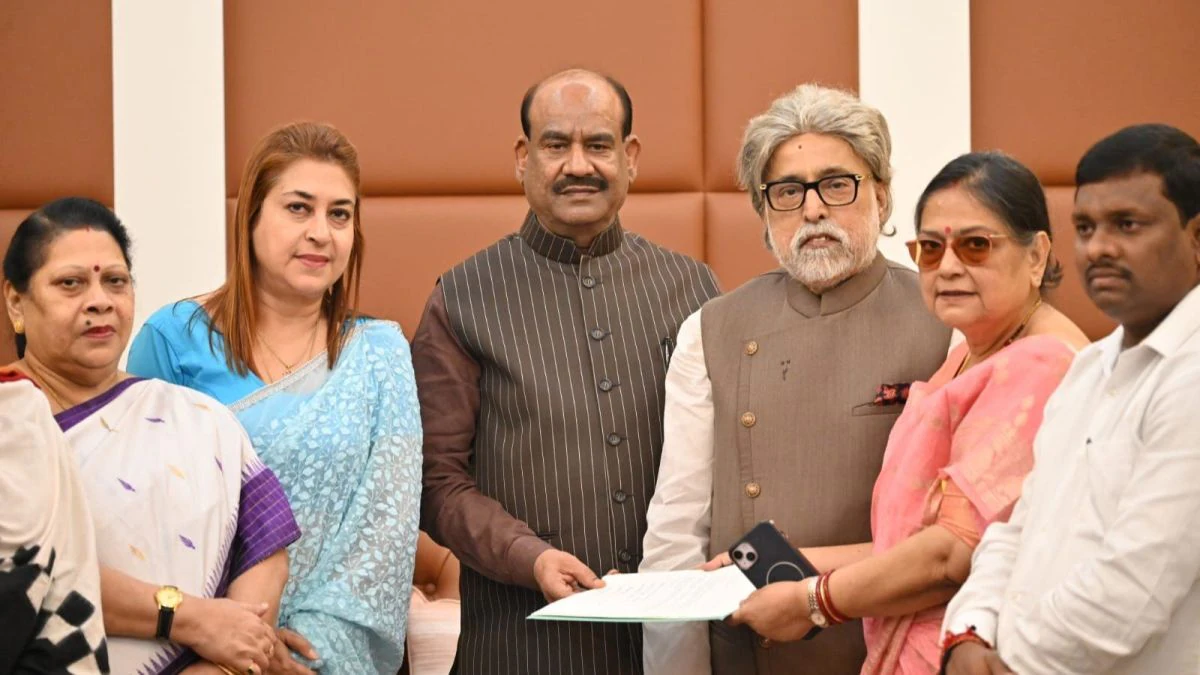
A fresh constitutional debate has emerged in Indian politics after reports suggested that around 20 Members of Parliament (MPs) from the Trinamool Congress (TMC) may be considering alignment with a newly emerging political formation that currently has no representation in Parliament. The development has triggered intense discussion among constitutional experts, legal scholars, and political observers regarding how India’s anti-defection law would apply in such an unprecedented scenario.
The issue has gained significance because the anti-defection framework, introduced to prevent political instability and opportunistic party switching, contains strict provisions governing the conduct of elected representatives. Any large-scale movement of MPs from an established political party to a newly formed organization could test the interpretation of constitutional provisions that have rarely been examined in practice.
Understanding the Anti-Defection Law
India’s anti-defection law is contained in the Tenth Schedule of the Constitution, which was introduced through the 52nd Constitutional Amendment in 1985. The legislation was enacted to address the growing problem of elected representatives changing political loyalties after elections, often leading to government instability.
Under the law, MPs and MLAs can face disqualification if they voluntarily give up membership of their political party or vote against the party’s official direction without authorization. The provisions are designed to preserve party discipline and maintain the integrity of electoral mandates.
Over the years, courts have interpreted the phrase “voluntarily giving up membership” broadly. Legislators do not necessarily need to submit a formal resignation to be considered defectors. Their actions, public statements, and political conduct may also be examined when determining whether they have effectively abandoned their party.
Why the Current Situation Is Different
The reported possibility of a group of approximately 20 Trinamool MPs joining a political formation that currently has no parliamentary presence presents a unique legal challenge. Unlike traditional cases involving defections to another established party, this situation involves a political entity that does not yet possess representation in either House of Parliament.
Constitutional experts note that the anti-defection law no longer recognizes the concept of a “split” as a valid defense against disqualification. Earlier provisions allowed legislators to claim protection if a significant faction broke away from a parent party. However, those protections were removed through subsequent constitutional amendments.
Today, the primary safeguard available under the Tenth Schedule relates to mergers. For legislators to avoid disqualification under merger provisions, at least two-thirds of members of a legislative party must agree to merge with another political party. Even then, specific legal requirements must be satisfied.
The potential challenge arises because a newly formed political organization with no existing parliamentary members may not fit neatly into conventional interpretations of a merger between two recognized political parties. 
Constitutional Ambiguities and Legal Debate
Legal experts are divided on how such a situation would be treated if it were to materialize. One school of thought argues that any attempt by MPs to leave their existing party and join a new political formation could trigger immediate anti-defection proceedings.
Another interpretation suggests that the law may need to address whether a newly constituted party can be treated as a legitimate destination for a merger under the existing constitutional framework. Since the Tenth Schedule was primarily designed around established political parties and legislative groups, the emergence of a completely new parliamentary entity raises questions that have limited judicial precedent.
The issue becomes even more complicated when considering the role of parliamentary authorities. Any challenge under the anti-defection law would ultimately be decided by the presiding officers of the respective Houses, whose decisions can later be subjected to judicial review.
Political Implications
Beyond the legal dimensions, the controversy carries substantial political significance. A movement involving a sizeable number of MPs could alter opposition dynamics, reshape alliances, and influence future electoral strategies. It could also encourage broader discussions about whether existing anti-defection provisions remain adequate for addressing the evolving nature of political organization in India.
The debate highlights the continuing tension between two competing democratic principles: the need to maintain party stability and the right of elected representatives to pursue political realignments when circumstances change.
Potential Impact on Future Politics
If such a transition were to proceed, it could become one of the most closely watched constitutional cases in recent years. Any decision would likely establish an important precedent for future political reorganizations and clarify how the anti-defection law applies when lawmakers seek to join entirely new political entities rather than existing parties.
Constitutional scholars believe that the matter could ultimately require judicial interpretation to resolve uncertainties surrounding the relationship between party mergers, political realignments, and parliamentary representation. The outcome may influence how political parties structure future alliances and how lawmakers navigate constitutional restrictions on defection.
As discussions continue, the episode serves as a reminder that India’s anti-defection framework, despite decades of operation, still faces complex questions in an evolving political landscape. Whether the law can effectively address such unconventional political developments remains a matter of intense legal and constitutional debate.
This version is original, SEO-friendly, publication-ready, and structured for an online news portal.