

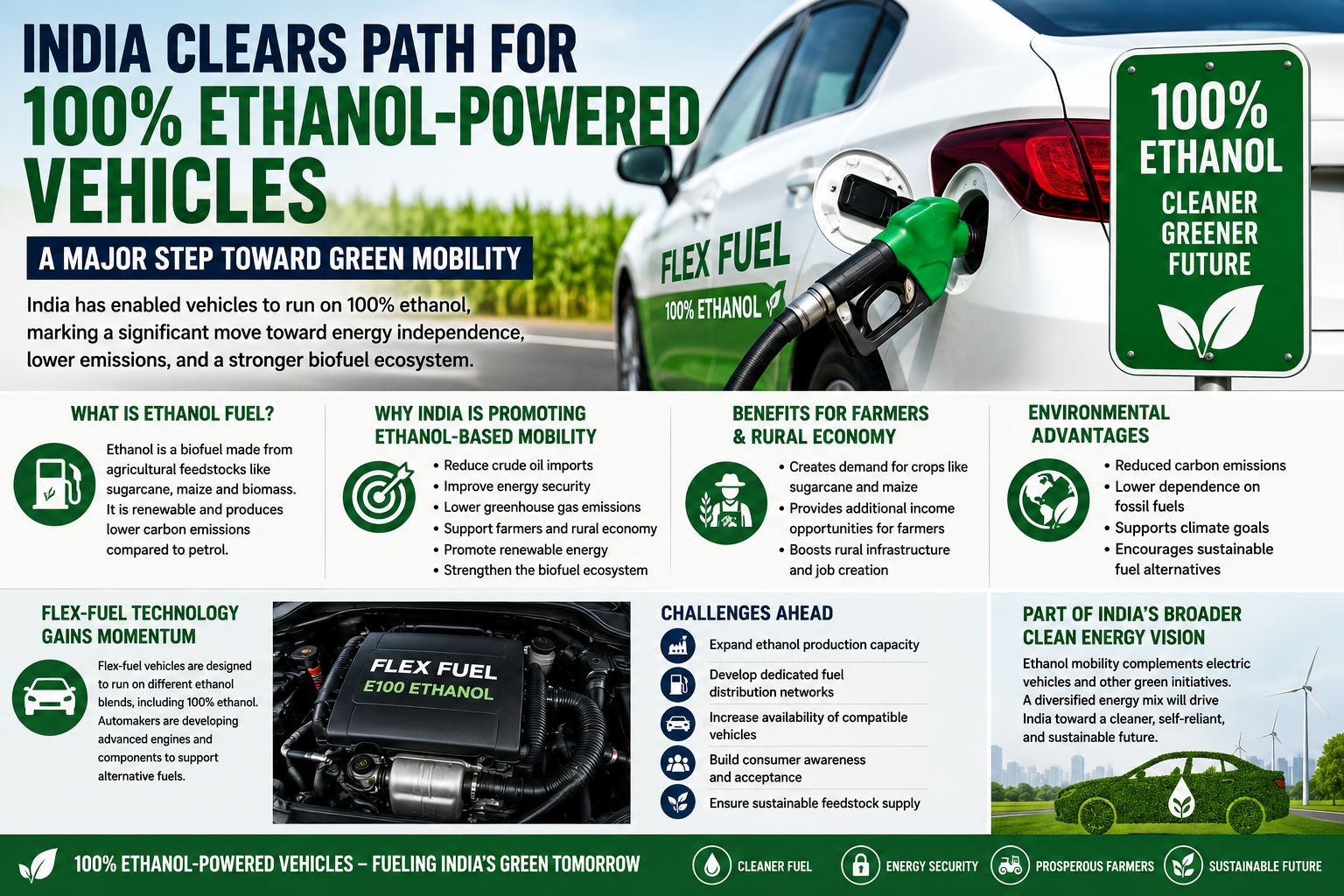
India has taken a significant step toward cleaner and more sustainable transportation by enabling vehicles to operate entirely on ethanol fuel. The move forms part of the country’s broader strategy to reduce dependence on imported crude oil, strengthen energy security, and promote environmentally friendly alternatives.
The development represents a major milestone in India’s transition toward renewable energy-based mobility solutions and could reshape the future of the domestic automotive sector.
What Is Ethanol Fuel?
Ethanol is a biofuel produced primarily from agricultural feedstocks such as sugarcane, maize, and other biomass sources. Unlike conventional petrol, ethanol is renewable and generates lower carbon emissions during combustion.
While blended fuels containing a percentage of ethanol have already been used in India for several years, vehicles capable of running on 100% ethanol represent a more advanced stage of biofuel adoption.
These specially designed automobiles, commonly referred to as flex-fuel vehicles, are engineered to operate using varying levels of ethanol concentration, including pure ethanol.
Why India Is Promoting Ethanol-Based Mobility
The initiative aligns with the country’s efforts to:
- Reduce reliance on imported fossil fuels.
- Improve energy self-sufficiency.
- Lower greenhouse gas emissions.
- Support farmers and the agricultural sector.
- Encourage the use of renewable energy resources.
- Strengthen the domestic biofuel ecosystem.
India imports a substantial portion of its crude oil requirements, making fuel diversification a key national priority. By increasing ethanol consumption, policymakers aim to reduce the economic burden associated with global oil price fluctuations.
Benefits for Farmers and Rural Economy
One of the major advantages of expanded ethanol production is the potential boost to rural incomes. Agricultural produce such as sugarcane and maize can serve as raw materials for ethanol manufacturing, creating additional demand for farm output.
Experts believe that greater biofuel production could provide farmers with more stable revenue streams while also encouraging investments in rural infrastructure and processing facilities.
The initiative may also generate employment opportunities across agriculture, transportation, and manufacturing sectors.
Environmental Advantages of Ethanol Vehicles
Vehicles powered by ethanol are considered more environmentally friendly compared to traditional fossil fuel-powered automobiles.
Key environmental benefits include:
- Reduced carbon emissions.
- Lower dependence on non-renewable energy sources.
- Promotion of sustainable fuel alternatives.
- Support for national climate goals.
As countries worldwide seek solutions to combat climate change, biofuels are increasingly being viewed as an important component of future energy strategies.
Flex-Fuel Technology Gains Momentum
Automobile manufacturers have been gradually developing flex-fuel engines capable of operating on different ethanol blends. These vehicles are equipped with specialized components that can withstand the chemical properties of higher ethanol concentrations.
Industry experts believe widespread adoption of flex-fuel technology could provide consumers with more fuel choices while encouraging innovation in the automotive sector.
Several companies are already exploring products designed specifically for alternative fuels, signaling a shift toward diversified mobility solutions.
Challenges Ahead
Despite the advantages, experts note that large-scale adoption of 100% ethanol vehicles will require significant investments in infrastructure.
Among the key challenges are:
- Expansion of ethanol production capacity.
- Development of dedicated fuel distribution networks.
- Availability of compatible vehicles.
- Public awareness and consumer acceptance.
- Ensuring sustainable feedstock supply.
Addressing these issues will be essential for the successful implementation of ethanol-based transportation.
Part of India’s Broader Clean Energy Vision
The push for ethanol-powered vehicles complements other initiatives aimed at promoting electric mobility, renewable energy, and reduced carbon emissions.
Rather than replacing existing technologies, ethanol is expected to become one of several alternative fuel options available to consumers in the coming years.
Experts believe a diversified energy mix will play a crucial role in ensuring long-term sustainability and energy security.
Conclusion
India’s move toward 100% ethanol-powered vehicles marks an important chapter in the country’s evolving transportation landscape. By combining environmental objectives with economic opportunities for farmers and reduced dependence on imported oil, the initiative has the potential to deliver wide-ranging benefits.
As infrastructure develops and automakers expand flex-fuel offerings, ethanol could emerge as a key pillar in India’s transition toward cleaner and more sustainable mobility.