
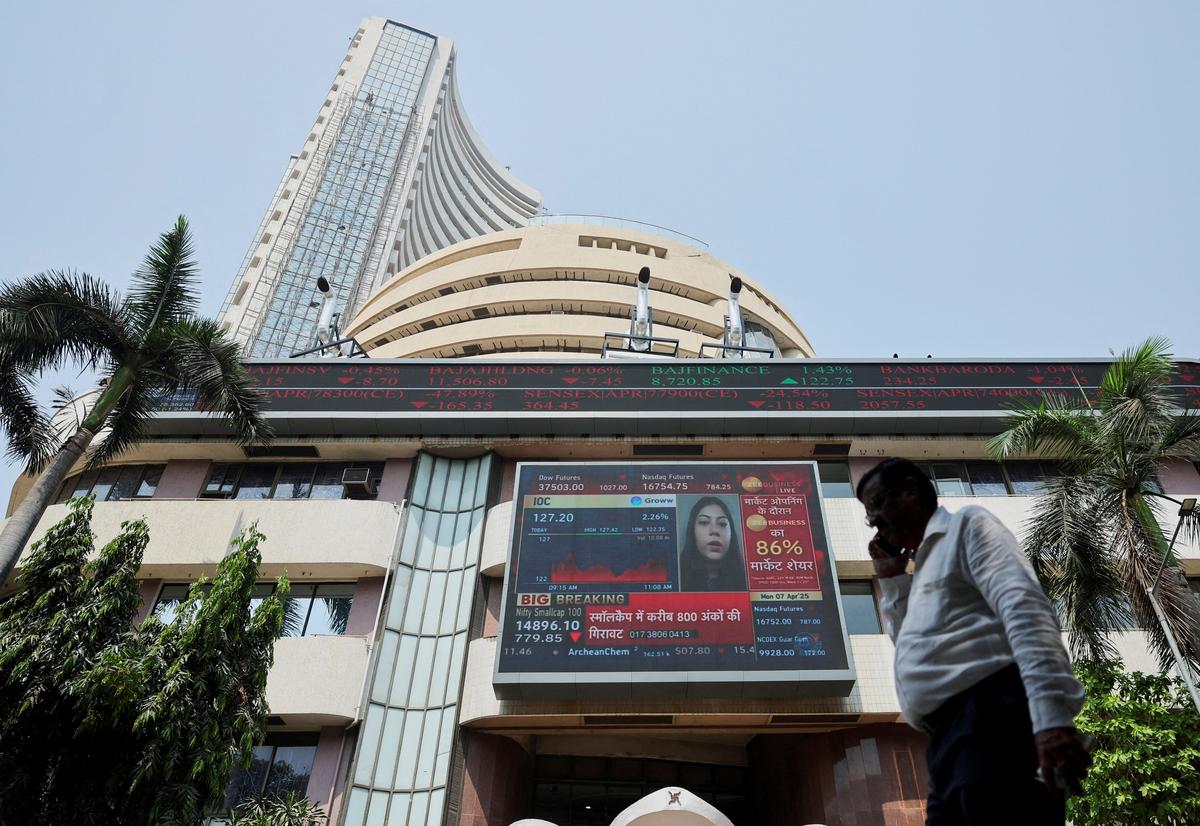
Indian equity markets staged a strong recovery in early trade on Thursday, September 3, after declining for three consecutive sessions. Buying in major banking and financial stocks, along with improved global market sentiment and easing US bond yields, helped lift the benchmark indices.
The 30-share BSE Sensex gained 334.16 points, or 0.44%, to reach 76,904.51 during morning trading. The NSE Nifty 50 advanced 95.45 points to trade at 24,009.90. The recovery came after a sharp sell-off in the previous session, when the Sensex had fallen nearly 374 points and the Nifty declined more than 141 points.
Banking stocks drive early gains
Banking stocks were at the forefront of Thursday’s recovery, with investors showing renewed interest in several large-cap financial companies.
Axis Bank, ICICI Bank, State Bank of India and HDFC Bank were among the prominent banking counters supporting the benchmarks. Tata Steel, Adani Ports, Power Grid, Eternal, Larsen & Toubro, Bharti Airtel and UltraTech Cement were also among the stocks recording gains in early trading.
The strength in banking stocks provided important support to the broader market after three sessions of losses. The movement suggested that investors were using the recent decline as an opportunity to buy selected blue-chip shares.
However, the recovery was not uniform across all sectors. Several information technology and consumer-oriented stocks remained under pressure.
Tech Mahindra, HCL Technologies, Infosys and Tata Consultancy Services were among the notable losers. Bajaj Finance, Titan, IndiGo, Sun Pharmaceutical Industries and ITC also traded lower during the early session.
Positive global signals improve investor sentiment
Global market trends also contributed to the improvement in domestic investor sentiment.
US equity markets had ended higher in the previous session, while several Asian markets were also trading in positive territory on Thursday. The improved global environment provided some relief to investors following the recent pressure caused by concerns over bond yields, crude oil prices and geopolitical developments.
A modest easing in US Treasury yields was another supportive factor. Higher US bond yields can make emerging-market assets relatively less attractive and increase concerns about global borrowing costs. The recent moderation therefore offered some relief to equity investors.
Despite the improved global cues, analysts continued to maintain a cautious outlook because several international risks remain unresolved.
Large foreign-currency inflows offer support to the rupee
A major factor behind the improved sentiment was the substantial foreign-currency mobilisation through special measures associated with the Reserve Bank of India.
Banks raised around $136 billion through foreign-currency deposit and borrowing schemes, significantly exceeding expectations. Foreign-currency non-resident deposits accounted for a major portion of the inflows.
The scale of the inflows is important for India’s foreign-exchange liquidity and could provide additional support to the rupee. Greater availability of foreign currency can also strengthen investor confidence by reducing concerns about excessive pressure on the domestic currency.
A more stable rupee could be positive for foreign investors and companies that depend heavily on imported inputs. It may also help reduce some of the pressure created by elevated crude oil prices.
Institutional buying provides further support
Foreign institutional investors and domestic institutional investors were net buyers in the previous trading session, providing an additional source of support for Indian equities.
Foreign institutional investors purchased Indian equities worth about ₹6,688 crore, while domestic institutional investors bought shares worth approximately ₹2,813 crore.
Despite this buying, the benchmark indices had ended Wednesday sharply lower, demonstrating the strength of the broader selling pressure at that time. Thursday’s early recovery indicated that investors were beginning to respond more positively to attractive valuations in selected large-cap stocks.
Market recovers after three consecutive sessions of losses
The Thursday rebound followed three straight sessions of declines.
On Wednesday, the Sensex fell 373.93 points to close at 76,570.35, while the Nifty dropped 141.35 points to finish at 23,914.45.
The recent weakness has been linked to several factors, including elevated crude oil prices, uncertainty surrounding global interest rates, rising bond yields and geopolitical tensions.
The latest recovery therefore represents an attempt by investors to stabilise the market following the recent correction. Whether the gains can be sustained will depend on global market conditions, institutional flows, currency movements and developments in the commodity market.
Crude oil remains a key risk
Despite the positive opening, crude oil prices remained an important concern for Indian investors.
Brent crude was trading around $95 per barrel during early trade. Although prices eased marginally, they remained elevated.
Higher crude prices can have a significant impact on India’s economy because the country depends heavily on imports to meet its energy requirements. A prolonged increase in oil prices can raise the country’s import bill, put pressure on the rupee and increase costs for businesses and consumers.
For equity investors, sustained increases in crude prices could therefore limit the upside in Indian markets even if banking and other large-cap stocks continue to attract buying interest.
Banking sector emerges as market’s key support
The strong performance of banking and financial stocks was one of the most notable features of Thursday’s trading session.
Banks are closely watched by investors because their performance is linked to credit growth, interest rates, liquidity conditions and overall economic activity. The latest foreign-currency inflows also provided an additional positive factor for the banking sector.
The strength in private and public-sector lenders helped offset weakness in several technology and consumer stocks, allowing the benchmark indices to recover.
Outlook remains cautiously optimistic
The early rebound in the Sensex and Nifty provides some relief after three consecutive sessions of losses. Strong buying in banking stocks, positive global cues, easing US bond yields and substantial foreign-currency inflows have collectively improved market sentiment.
However, investors remain cautious. Elevated crude oil prices, geopolitical uncertainty, global bond-market movements and expectations surrounding interest rates could continue to create volatility.
The ability of the Nifty to sustain levels around 24,000 and the Sensex to build on its early gains will be closely watched during the remainder of the trading session.
For now, the market’s recovery suggests renewed buying interest in large-cap stocks, particularly banks and financial companies. Sustained institutional buying and stability in the rupee could provide further support, although external risks remain capable of triggering renewed selling pressure.