
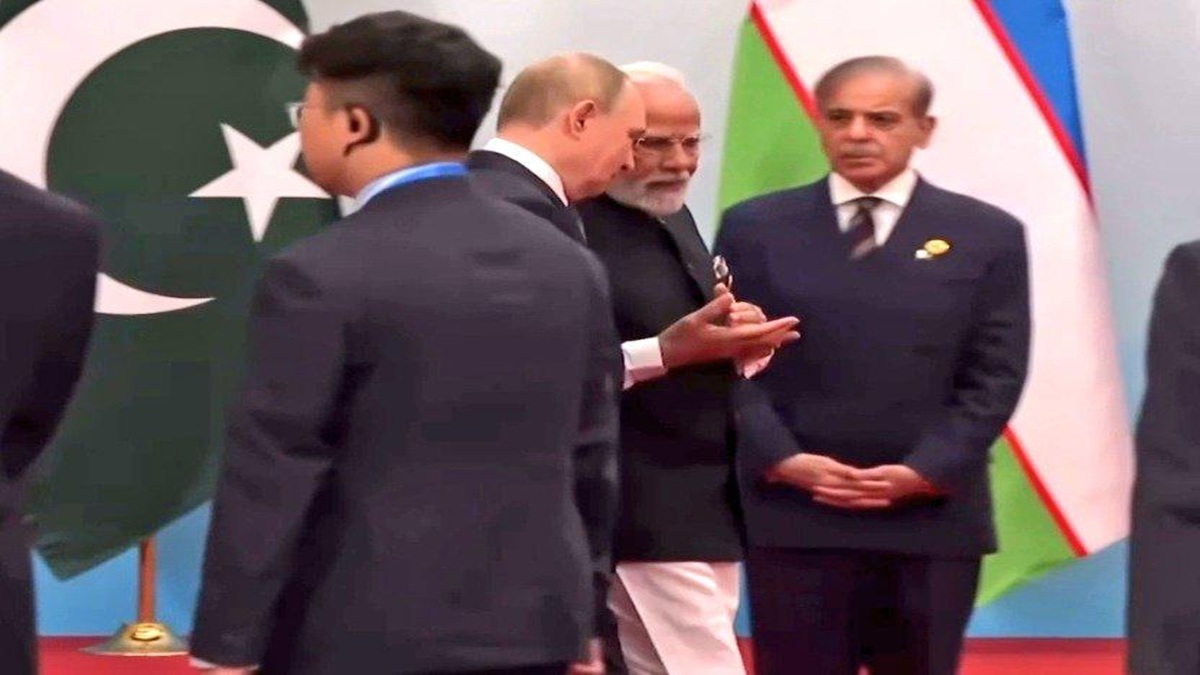
Prime Minister Narendra Modi and Chinese President Xi Jinping were seen exchanging a few words during the 26th Shanghai Cooperation Organisation (SCO) Summit in Bishkek, Kyrgyzstan, on Tuesday, as leaders of the regional grouping gathered for an official group photograph.
The brief interaction between Modi and Xi took place as the leaders assembled at the Yrys Ordo Congress Hall for the traditional SCO family photograph. Russian President Vladimir Putin was also present on the stage, placing the leaders of India, China and Russia together in a closely watched diplomatic setting.
The moment came amid heightened international attention on the evolving relationship between India and China and the broader geopolitical significance of the SCO platform. The three countries remain important players in the organisation, even as their bilateral relationships are shaped by different strategic priorities and areas of cooperation and competition.
Modi, Xi and Putin together at SCO gathering
The gathering in Bishkek brought together senior leaders from across the SCO’s membership and partner countries. Kyrgyzstan President Sadyr Japarov, who is hosting the summit and holds the organisation’s chairmanship, led the proceedings.
Alongside Modi, Xi and Putin, the gathering included Pakistan Prime Minister Shehbaz Sharif, Iranian President Masoud Pezeshkian, Belarusian President Alexander Lukashenko, Kazakh President Kassym-Jomart Tokayev, Uzbek President Shavkat Mirziyoyev and Tajik President Emomali Rahmon.
The presence of the three major powers—India, China and Russia—on the same stage gave the group photograph considerable diplomatic significance. While such images are a regular feature of multilateral summits, meetings involving the leaders of these countries often attract attention because of their influence over Asian security, trade, energy and international affairs.
Brief Modi-Xi interaction draws attention
Modi and Xi were briefly seen speaking to each other during the gathering. The interaction occurred in a public setting rather than as part of a formally announced bilateral meeting.
The exchange nevertheless attracted attention because India-China relations remain an important factor in the wider Asian strategic landscape. The two countries have sought to stabilise ties while continuing to manage differences on issues including their border and broader regional interests.
A short interaction at a multilateral event does not by itself indicate a major diplomatic breakthrough. However, such moments can assume significance when they occur against the backdrop of efforts by both sides to maintain dialogue and prevent differences from escalating.
The SCO provides an important platform for India and China to engage alongside other major Asian powers. It allows the two countries to participate in discussions on regional security, economic cooperation, connectivity and other shared concerns while maintaining separate bilateral diplomatic channels.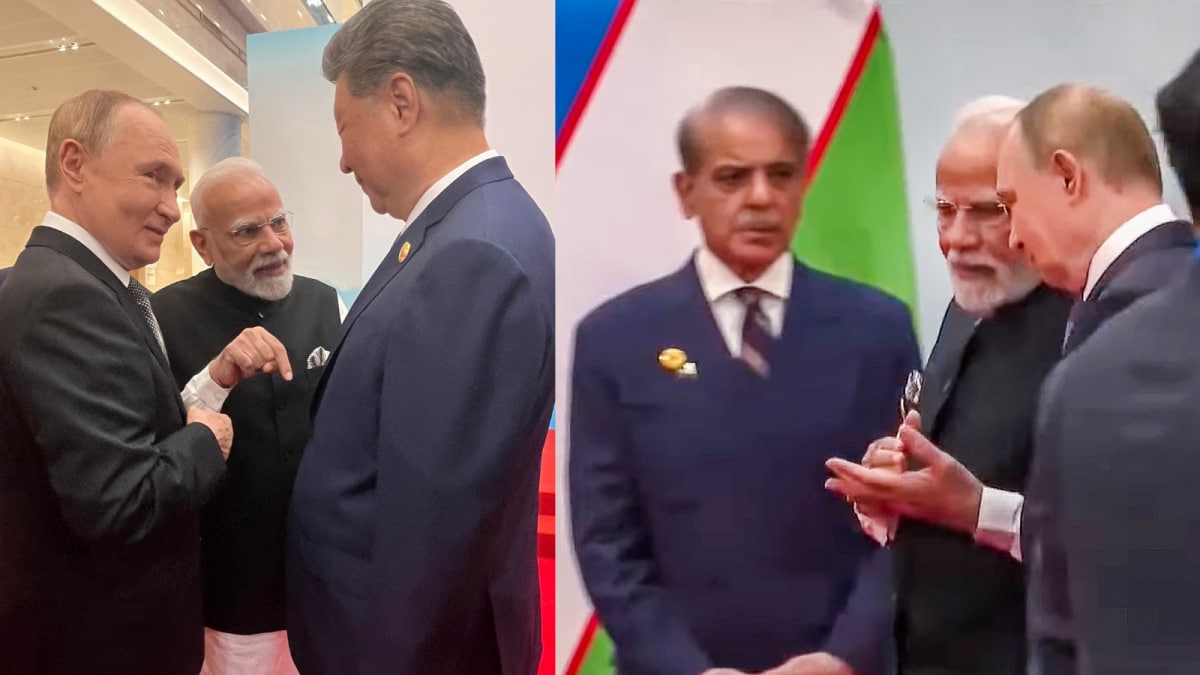
Putin also shares the stage
Russian President Vladimir Putin was also prominently present during the SCO gathering. His presence alongside Modi and Xi added another layer to the diplomatic significance of the event.
India maintains a longstanding strategic relationship with Russia, while Moscow and Beijing have developed increasingly close strategic coordination. New Delhi, meanwhile, continues to pursue an independent foreign-policy approach, maintaining relations with Russia and China while also strengthening partnerships with other major powers.
The appearance of Modi, Xi and Putin together therefore highlighted the complex diplomatic balance within the SCO. Their participation demonstrates how the organisation brings together countries with overlapping interests but also significant differences in strategic outlook.
SCO summit focuses on regional and global issues
The 26th SCO Leadership Summit is bringing together the organisation’s members, observers and partner countries to discuss a broad range of regional and international issues.
The organisation currently has 10 member states and has positioned itself as a platform for dialogue and cooperation on matters including security, economic relations, connectivity and regional development.
Security remains a central area of discussion for the grouping. Counterterrorism, transnational threats and regional stability are among the issues that have traditionally occupied an important place on the SCO agenda.
Economic cooperation and connectivity are also increasingly important as member states seek to expand trade and transport links across Eurasia. Energy security, investment, digital cooperation and infrastructure development have become significant components of the wider regional dialogue.
India balances multiple diplomatic priorities
For India, participation in the SCO represents another opportunity to engage simultaneously with several major powers and neighbouring countries.
New Delhi has consistently emphasised strategic autonomy in its foreign policy, allowing it to maintain relationships with countries that may have competing interests. India’s engagement with Russia, China, Central Asian nations and other SCO members reflects this broader diplomatic approach.
The Bishkek summit is particularly significant because it comes at a time of major geopolitical uncertainty. Conflicts and tensions in different parts of the world have affected international trade, energy security and diplomatic relationships.
Against this backdrop, India’s participation allows Modi to present India’s position on regional stability while also pursuing bilateral and multilateral engagement.
Why the Modi-Xi moment matters
The brief exchange between Modi and Xi should be viewed within the larger framework of India-China engagement rather than as an isolated diplomatic development.
India and China are two of Asia’s largest economies and major regional powers. Their relationship has consequences not only for bilateral trade and border stability but also for wider Asian geopolitics.
Any sustained improvement in relations between the two countries could have implications for regional connectivity, commerce and cooperation in multilateral organisations. At the same time, unresolved differences mean that diplomacy between New Delhi and Beijing remains closely watched.
The presence of Putin alongside Modi and Xi further underlined the importance of the SCO as a venue where major Asian powers can interact despite differences in their bilateral relationships.
A significant diplomatic backdrop
The Bishkek summit comes as India prepares for further high-level diplomatic engagements in the coming weeks. The SCO meeting gives Modi an opportunity to interact with several world leaders in one location and advance India’s interests through both formal discussions and informal diplomatic contacts.
The group photograph may have lasted only moments, but the appearance of Modi, Xi and Putin together offered a visual representation of the complicated geopolitical landscape in Eurasia.
The brief Modi-Xi exchange, meanwhile, highlighted the continuing importance of dialogue between New Delhi and Beijing. While the interaction alone does not signal a major shift in bilateral relations, it reflects the reality that India and China remain closely connected through regional and multilateral platforms.
As the SCO continues its discussions in Bishkek, attention will remain focused on how its member states navigate security concerns, economic interests and the competing strategic priorities shaping the region.