
Prime Minister Narendra Modi has renewed his appeal for Indians to prioritise domestic consumption and support the broader idea of self-reliance, linking individual spending choices with India’s economic strength. In a video message on Tuesday, Modi congratulated the country after India recorded a 7.8% economic growth rate in the first quarter of the financial year 2026-27.
The Prime Minister urged citizens to reconsider non-essential spending abroad, including leisure travel and overseas weddings, while also advising people to avoid purchasing gold unless there was a genuine need. His remarks came against the backdrop of continuing global economic uncertainty, geopolitical tensions and disruptions affecting international supply chains.
Modi links economic growth with self-reliance
Congratulating Indians on the latest GDP figures, Modi said the country’s economic performance demonstrated its ability to maintain momentum despite challenging conditions globally.
He used the occasion to make a renewed case for the “swadeshi” approach, encouraging greater reliance on Indian products and services. According to the Prime Minister, stronger domestic consumption and reduced dependence on imported goods can contribute to the country’s long-term economic resilience.
Modi argued that individual decisions can have a wider economic impact. Spending on overseas holidays, destination weddings and imported products can contribute to money flowing out of the country, while choosing Indian alternatives can help retain economic activity within India.
The Prime Minister also said that greater emphasis on self-reliance could help India move towards the goal of becoming a developed nation by the centenary of Independence.
Appeal against unnecessary foreign travel
One of the key points in Modi’s message was his appeal to Indians to avoid overseas leisure trips when they are not necessary.
Foreign travel involves spending on international transportation, accommodation, food, entertainment and other services. From the government’s broader economic perspective, reducing non-essential overseas expenditure can help limit the outflow of foreign exchange.
Modi also extended the appeal to weddings. He suggested that families should consider holding wedding ceremonies within India instead of travelling overseas for destination weddings.
India has a large domestic wedding and tourism industry, with substantial economic activity generated through hotels, transport, catering, event management, jewellery, clothing and other services. Encouraging families to hold major events domestically could therefore direct more spending towards Indian businesses.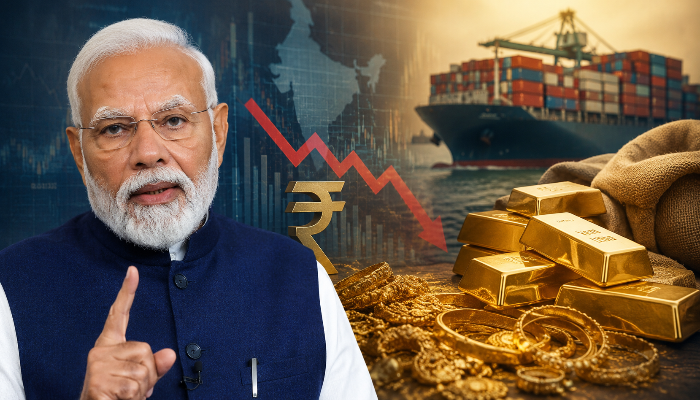
Why gold became part of the appeal
Gold was another major element of the Prime Minister’s message. Modi advised citizens not to purchase gold unless it was necessary.
Gold has a particular place in Indian households and is closely associated with weddings, festivals, savings and traditional investment practices. At the same time, India depends heavily on imported gold to meet domestic demand.
Higher gold imports can increase the country’s import bill and affect the trade balance. This makes gold purchases an important consideration when policymakers are looking at ways to conserve foreign exchange.
The Prime Minister’s latest remarks therefore place gold consumption within the wider discussion about reducing unnecessary imports and encouraging more disciplined spending.
India’s 7.8% growth provides backdrop to message
The appeal came shortly after India reported 7.8% economic growth in the first quarter of financial year 2026-27. The latest figure represented an improvement over the 6.9% growth recorded in the corresponding quarter of the previous year.
Modi described the performance as evidence of India’s economic strength at a time when the global economy continues to face uncertainty.
The growth data has given the government an opportunity to emphasise the resilience of the Indian economy. However, the Prime Minister’s message also highlighted that maintaining growth will require continued attention to domestic demand, imports, foreign exchange and economic self-reliance.
Global uncertainty remains a concern
Modi referred to wars, international crises and supply-chain disruptions while discussing India’s economic performance. Global geopolitical developments can affect India through several channels, including energy prices, shipping costs, imports, exports and currency movements.
For an economy that remains dependent on imported energy and several categories of goods, international disruptions can create additional pressure. This is particularly significant when global commodity prices rise or international trade routes are affected.
Against this backdrop, the government’s renewed focus on swadeshi is not limited to a cultural message. It also carries an economic argument: strengthening domestic production and consumption can reduce vulnerabilities arising from external shocks.
Modi takes aim at pessimistic narratives
In his message, Modi also criticised what he described as an atmosphere of pessimism within the country. He argued that some people were spreading what he called false narratives despite India’s economic progress.
The comments reflect a broader political and economic debate over how India’s growth should be assessed. While the government highlights headline GDP growth and India’s position among major economies, critics often focus on issues such as employment, household income, inflation and the distribution of economic gains.
Modi’s latest statement placed the GDP numbers within a larger narrative of confidence, self-reliance and India’s ambition to become a developed economy.
Swadeshi push combines economic and social messaging
The Prime Minister’s appeal combines several strands of economic policy and public behaviour. Avoiding unnecessary foreign travel, holding weddings in India and limiting non-essential gold purchases are different decisions, but the government views them through a common lens: reducing avoidable foreign-exchange outflows and supporting domestic economic activity.
The message also builds on the broader idea of “Atmanirbhar Bharat”, or self-reliant India, which has been a recurring theme in the government’s economic policy.
The emphasis on domestic products and services is intended to encourage consumers to look beyond individual purchasing decisions and consider their potential contribution to Indian businesses, manufacturers, workers and service providers.
What the appeal could mean for consumers
The Prime Minister’s remarks are an appeal rather than a blanket prohibition on foreign travel, overseas weddings or gold purchases. His emphasis was on avoiding such spending when it is not necessary.
For consumers, the message effectively calls for greater consideration of where and how money is spent. Domestic tourism, Indian-made products and locally organised events could potentially benefit from a shift in spending patterns.
At the same time, consumer decisions are influenced by several factors, including price, quality, personal preferences, social traditions and financial circumstances. Whether the appeal significantly changes spending behaviour will depend on how strongly households respond to the government’s call for greater economic self-reliance.
India’s growth story enters another phase
The 7.8% GDP growth recorded in the first quarter gives the government a strong headline figure with which to reinforce its economic narrative. Modi’s decision to connect the growth data with swadeshi and self-reliance indicates that the government wants economic expansion to be supported by stronger domestic demand and reduced dependence on imports.
His remarks also come at a time when global uncertainty continues to make economic resilience a major policy concern.
The central message is that India’s growth cannot depend solely on favourable global conditions. According to Modi’s argument, consumers, businesses and policymakers all have a role to play in strengthening the domestic economy.
As India looks towards its long-term ambition of becoming a developed nation, the Prime Minister has once again placed swadeshi at the centre of the economic conversation—urging citizens to make choices that, in his view, can strengthen India’s self-reliance while supporting the country’s growth momentum.