
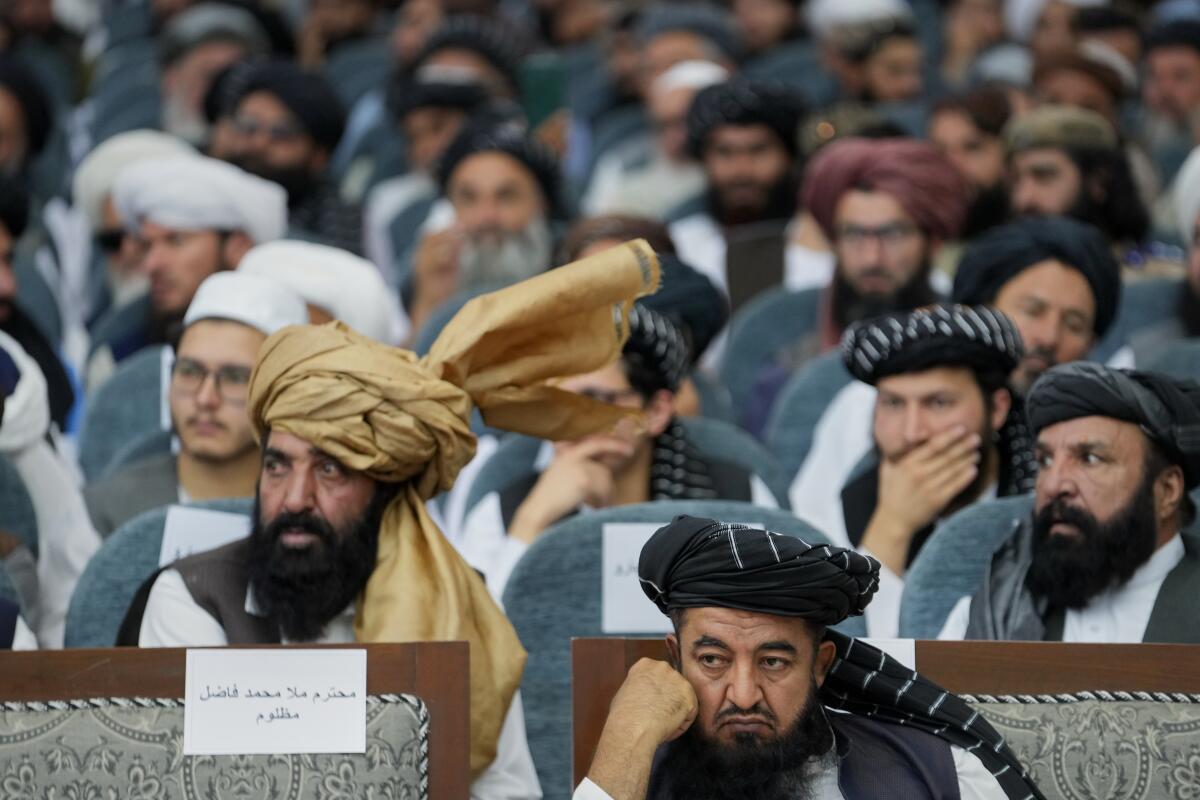
Five years after the Taliban seized control of Afghanistan, the international community continues to face a difficult question: how should the world deal with a regime that has established firm control over the country but remains deeply controversial because of its policies on human rights, women’s freedoms and political participation?
The Taliban returned to power in Kabul on August 15, 2021, following the withdrawal of US and allied forces and the collapse of the internationally backed Afghan government. What initially appeared to be a dramatic turning point has since developed into a more complicated reality. The Taliban have managed to consolidate their authority and maintain control over most of the country, but Afghanistan continues to struggle with severe humanitarian, economic and social problems.
The situation has created a contradiction for the international community. On one hand, governments cannot easily ignore the authorities controlling Afghanistan. On the other, closer engagement risks being interpreted as acceptance or legitimisation of policies that have sharply restricted the rights of Afghan women and girls.
Stability Has Not Meant Inclusion
One of the Taliban’s central claims since returning to power has been that Afghanistan has achieved greater security and stability. Compared with the years of intense conflict involving Taliban fighters, Afghan government forces and international troops, large-scale fighting has significantly declined.
However, stability cannot be measured only by the absence of war.
Afghanistan remains deeply divided when stability is viewed through the broader lens of political participation, civil liberties and social inclusion. Large sections of society have been pushed away from public life, while journalists, activists and critics face significant restrictions.
The position of women and girls is particularly important. Since taking power, the Taliban have introduced a series of restrictions affecting education, employment, movement and participation in public life. Girls remain excluded from secondary and higher education, while women have faced severe limitations on employment and their ability to participate freely in society.
This has transformed everyday life for millions of Afghans and has also created serious consequences for the country’s long-term development.
Afghan Women Remain at the Centre of the International Debate
The treatment of women has become the most visible point of disagreement between the Taliban and much of the international community.
Education is one of the clearest examples. Afghan girls have been prevented from continuing their education beyond certain levels, while women have been excluded from universities. The restrictions have deprived an entire generation of young Afghans of educational opportunities and have raised concerns about the future of the country’s professional workforce.
The consequences go beyond education.
Women who are unable to study are less likely to enter professions such as medicine, teaching, law, journalism and public administration. This weakens the country’s institutional capacity and limits Afghanistan’s ability to develop a self-sufficient economy.
Restrictions on women also affect humanitarian operations. Female aid workers play an important role in reaching women and children, particularly in communities where cultural or social considerations make access by male workers difficult.
As international humanitarian agencies struggle with funding shortages, restrictions on female participation can make an already difficult situation even more complicated.
The Humanitarian Crisis Continues
Afghanistan’s economic and humanitarian problems remain another major challenge.
The country has experienced years of poverty, displacement, weak infrastructure and dependence on foreign assistance. The Taliban takeover further disrupted the economy, particularly as international financial support declined and Afghanistan became increasingly isolated from the global financial system.
Humanitarian needs have remained high, while international funding has come under pressure. Afghanistan has also faced natural disasters, drought and other economic pressures that have added to the difficulties confronting ordinary citizens.
For millions of Afghans, political changes at the top have not necessarily translated into improvements in everyday life. Food security, employment, healthcare and access to basic services continue to be major concerns.
This creates another dilemma for foreign governments. Humanitarian assistance is essential to prevent further suffering, but delivering that assistance often requires cooperation with the authorities in Kabul.
The Problem of International Recognition
The question of whether to formally recognise the Taliban government has remained one of the most complicated issues in Afghanistan’s foreign relations.
The Taliban control the state and its institutions, but political recognition carries a much greater significance. Recognition can provide diplomatic legitimacy and potentially strengthen the regime’s international position.
Many governments have therefore preferred a middle path: maintaining communication without offering unconditional political recognition.
This approach allows countries to discuss practical matters such as humanitarian assistance, migration, border security and counterterrorism while retaining pressure over human-rights concerns.
However, the distinction is becoming increasingly difficult to maintain.
As more countries establish diplomatic contacts with Taliban representatives, the movement is gradually reducing its international isolation. Governments have strategic interests in Afghanistan, including concerns about terrorism, trade, migration and regional stability.
The Taliban can use these interests to encourage greater engagement with its government.
Regional Powers Cannot Ignore Afghanistan
Afghanistan’s neighbours have particularly strong reasons to maintain contact with the Taliban.
Pakistan, Iran, China and the Central Asian countries all have direct security, economic or migration interests connected to Afghanistan. Instability inside Afghanistan can have consequences for neighbouring states through refugee movements, militant networks, border tensions and illegal trafficking.
For regional powers, therefore, complete diplomatic isolation is difficult to sustain.
Trade and connectivity are also becoming increasingly important. Afghanistan occupies a strategically significant position between South Asia, Central Asia and the Middle East. Its geographic location gives it potential importance for regional transportation and economic projects.
The Taliban are attempting to use this position to strengthen their diplomatic and economic relationships.
This has produced an important shift in international policy. Instead of asking only whether the Taliban should be engaged, governments increasingly have to determine what kind of engagement is possible and what conditions should accompany it.
Engagement Versus Legitimisation
The distinction between engagement and recognition is at the heart of the international dilemma.
Engagement can be necessary for humanitarian reasons. Aid organisations need access to vulnerable populations. Foreign governments need channels to discuss security threats. Neighbouring countries need to address border and migration concerns.
But engagement can also have unintended consequences.
If diplomatic contact gradually becomes routine and economic cooperation expands without meaningful conditions, the Taliban could gain international legitimacy without making significant changes to its policies.
This creates a difficult balancing act for governments. Complete isolation could harm ordinary Afghans and reduce international influence over events inside the country. Unconditional engagement, however, could weaken international pressure for reforms.
The challenge is to find a middle ground that protects humanitarian interests while continuing to demand basic rights and political inclusion.
Security Is Only One Part of Peace
The Afghan experience also raises a broader question about the meaning of peace.
A reduction in armed conflict is undoubtedly significant. Ordinary citizens benefit when roads are safer and large-scale battles become less frequent.
But peace involves more than the absence of fighting.
A sustainable peace requires functioning institutions, economic opportunity, access to education, protection of civil liberties and participation in public life. If half of the population is effectively prevented from participating in society, questions remain about whether stability can be considered genuinely sustainable.
The exclusion of women and girls is therefore not merely a human-rights issue. It is also a question of Afghanistan’s future political and economic stability.
The Taliban Have Survived International Pressure
One of the clearest developments of the past five years is the Taliban’s ability to survive despite international pressure.
The movement has remained in control of Afghanistan and has gradually developed relationships with a number of foreign governments. Although broad international acceptance remains limited, diplomatic engagement has increased.
This demonstrates the limits of isolation as a foreign-policy tool.
The Taliban leadership has shown little indication that external pressure alone will force it to fundamentally change its governing philosophy. At the same time, governments seeking to protect their own security interests have increasingly found reasons to maintain communication with Kabul.
The result is a gradual shift from confrontation towards pragmatic engagement.
What Comes Next for Afghanistan?
The future of Afghanistan will depend on several interconnected factors.
The country’s economic recovery will require greater domestic productivity, investment and international cooperation. Its humanitarian situation will depend heavily on continued assistance and improved access to vulnerable communities. Its political future will depend on whether the Taliban are willing to create a more inclusive system of governance.
The position of women and girls will remain a particularly important test.
If restrictions continue indefinitely, Afghanistan risks losing an entire generation of educated women and girls. The consequences could affect healthcare, education, administration, economic development and social stability for decades.
The international community therefore faces a difficult choice between maintaining pressure and maintaining engagement.
A Dilemma Without an Easy Solution
Five years after the Taliban returned to power, Afghanistan is no longer defined by the immediate chaos that followed the fall of Kabul. The Taliban have consolidated their authority and established themselves as the country’s de facto rulers.
But consolidation of power has not resolved Afghanistan’s deeper problems.
Humanitarian needs remain substantial, economic vulnerabilities persist, and restrictions on women and girls continue to generate international condemnation. At the same time, regional and global powers increasingly recognise that they cannot simply ignore Afghanistan.
The result is an enduring international dilemma.
The world must engage with the authorities who control Afghanistan while avoiding unconditional acceptance of policies that undermine fundamental rights. It must provide humanitarian assistance without allowing aid to become a substitute for long-term economic development. And it must pursue regional security without abandoning the demand for a more inclusive Afghan society.
Five years after the Taliban’s return, the central question therefore remains unanswered: can Afghanistan achieve lasting stability while a significant part of its population remains excluded from public life?
Until that question is addressed, the Taliban’s grip on power may remain a political reality, but the search for a genuinely peaceful, inclusive and sustainable Afghanistan will remain unfinished.