
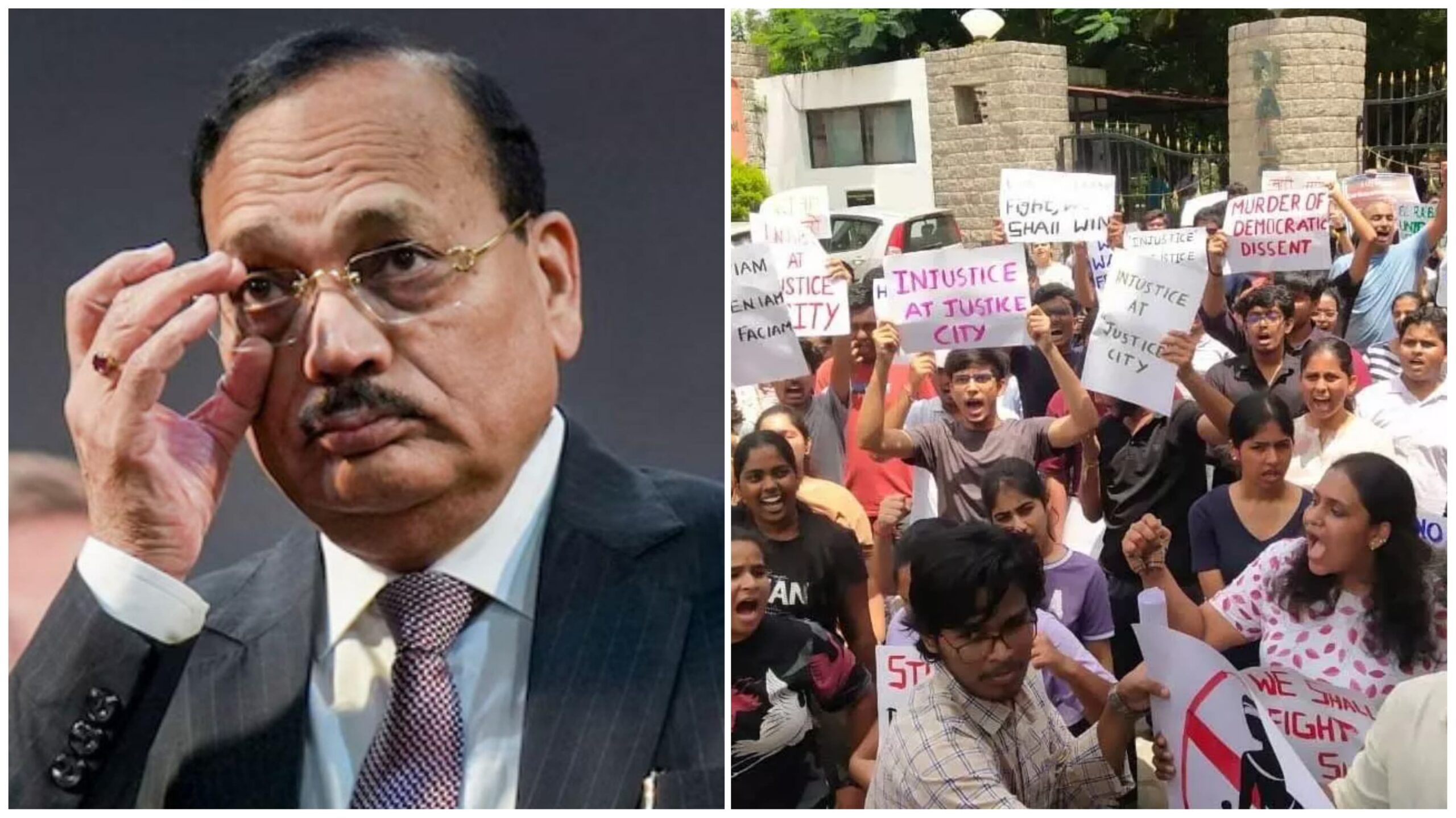
The controversy surrounding students of the National Academy of Legal Studies and Research (NALSAR) in Hyderabad has taken a dramatic turn, moving from a campus dispute over the university’s convocation to a wider debate over student expression, institutional authority and the independence of legal education.
The dispute began after a section of NALSAR students objected to the invitation extended to Chief Justice of India Surya Kant as the chief guest for the university’s 2026 convocation. The students questioned the decision in light of remarks made by the CJI during proceedings concerning allegations of police excesses against student protesters.
What initially appeared to be a disagreement over a ceremonial invitation soon escalated after the Bar Council of India (BCI) intervened. The council directed State Bar Councils not to enrol NALSAR’s 2026 graduating students as advocates until further orders. The decision immediately generated concern because the proposed action potentially affected an entire graduating batch over a dispute involving student protest.
The situation changed rapidly over the following days. The BCI withdrew the enrolment restriction, while maintaining that an inquiry into the circumstances surrounding the student campaign would continue. The issue then reached the Supreme Court, where Chief Justice Surya Kant strongly questioned the BCI’s intervention and stressed that students have a right to express their views through lawful and peaceful protest.
The BCI subsequently moved towards reconciliation. Chairman Manan Kumar Mishra issued an apology to law students, expressing regret if his words, letters or any developments connected with the controversy had caused hurt or distress.
How the NALSAR controversy began
The immediate trigger for the dispute was the proposed participation of CJI Surya Kant as chief guest at NALSAR’s 2026 convocation.
A group of students opposed the invitation and communicated their concerns to university authorities. Their objections were linked to the CJI’s observations during proceedings concerning alleged police action against student protesters. The students argued that the issue was connected to broader principles of constitutional rights, access to justice and the ability of authorities to respond meaningfully to grievances.
The protest was therefore not presented simply as opposition to an individual attending a university event. The students framed their concerns around the values they believed a leading law university should uphold.
The disagreement, however, soon attracted the attention of the BCI, the statutory body responsible for regulating legal education and professional standards in the country.
BCI’s enrolment decision sparks backlash
The BCI’s intervention significantly raised the stakes.
The council initially directed State Bar Councils not to enrol members of NALSAR’s 2026 graduating batch as advocates until further orders. Such enrolment is an important step for law graduates seeking to enter professional legal practice.
The decision meant that an entire graduating cohort faced uncertainty because of a controversy surrounding student opposition to the convocation invitation.
The BCI also sought an authenticated report from NALSAR concerning those who had allegedly initiated, organised, coordinated or mobilised the campaign opposing the CJI’s participation.
The action generated widespread criticism, with questions being raised over whether students could face professional consequences for participating in a peaceful campus protest.
The council subsequently reversed the enrolment freeze. Although the restriction was withdrawn, the inquiry into the circumstances surrounding the controversy initially remained in place.
The matter was later taken further when the BCI chairman announced that proceedings against the entire 2026 batch were being closed.
Supreme Court steps in
The controversy reached the Supreme Court amid growing concern over the BCI’s actions.
During the proceedings, CJI Surya Kant took a strong position on the rights of students to protest. He questioned why the BCI had intervened in a dispute that, in his view, concerned a direct interaction between the judiciary and students.
The Supreme Court made it clear that students could not be prevented from raising their voices merely because their views were unpopular or potentially critical of a constitutional authority.
The court emphasised the distinction between unlawful conduct and peaceful dissent. While unlawful activities can attract appropriate legal action, students exercising their right to protest peacefully cannot automatically be subjected to punitive measures.
The bench also restrained the BCI and State Bar Councils from pursuing punitive or criminal action against students and faculty members of national law universities and other universities in connection with the controversy.
The proceedings therefore transformed the NALSAR dispute into a larger constitutional discussion about freedom of expression and the role of student dissent in a democratic society.
CJI stresses importance of dissent
During the hearing, the CJI highlighted his own experience of student activism and underscored that students must have space to express disagreement.
The central message from the court was that peaceful protest is not, by itself, misconduct.
The court’s intervention also raised questions about the manner in which the BCI had taken its initial decision. The bench sought clarification on whether the BCI’s council had formally convened to take the decision concerning the NALSAR graduates and asked the organisation to explain the process it had followed.
The judicial intervention effectively shifted the focus from the original disagreement over the convocation to the much broader issue of whether a regulatory body can impose professional consequences on students because of their participation in a peaceful protest.
BCI chairman apologises
Following the Supreme Court’s intervention, BCI chairman Manan Kumar Mishra issued an Independence Day letter addressed to law students.
Mishra acknowledged that the events of the preceding days had caused concern and anguish among sections of the student community. He said that whenever students feel hurt or aggrieved, their concerns should be heard with patience, sensitivity and respect.
He expressed regret and apologised if any of his words, letters or other developments associated with the controversy had hurt the feelings of law students.
Mishra also sought to make clear that an apology should not be viewed as an issue of prestige or authority. Instead, he described an expression of regret as an acknowledgement that the concerns and feelings of students matter.
The statement represented a significant shift in tone from the BCI’s initial intervention.
Students must be free to form their own views
In his letter, Mishra emphasised that law students are among the country’s most informed young citizens because their education exposes them to the Constitution, the rule of law, fairness and the importance of considering different sides of an issue.
He said students do not require others to make decisions on their behalf.
Mishra further acknowledged that peaceful disagreement, questioning and protest are important components of a constitutional democracy. He maintained that students should remain free to express their views.
At the same time, he suggested that holding a particular position and subsequently reconsidering it after receiving additional information are not contradictory actions.
According to this approach, students can raise genuine concerns while remaining open to clarification and further facts.
Decision on attending convocation left to students
The BCI chairman also addressed the question of whether students should attend the NALSAR convocation.
He said the decision must ultimately belong to the students themselves. No student, he indicated, should be forced either to attend the ceremony or to stay away from it.
The appeal was for students to consider the entire issue independently and make their own decision rather than being influenced by external pressure.
This marked another attempt to move the dispute away from confrontation and towards dialogue.
Larger questions about academic freedom
The NALSAR controversy has raised questions extending beyond the immediate dispute.
At its core is the question of how universities, professional regulators and constitutional institutions should respond when students publicly disagree with decisions involving senior public officials.
Law universities occupy a particularly important position in this debate because their students are being trained in constitutional principles, legal rights and democratic institutions. The ability to question authority is therefore closely connected to the academic environment in which future lawyers are educated.
The episode also highlighted the potential consequences when regulatory powers intersect with student activism. Any action affecting professional enrolment can have long-term implications for graduates beginning their legal careers.
The initial decision to restrict enrolment therefore attracted particular attention because it involved an entire graduating batch rather than being limited to individuals accused of specific unlawful conduct.
A controversy that moved beyond NALSAR
What began as a disagreement over a convocation invitation ultimately involved one of India’s most important legal regulatory bodies and the country’s highest court.
The sequence of events — student opposition, BCI intervention, withdrawal of the enrolment restriction, Supreme Court criticism and the BCI chairman’s subsequent apology — has made the episode a significant discussion point within India’s legal education community.
The controversy has also underlined the importance of maintaining institutional boundaries. Universities must be able to provide space for debate, regulatory bodies must exercise their powers within their legal mandate, and students must be able to raise concerns without fear of disproportionate consequences when their conduct remains lawful.
For now, the immediate threat to the NALSAR 2026 graduating batch’s professional enrolment has been removed, and proceedings against the batch have been closed. The broader questions raised by the episode, however, are likely to continue to influence discussions about student rights, academic freedom and the relationship between legal institutions and law schools.
The latest developments suggest an effort by the institutions involved to de-escalate the confrontation. The BCI’s apology and the Supreme Court’s defence of peaceful student protest have shifted the conversation towards dialogue, independent decision-making and mutual respect.
The NALSAR episode ultimately serves as a reminder that disagreement within educational institutions need not become institutional conflict. In a constitutional democracy, the ability to question authority, express dissent and reconsider one’s position after hearing another side is itself an important part of legal and civic education.