
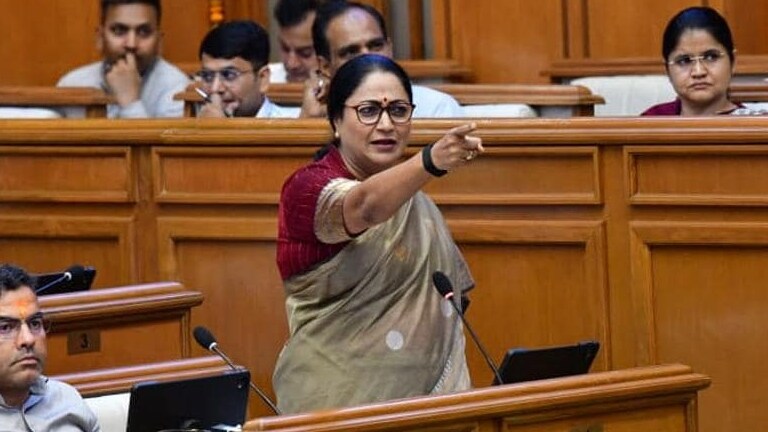
Delhi Chief Minister Rekha Gupta has defended the eligibility conditions of the Delhi Lakshmi Yojana amid criticism from the opposition, saying women should not be viewed merely as a means of increasing family size. She maintained that women’s health, dignity and financial independence remain central to the government’s welfare policies.
The remarks came during the ongoing Monsoon Session of the Delhi Assembly, where the government faced questions over restrictions attached to the scheme. The Aam Aadmi Party (AAP) has criticised several eligibility conditions, particularly the exclusion of women from families with more than three children and the requirement to demonstrate long-term residence in Delhi.
Gupta said decisions related to family planning should remain a matter of personal choice. She argued that women should not be expected to repeatedly undergo pregnancies because families want a male child, stressing that such practices can have serious consequences for women’s health.
What is the Delhi Lakshmi Yojana?
The Delhi Lakshmi Yojana is one of the major welfare initiatives announced by the BJP-led Delhi government. Under the programme, eligible women between the ages of 21 and 60 are entitled to financial assistance of ₹2,500 every month.
The government has earmarked ₹5,100 crore for the scheme and expects it to benefit approximately 17 lakh women across the national capital.
The monthly assistance is divided into two components. According to the government, ₹1,000 will be provided through a digital wallet, while another ₹1,500 will be placed into a fixed deposit or recurring deposit arrangement.
The savings component is intended to encourage women to build a financial reserve over time. The government has said that the accumulated amount could reach around ₹60,000, including interest, after three years.
The scheme’s registration portal was launched on August 1. By the time Gupta addressed the Assembly, more than 5.9 lakh registrations had reportedly been completed.
Opposition questions eligibility conditions
The AAP has raised concerns over several conditions that determine who can receive the financial assistance.
One of the most contentious provisions concerns women who have more than three children. Such women are excluded from the scheme. Opposition leaders have argued that this condition could prevent a section of economically vulnerable women from receiving government support.
Former Delhi minister and AAP leader Gopal Rai also questioned the requirement for applicants to establish that they have been residents of Delhi for at least 10 years.
Rai further criticised the registration process, describing it as complicated and time-consuming. The opposition has argued that restrictive eligibility rules could reduce the number of women who ultimately benefit from the scheme.
Gupta defends family-planning condition
Responding to the criticism, Gupta said the government’s approach was not intended to control women’s reproductive decisions. Instead, she framed the policy around women’s health and financial security.
The chief minister said family planning is an individual decision and does not require permission from the government or any other authority.
She also raised concerns about families continuing to have children in the hope of having a son. According to Gupta, women should not be forced to bear the physical and health consequences of repeated pregnancies because of social or family expectations surrounding male children.
Her argument placed women’s health at the centre of the debate over the scheme’s eligibility criteria.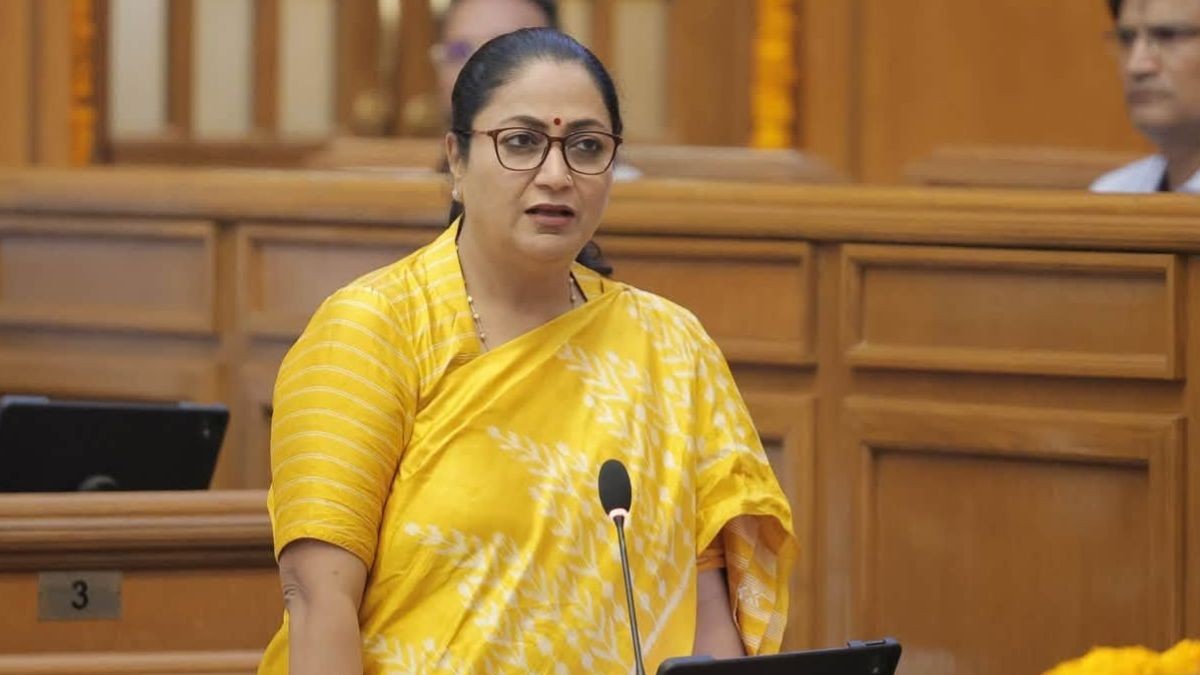
Government and opposition clash over welfare policies
The debate over the Lakshmi Yojana has become part of a wider political confrontation in the Delhi Assembly.
Gupta argued that the scale of the initiative demonstrated the government’s commitment to women’s financial empowerment. She also criticised previous Congress and AAP governments, claiming that they had failed to implement a welfare programme of similar scale.
The opposition, meanwhile, has focused on the scheme’s restrictions and questioned whether the conditions could prevent many women from accessing the promised assistance.
The disagreement highlights a broader debate over how welfare programmes should balance financial assistance with eligibility requirements designed by governments.
Restrictions extend beyond family size
The three-child condition is not the only restriction under the scheme.
Women who already receive financial assistance or pensions through another government programme are excluded. Income-tax payers, GST return filers and government employees are also outside the scheme’s eligibility framework.
The scheme additionally excludes women whose families include members employed by the central or state governments.
Other conditions relate to household assets and consumption. Families that own a four-wheeler are excluded, while households whose annual electricity consumption exceeds 2,400 units also do not qualify.
Women with a criminal record are similarly excluded.
These conditions are intended to ensure that government assistance is directed towards women considered financially vulnerable, although opposition parties have questioned whether some of the restrictions could unnecessarily leave out potential beneficiaries.
Debate over Delhi residents and welfare benefits
Gupta also defended the government’s position on welfare benefits available to women from neighbouring states.
She referred to the Saheli Pink Smart Card programme, which provides free travel on Delhi Transport Corporation and cluster buses to eligible women and transgender residents of Delhi.
Gupta argued that public funds collected through taxpayers should primarily be used for residents of the national capital.
The issue has political significance because Delhi attracts a large population from neighbouring states, particularly Uttar Pradesh and Bihar. The AAP has accused the government of creating policies that could disadvantage women who have migrated to Delhi from these states.
The disagreement reflects the larger political debate over who should be prioritised when Delhi government welfare schemes are funded through the city’s public resources.
Bicycle scheme for girls also faces political criticism
The chief minister also defended the government’s proposed bicycle scheme for schoolgirls.
Opposition criticism suggested that the initiative could have political motivations. Gupta rejected that argument, saying the programme was designed to help girls travel to school more easily and continue their education.
She said improving transportation access could help reduce school dropout rates, particularly among girls who face difficulties travelling to educational institutions.
The government has presented the initiative as part of a broader effort to improve educational access and support girls from government schools.
New legislation on time-bound government services
The Assembly session also saw the introduction of a separate piece of legislation aimed at improving the delivery of government services.
Delhi Information Technology Minister Pankaj Kumar Singh introduced the Delhi (Right of Citizens to Time Bound and Ease of Delivery of Services) Bill, 2026.
The proposed legislation seeks to replace the existing 2011 law and provide citizens with a legal right to receive notified government services within specified deadlines.
Officials could face financial penalties for unjustified delays or wrongful rejection of applications. The proposed penalty is ₹250 per day, subject to a maximum of ₹5,000.
The measure is aimed at making government departments more accountable and ensuring that citizens do not face unnecessary delays while accessing public services.
Meanwhile, the Delhi Private Universities Bill has been kept on hold and is unlikely to be introduced during the current Assembly session.
BJP-AAP confrontation intensifies
The Assembly proceedings also witnessed a sharp political confrontation between the BJP and AAP over the conviction of former AAP councillor Tahir Hussain in the murder of Intelligence Bureau officer Ankit Sharma.
The issue triggered heated exchanges between members of the two parties, with both sides accusing each other in connection with the political and communal tensions surrounding the 2020 northeast Delhi riots.
The dispute added another layer to an already contentious Assembly session, where welfare schemes, women’s issues, governance reforms and law-and-order matters have become subjects of intense political debate.
The controversy surrounding the Lakshmi Yojana is therefore part of a wider discussion about the Delhi government’s approach to welfare delivery, eligibility rules and women’s empowerment.
For the government, the scheme represents a major financial support programme aimed at strengthening women’s economic security. For the opposition, the eligibility restrictions raise questions about who will actually be able to access that support.
As registrations continue, the implementation of the scheme and the number of women who ultimately qualify will likely determine how effectively the programme delivers on its stated objective of improving women’s financial independence.