
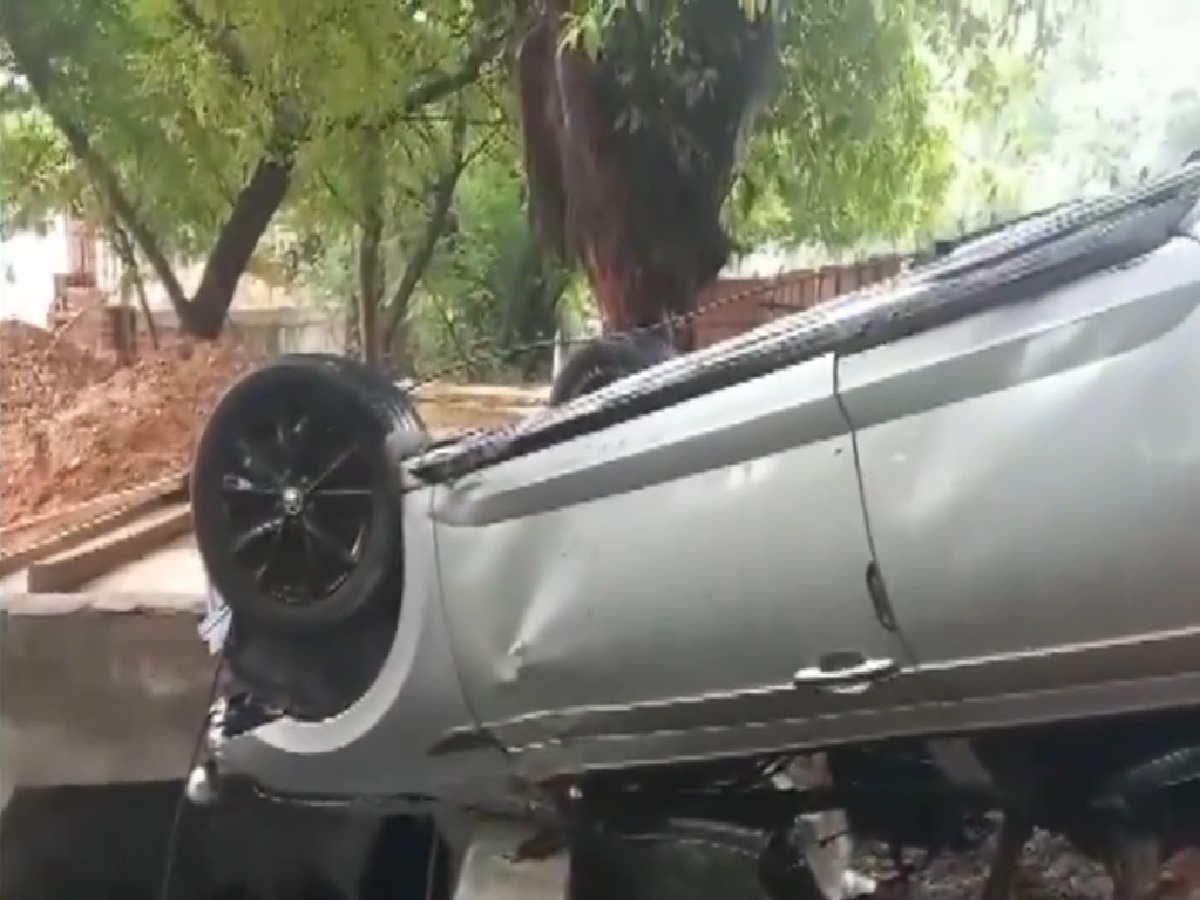
A 20-year-old man, identified as Yashvendra, died after the car he was driving plunged into a water-filled drain in Delhi’s Vasant Kunj area, triggering concerns over alleged safety deficiencies at the accident site. Yashvendra, the son of an Indian Army officer, was pursuing higher studies in the United States and had reportedly returned to India when the fatal incident occurred.
The accident took place in the Nangal Dewat area near a traffic signal. According to preliminary information, the vehicle, which belonged to a female friend travelling with Yashvendra, reportedly lost control while negotiating a sharp turn before falling into the drain. The impact left Yashvendra critically injured, while his companion survived but sustained injuries.
The incident has since drawn attention to the condition of the stretch, particularly the alleged absence of a protective safety barrier or wall along the water-filled drain. Local concerns have also been raised about the presence of stagnant or discharged water near the road and the potential risks faced by motorists travelling through the area.
Car Plunges Into Drain Near Traffic Signal
According to the available details, Yashvendra and his female friend were travelling in the area when the vehicle reportedly veered off the road at a sharp turn. The car then plunged into a deep, water-filled drain close to a traffic signal.
The circumstances of the crash meant that rescuers faced considerable difficulty in reaching the vehicle. Yashvendra was reportedly trapped in the driver’s seat and was unable to get out of the car. Although efforts were made to reach him, the depth of the water made the rescue operation challenging.
Yashvendra was eventually taken for medical treatment but succumbed to his injuries at a nearby hospital. His death has left his family and friends devastated, while the incident has also prompted renewed questions about whether adequate safety arrangements were in place at the location.
The female passenger travelling with him managed to survive the crash but was injured. Police are examining the circumstances surrounding the accident, including the sequence of events leading to the vehicle losing control and plunging into the drain.
Eyewitness Raises Questions Over Safety Arrangements
An eyewitness who reportedly reached the area after the accident described the efforts made to seek immediate help. According to the account, the female passenger was seen calling for assistance after the crash, while police personnel were also present at the scene.
The eyewitness said efforts were made along with the police to reach the person trapped inside the vehicle. However, the depth of the water-filled drain reportedly prevented rescuers from immediately reaching Yashvendra.
The incident has raised concerns about the safety of roads adjoining open drains and water-filled stretches, particularly where there are no adequate protective barriers to prevent vehicles from leaving the carriageway.
Questions have also been raised over whether a safety wall, railing or other protective infrastructure could have reduced the severity of the accident or made the rescue operation easier.
The eyewitness reportedly called for authorities to take steps to secure the area, including covering the drain or installing safety walls. Such measures, according to the concerns raised, could help prevent similar accidents in the future. 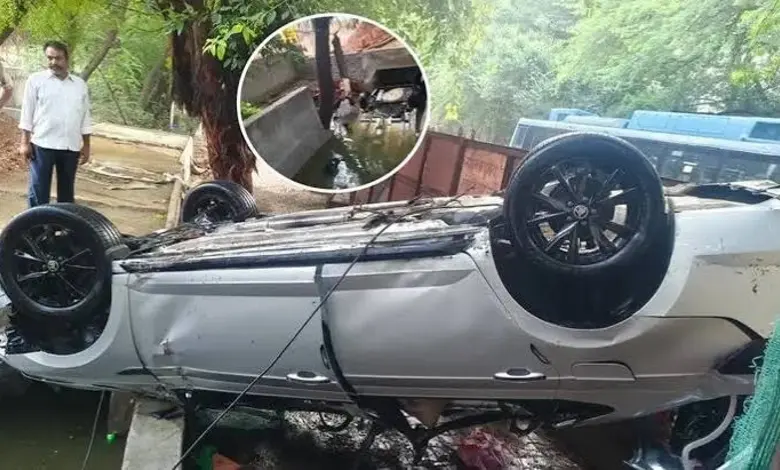
Allegations Over Water Accumulation
Apart from concerns about the missing protective barrier, allegations have also emerged regarding the source of the water accumulating in the drain.
An eyewitness claimed that the water was not simply rainwater and alleged that sewage water from the nearby Aerocity area was being discharged into the location. The claim has not been independently established, but it has added another dimension to the questions surrounding the accident site.
The witness also alleged that the water had contributed to making the road slippery, potentially increasing the danger for motorists. However, the exact cause of the crash, including whether road conditions played a direct role, remains subject to investigation.
Authorities would need to establish the precise circumstances of the incident, including the condition of the road, the visibility and lighting at the location, the speed and movement of the vehicle, and whether any infrastructure-related deficiencies contributed to the accident.
Yashvendra Was Studying in the US
Yashvendra, who was 20 years old, had been pursuing higher education in the United States. Police reportedly said that he and the woman travelling with him were students at the same educational institution and had become friends while studying there.
According to reports, the two had stayed at a friend’s residence the night before the accident. They were reportedly travelling towards the woman’s residence on Friday morning when the crash occurred.
The accident has therefore drawn attention not only because of the circumstances of the crash but also because of the loss of a young student who was pursuing his education abroad.
The death of a young person in a road accident has once again highlighted the risks posed by inadequate safety infrastructure, particularly around open drains, construction zones, waterlogged areas and unprotected roadside stretches.
Safety Concerns Beyond a Single Accident
The incident has revived a wider debate over road safety in Delhi and the need for stronger safeguards around potentially dangerous roadside infrastructure.
Open drains and deep water-filled areas located close to roads can pose a serious risk to motorists, especially when protective walls, crash barriers or visible warning signs are absent. The danger can become even greater during periods of poor visibility, heavy rain or fog, when drivers may have limited time to react to sudden turns or hazards.
The concerns raised after the Vasant Kunj accident are particularly significant because the vehicle reportedly went off the road near a sharp turn. In such locations, safety barriers can serve as an important line of protection by preventing vehicles from directly entering hazardous areas.
The accident also underscores the importance of maintaining roadside drainage systems and ensuring that water does not accumulate in locations where it can create additional risks for commuters.
Investigation Into the Crash Continues
While allegations of negligence and inadequate safety arrangements have surfaced, the exact cause of the accident will have to be determined through an official investigation.
Investigators are expected to examine the circumstances in which the vehicle lost control, the condition of the road and drain, and other factors that may have contributed to the crash. The role of road design, visibility, water accumulation and the absence or presence of safety infrastructure may also come under scrutiny.
For Yashvendra’s family, however, the investigation comes after an irreparable loss. His death has highlighted how a single road accident can raise broader questions about public infrastructure and safety standards.
The tragedy has also renewed calls for authorities to identify vulnerable stretches across the capital and install appropriate protective measures before more lives are put at risk. Safety walls, crash barriers, proper drainage, warning signs and regular maintenance can play a crucial role in preventing vehicles from entering hazardous roadside areas.
As the circumstances surrounding the accident are examined, the incident serves as another reminder that road safety extends beyond driver behaviour. The condition and design of public infrastructure, along with timely maintenance and effective safety measures, are equally important in protecting commuters and reducing the impact of road accidents.