
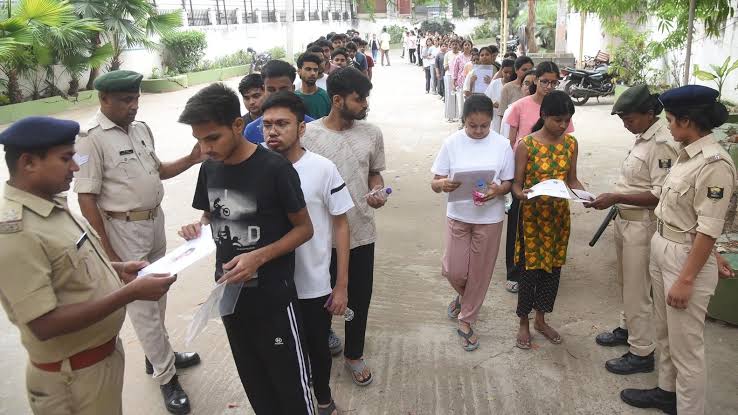
Tamilaga Vettri Kazhagam (TVK), the political party led by actor-turned-politician Vijay, has reiterated its demand for the complete scrapping of the National Eligibility cum Entrance Test (NEET), urging the Tamil Nadu government to maintain a firm and uncompromising position on the medical entrance examination.
The party’s latest stand comes amid the continuing political and public debate in Tamil Nadu over the future of NEET and its impact on students seeking admission to medical colleges. The issue has remained a major point of discussion in the state, with several political parties and student groups opposing the examination system and calling for greater autonomy for Tamil Nadu in deciding the method of medical admissions.
TVK has maintained that the NEET system places an additional burden on students, particularly those from economically weaker sections and rural areas. The party has argued that the examination creates disparities between students based on access to expensive coaching facilities and other academic resources.
According to the party’s position, students who attend private coaching institutes may have an advantage over those who rely primarily on the state school education system. TVK has therefore called for a system that provides equal opportunities to students regardless of their financial background or place of residence.
The party has also urged the Tamil Nadu government not to dilute its opposition to NEET. It has called for a consistent and firm approach towards securing an exemption for the state from the examination and ultimately seeking its complete abolition.
The debate over NEET has been particularly intense in Tamil Nadu, where the examination has become a politically sensitive issue. Critics of the test have repeatedly questioned whether a single national-level examination is an appropriate measure for assessing students who come from different educational and socio-economic backgrounds.
Opponents of NEET in the state have also highlighted concerns about the pressure faced by medical aspirants. The competitive nature of the examination, combined with the importance attached to securing high scores, has raised concerns among parents, educators and political leaders about the mental stress experienced by students.
TVK’s position reflects its broader political emphasis on issues affecting young people and education. The party has increasingly focused on student welfare and access to educational opportunities as part of its emerging political agenda.
The demand for the removal of NEET is also linked to a larger discussion about the relationship between state governments and the Centre in matters concerning education and medical admissions. While supporters of NEET argue that a common entrance examination ensures uniformity and transparency in the admission process, critics maintain that states should have greater flexibility to design admission systems suited to their own educational circumstances.
Supporters of the examination have also argued that NEET has helped establish a common benchmark for medical admissions across the country and has reduced the scope for arbitrary admission practices. However, its opponents contend that the examination has increased dependence on coaching centres and may disadvantage students who cannot afford additional preparation outside the formal school system.
Tamil Nadu has been at the forefront of opposition to NEET, with the state government repeatedly seeking relief from the examination. The issue has remained a significant political subject, with parties across the political spectrum expressing varying degrees of opposition to the current system.
Against this backdrop, TVK’s renewed call for the complete scrapping of NEET is expected to keep the issue at the centre of political and public discussions in the state. The party has stressed that its position is not limited to seeking temporary relief but is aimed at establishing a broader policy framework that it believes would provide fairer access to medical education.
The demand also comes at a time when questions surrounding medical education, competitive examinations and student welfare continue to receive considerable attention across India. The discussion over NEET has increasingly moved beyond the examination itself, encompassing issues such as educational inequality, affordability of coaching, rural access to quality education and the pressure faced by young students.
For Tamil Nadu, the issue carries an additional political dimension because of the state’s longstanding emphasis on social justice and equitable access to education. The opposition to NEET has often been framed within this larger policy debate, with critics arguing that admission procedures should ensure that students from diverse social and economic backgrounds are not placed at a disadvantage.
TVK’s latest statement therefore places the party firmly within the ongoing debate over medical admissions in Tamil Nadu. By demanding a complete withdrawal of NEET and calling for an uncompromising position from the state government, the party has indicated that the examination will remain an important issue in its political messaging.
The future of the NEET debate in Tamil Nadu is likely to depend on developments involving the state government, the Centre and the legal and constitutional framework governing medical admissions. Until a final resolution is reached, the examination is expected to remain a major issue in the state’s education and political discourse.