
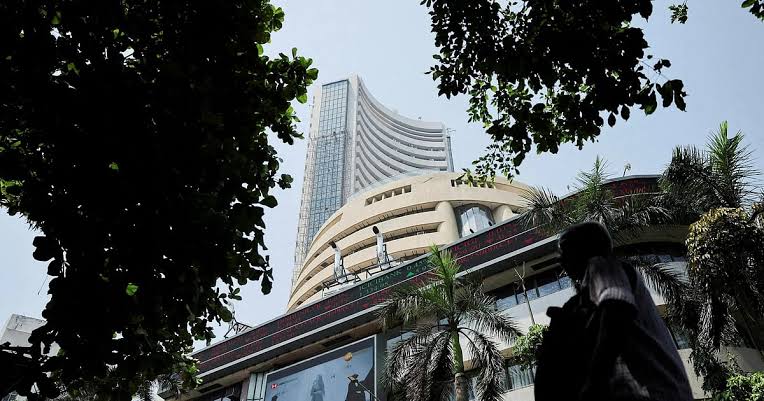
Indian equity markets witnessed a sharp decline as renewed geopolitical tensions in West Asia rattled investors across global financial markets. Mounting concerns over the widening regional conflict, rising crude oil prices, and uncertainty in international markets prompted investors to reduce exposure to riskier assets, leading to broad-based selling across Indian equities.
The benchmark indices closed significantly lower after a volatile trading session, reflecting growing investor anxiety over the potential economic consequences of prolonged geopolitical instability. Alongside the stock market decline, the Indian rupee also weakened against the US dollar, highlighting the broader impact of global uncertainty on domestic financial markets.
Sensex and Nifty Record Significant Losses
The BSE Sensex fell by more than 580 points during the trading session, while the NSE Nifty also ended in negative territory. Selling pressure remained widespread throughout the day, with losses extending across multiple sectors including banking, information technology, financial services, automobile, and metal stocks.
The decline followed weakness in international markets, where investors shifted toward safer investment options amid fears that escalating military tensions in West Asia could disrupt global trade and energy supplies.
Market participants noted that the sell-off reflected cautious investor sentiment rather than concerns about India’s domestic economic fundamentals.
Rupee Weakens Against the US Dollar
The Indian rupee also came under pressure as global investors sought the safety of the US dollar and other traditional safe-haven assets.
Currency markets reacted to increased demand for dollars amid concerns that higher crude oil prices could widen India’s import bill and increase inflationary pressures. Since India imports a substantial portion of its crude oil requirements, any sustained increase in global oil prices directly impacts the country’s trade balance and currency stability.
The weaker rupee further added to market concerns, especially for sectors dependent on imported raw materials. 
Rising Crude Oil Prices Add to Investor Worries
One of the primary reasons behind the market weakness was the sharp rise in global crude oil prices.
West Asia remains one of the world’s most important oil-producing regions, and any military escalation raises fears of supply disruptions. Investors are closely monitoring whether the conflict could affect major shipping routes or reduce oil exports from the region.
Higher crude prices typically create multiple challenges for the Indian economy, including:
- Increased fuel import costs
- Higher inflation risks
- Pressure on government finances
- Rising transportation and manufacturing expenses
- Potential impact on corporate profitability
These concerns collectively weighed on investor confidence throughout the trading session.
Global Markets Mirror Risk-Off Sentiment
Indian markets were not alone in experiencing losses. Equity markets across Asia and other major financial centres also traded lower as investors reacted to geopolitical uncertainty.
Financial markets generally become more volatile during periods of international conflict, with investors moving funds from equities into safer assets such as government bonds, gold, and the US dollar.
Analysts observed that uncertainty surrounding the duration and intensity of the conflict remains a key factor influencing market sentiment.
Foreign Investor Activity Under Watch
Foreign institutional investors are expected to remain cautious until there is greater clarity regarding developments in West Asia.
Periods of geopolitical uncertainty often lead global investors to reduce exposure in emerging markets, including India, resulting in temporary capital outflows. Such movements can place additional pressure on equity markets and the domestic currency.
However, domestic institutional investors have frequently helped cushion market declines during similar periods in recent years.
Sector-Wise Performance Reflects Broad Selling
The market decline was broad-based, with several major sectors ending lower.
Banking and financial stocks experienced selling pressure due to concerns over global economic uncertainty. Information technology companies also remained weak as investors reassessed growth expectations amid international market volatility.
Automobile and metal stocks declined on fears that rising commodity prices and higher energy costs could impact corporate earnings if geopolitical tensions continue.
Defensive sectors showed relatively better resilience compared with cyclical industries, although overall market sentiment remained negative.
Experts Urge Investors to Focus on Long-Term Fundamentals
Market experts believe that geopolitical developments often create short-term volatility, but long-term investment decisions should continue to be guided by economic fundamentals, corporate earnings, and domestic growth prospects.
India’s macroeconomic indicators remain relatively stable despite the current market correction. Analysts suggest that while volatility may persist in the near term, investors should avoid making impulsive decisions based solely on geopolitical headlines.
They also noted that future market direction will depend on several factors, including developments in West Asia, global crude oil prices, foreign investment flows, inflation trends, and upcoming economic data.
Outlook
Investors are expected to closely monitor geopolitical developments over the coming days as global markets assess the possibility of further escalation in West Asia.
Any signs of easing tensions could improve investor confidence and support a recovery in equities. Conversely, prolonged uncertainty or additional disruptions to energy markets may continue to exert pressure on stocks, currencies, and investor sentiment worldwide.
For now, Indian markets remain closely tied to global developments, with geopolitical risks emerging as the dominant driver of short-term market direction.