
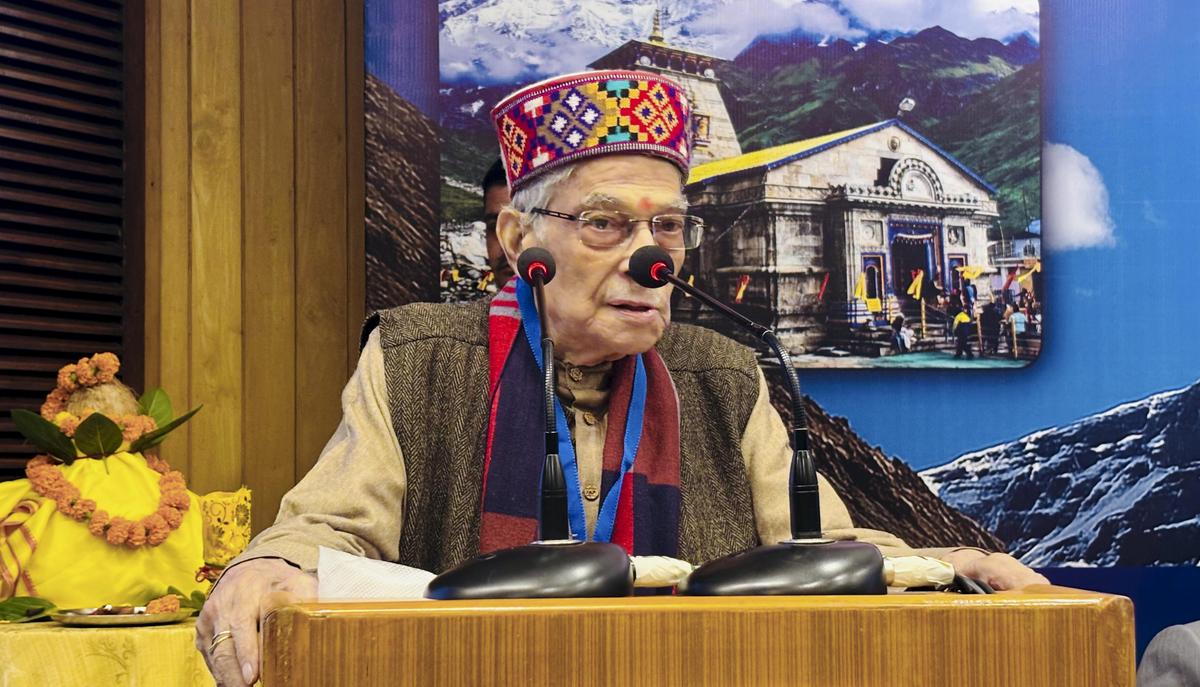
Senior Bharatiya Janata Party (BJP) leader and former Union Minister Murli Manohar Joshi has asserted that Urdu is fundamentally an Indian language, emphasizing that it should not be viewed through the prism of religion or politics. Speaking at a public event focused on language and culture, Joshi highlighted the historical evolution of Urdu in India and called for greater appreciation of the country’s rich linguistic diversity.
His remarks come amid recurring debates over language, identity, and cultural heritage in India, where discussions surrounding Hindi, Urdu, and regional languages frequently become politically charged. Joshi’s statement sought to underscore the historical and cultural roots of Urdu within the Indian subcontinent, arguing that the language belongs to the nation as much as any other Indian language.
Urdu Has Deep Indian Roots
Addressing the gathering, Joshi said Urdu emerged and flourished on Indian soil through centuries of interaction among diverse communities. He stressed that the language developed naturally through cultural exchanges and should be recognized as an inseparable part of India’s civilizational heritage.
According to Joshi, associating Urdu exclusively with a particular religion or community ignores its historical development and literary significance. He maintained that language should serve as a bridge connecting people rather than becoming a source of division.
The veteran leader noted that Urdu has contributed immensely to Indian literature, poetry, music, and intellectual discourse. Its influence extends across multiple artistic traditions, enriching India’s cultural landscape over generations.
Language Should Unite, Not Divide
Joshi emphasized that languages represent shared cultural assets rather than political identities. He argued that linguistic diversity has always been one of India’s greatest strengths and that every language spoken across the country deserves equal respect and recognition.
He urged citizens to move beyond narrow perceptions that categorize languages on communal lines. Instead, he advocated celebrating India’s multilingual character, where different languages have coexisted and influenced one another throughout history.
The former Union Minister also pointed out that preserving linguistic diversity is essential for safeguarding India’s cultural heritage. Encouraging the study and promotion of all Indian languages, he said, strengthens national unity and fosters mutual understanding among communities. 
Importance of Cultural Heritage
During his address, Joshi reflected on the broader role of language in shaping civilization. He observed that languages carry centuries of accumulated knowledge, traditions, literature, and philosophical thought, making their preservation crucial for future generations.
He said every Indian language reflects the country’s pluralistic identity and contributes to its cultural richness. Urdu, in particular, has played a significant role in shaping literary traditions through celebrated poetry, prose, and scholarly works that continue to influence readers across linguistic boundaries.
According to Joshi, efforts to protect and promote Indian languages should focus on their educational, literary, and cultural value rather than political considerations.
Call for Inclusive Approach
Joshi’s remarks also highlighted the need for an inclusive perspective toward India’s linguistic heritage. He encouraged educational institutions, scholars, and policymakers to promote greater awareness of the historical contributions made by various Indian languages.
He suggested that linguistic harmony can strengthen social cohesion and reinforce the constitutional vision of unity in diversity. Recognizing the shared heritage embodied by languages such as Urdu, he said, can help foster respect across communities and encourage cultural dialogue.
His comments resonated with the broader idea that India’s identity has been shaped by centuries of interaction among multiple languages, traditions, and civilizations.
Continuing Debate on Language and Identity
The discussion surrounding language remains an important aspect of public discourse in India, particularly in relation to education, administration, and cultural identity. Statements from political leaders on linguistic issues often attract attention because of their broader implications for national integration and social harmony.
Joshi’s observations reaffirm the view that Urdu’s origins and development are deeply connected with India’s historical and cultural evolution. By describing Urdu as an Indian language, he sought to reinforce the idea that linguistic heritage transcends religious or political boundaries.
His appeal for respecting every Indian language reflects an enduring emphasis on preserving the country’s diverse cultural traditions while promoting unity through mutual understanding and appreciation of its multilingual legacy.