
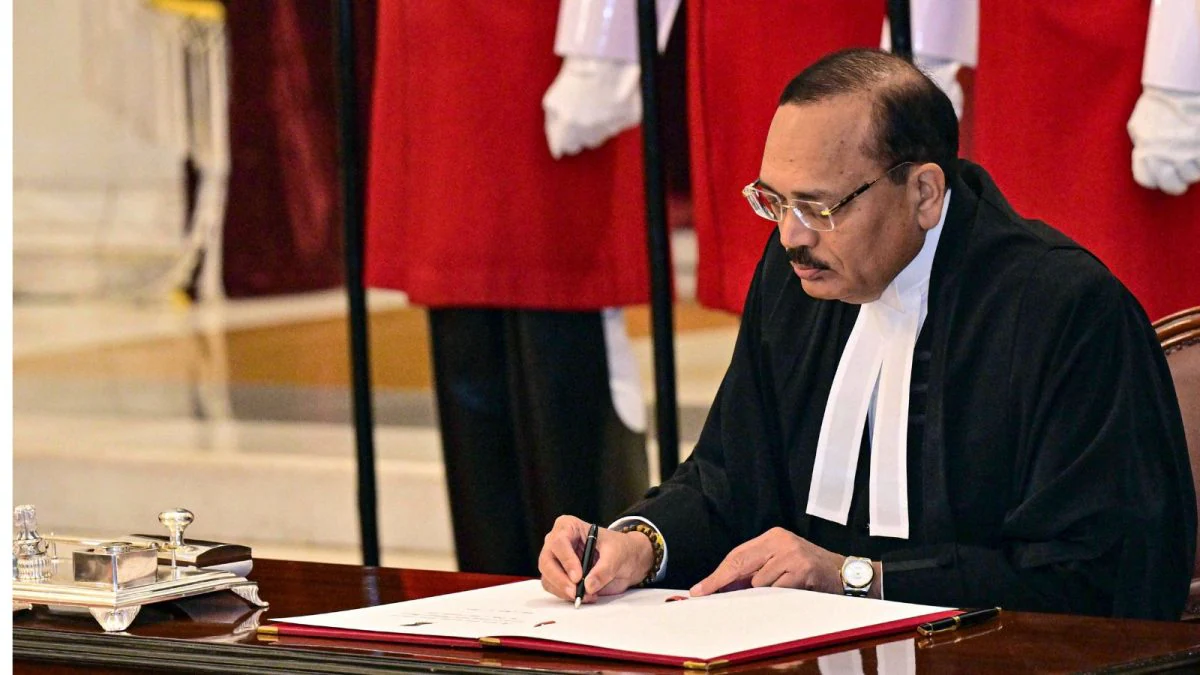
The Supreme Court on Monday addressed a politically sensitive controversy involving remarks allegedly comparing members or supporters of a political group to “cockroaches,” a statement that triggered sharp reactions and legal proceedings. During the hearing, the Chief Justice of India urged all sides not to respond emotionally to political rhetoric, observing that public discourse often becomes exaggerated in heated political environments.
The matter reached the apex court after petitions were filed over the controversial statement, which critics claimed was insulting and defamatory toward a political faction and its supporters. The case has since evolved into a wider debate about political speech, freedom of expression, and the limits of public commentary in India’s increasingly polarized political climate.
CJI Calls for Balanced Approach
While hearing the matter, the Chief Justice remarked that individuals involved in political life should avoid taking every controversial statement “so sentimentally.” The observation appeared aimed at encouraging restraint and maturity in political discourse, especially in cases where provocative language becomes part of public campaigning or ideological confrontation.
The bench emphasized that courts must carefully distinguish between genuinely unlawful speech and statements made in the course of political criticism, satire, or rhetorical expression. The court’s remarks reflected concerns over the growing tendency to criminalize political comments through multiple complaints and legal petitions.
Legal experts following the proceedings noted that the Supreme Court’s observations may influence how lower courts deal with similar complaints involving political rhetoric and allegations of offensive speech. 
Background of the Controversy
The dispute began after controversial comments allegedly referring to a political group using derogatory language sparked outrage among party supporters and leaders. Several complaints and legal actions were subsequently initiated, with complainants arguing that the statement crossed the boundaries of acceptable democratic criticism.
Supporters of the accused individual, however, argued that the comments were metaphorical and made within the context of political debate rather than as a direct attempt to incite hatred or violence. They contended that strong language, while controversial, has historically been part of political discourse across democracies.
The controversy quickly spread across political circles and social media platforms, leading to intense public reactions and renewed discussions on freedom of speech protections under the Constitution.
Debate Over Free Speech and Political Accountability
The hearing has once again brought attention to the ongoing tension between freedom of expression and accountability in political communication. In recent years, Indian courts have frequently been called upon to adjudicate cases involving allegedly offensive political remarks, satire, social media posts, and campaign speeches.
Constitutional experts argue that democratic systems must tolerate a high degree of political criticism, even when such speech is harsh or uncomfortable. At the same time, critics maintain that inflammatory or dehumanizing language can contribute to social hostility and should not be normalized in public discourse.
The Supreme Court’s comments during the hearing appeared to underline the importance of preserving democratic tolerance while discouraging excessive litigation over every political statement. 
Wider Political Implications
The case has also acquired political significance because it touches on broader concerns regarding shrinking tolerance in public debate and the increasing use of legal mechanisms against political opponents. Analysts believe the outcome of the matter could shape future legal standards relating to political speech and defamation claims.
Observers note that courts across India are witnessing a rise in petitions linked to speeches, online commentary, and public statements made by politicians, activists, and influencers. Many such cases involve accusations of hurting sentiments, promoting enmity, or insulting political communities.
The Supreme Court’s approach in this matter may therefore serve as an important judicial signal regarding how democratic institutions balance free expression with responsible speech.
Judiciary’s Repeated Stress on Democratic Tolerance
The judiciary has, on multiple occasions, highlighted the need for public figures and political participants to develop resilience toward criticism and provocative language. Courts have repeatedly observed that democracy thrives on open disagreement, criticism, and robust exchange of ideas.
At the same time, judges have also cautioned against speech that could incite violence, communal hatred, or direct threats to public order. The challenge before courts often lies in determining where political rhetoric ends and unlawful speech begins.
As the matter proceeds, the Supreme Court is expected to further examine whether the disputed remarks warrant criminal proceedings or fall within the broader protections of political expression under constitutional law.
The controversy continues to generate political reactions nationwide, with leaders from different parties interpreting the court’s observations according to their own ideological positions.