
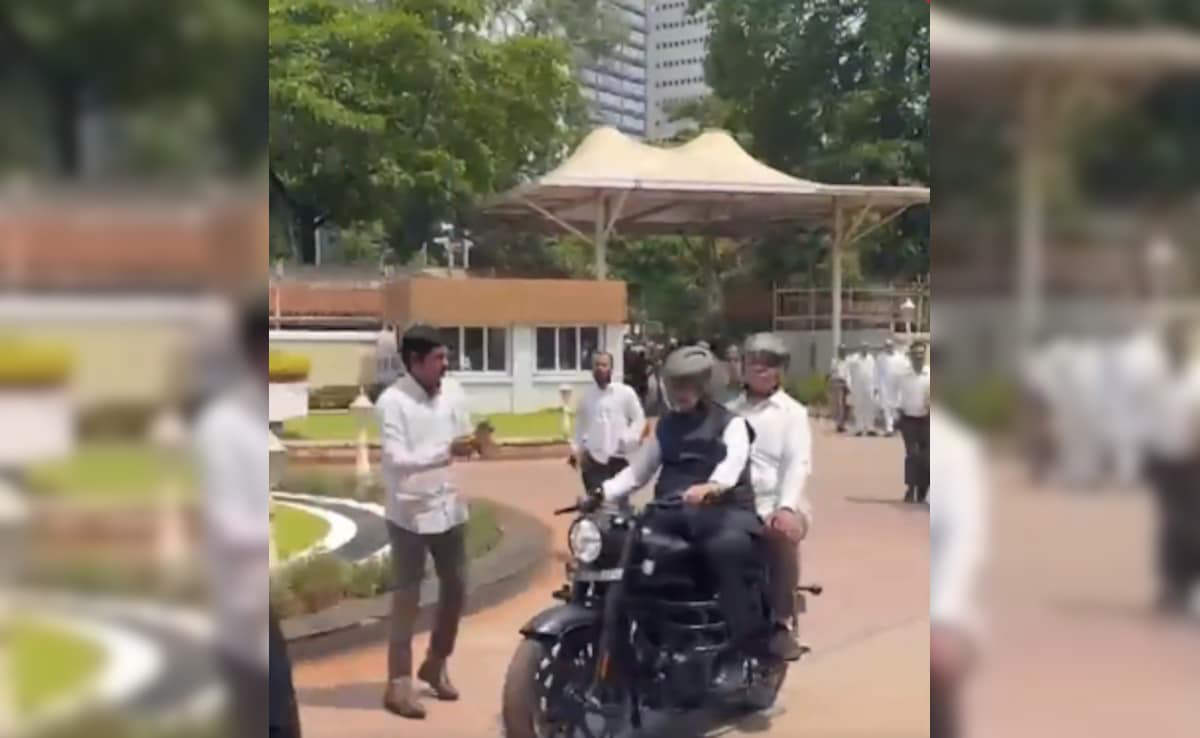
Maharashtra’s political leadership put on a public display of austerity and fuel conservation as Chief Minister Devendra Fadnavis arrived at Vidhan Bhavan on a Royal Enfield Bullet motorcycle, while Deputy Chief Minister Eknath Shinde chose an electric vehicle for official travel. Several ministers and government officials also opted to walk to government meetings, reflecting a broader effort to align with Prime Minister Narendra Modi’s recent call for austerity and reduced fuel consumption amid global uncertainty and rising energy concerns.
The symbolic shift in transportation methods came shortly after the Centre urged governments and public representatives to adopt practical energy-saving measures. The appeal gained urgency against the backdrop of instability in West Asia and concerns surrounding global fuel prices and supply chains. Maharashtra quickly responded by introducing a detailed Standard Operating Procedure (SOP) aimed at reducing fuel use and government expenditure.
In one of the most visible gestures of the campaign, Fadnavis travelled from his official residence to the state legislature on a motorcycle instead of using his usual official convoy. Accompanied by minister Ashish Shelar, the Chief Minister’s ride attracted widespread public and political attention. The reduced convoy and unconventional mode of transport were presented as an attempt to demonstrate that public representatives should lead by example during periods of economic and geopolitical uncertainty.
Deputy Chief Minister Shinde adopted a different approach by travelling in an electric vehicle, reinforcing the state government’s emphasis on cleaner and more sustainable transportation. Other ministers reportedly chose to walk to the cabinet meeting venue, adding to the visual impact of the austerity campaign’s first day. 
The Maharashtra government’s austerity framework goes beyond symbolic appearances. According to the newly introduced SOP, ministers and officials have been instructed to reduce unnecessary travel, avoid foreign visits, and prefer virtual meetings wherever possible. Government departments have also been asked to minimise vehicle usage, encourage carpooling, and make greater use of public transportation systems including metro rail, local trains, and state-run buses.
Another major aspect of the initiative involves a significant reduction in official convoys. Reports indicate that ministerial convoys in Maharashtra are being cut by nearly half as part of the fuel-saving exercise. The administration has additionally advised officials to limit the use of government helicopters and aircraft, recommending commercial travel unless special circumstances require otherwise.
The campaign also places strong emphasis on electric mobility. Government departments have been encouraged to increase EV adoption while simultaneously expanding charging infrastructure across the state. Officials have been directed to accelerate the installation of charging stations and reduce operational costs associated with electric vehicles to encourage broader acceptance among public employees and citizens alike.
Despite the government’s messaging, opposition parties questioned whether the gestures represented genuine long-term policy changes or short-lived political optics. Critics argued that symbolic acts alone would not significantly reduce fuel consumption unless backed by consistent administrative reforms and sustained implementation over time. Some opposition leaders also mocked the choice of a heavyweight motorcycle for a fuel-saving campaign, suggesting that the symbolism overshadowed practical efficiency concerns.
Political observers noted that the Maharashtra government’s response reflects a wider national trend of leaders publicly aligning themselves with the Prime Minister’s appeal for restraint and resource conservation. Similar austerity-related actions have been reported from multiple states, where ministers and officials are being encouraged to reduce expenses and demonstrate visible commitment to energy conservation measures.
The developments have sparked considerable public discussion, especially on social media, where images and videos of ministers arriving on motorcycles, electric vehicles, and on foot quickly went viral. Supporters praised the effort as a meaningful attempt to promote responsible governance and environmental awareness, while critics questioned whether the measures would continue beyond the immediate political spotlight.
As fuel prices, geopolitical tensions, and economic concerns continue to influence policy discussions, Maharashtra’s austerity drive may serve as an early indicator of how state governments across India could increasingly incorporate cost-cutting and energy-saving practices into public administration.