
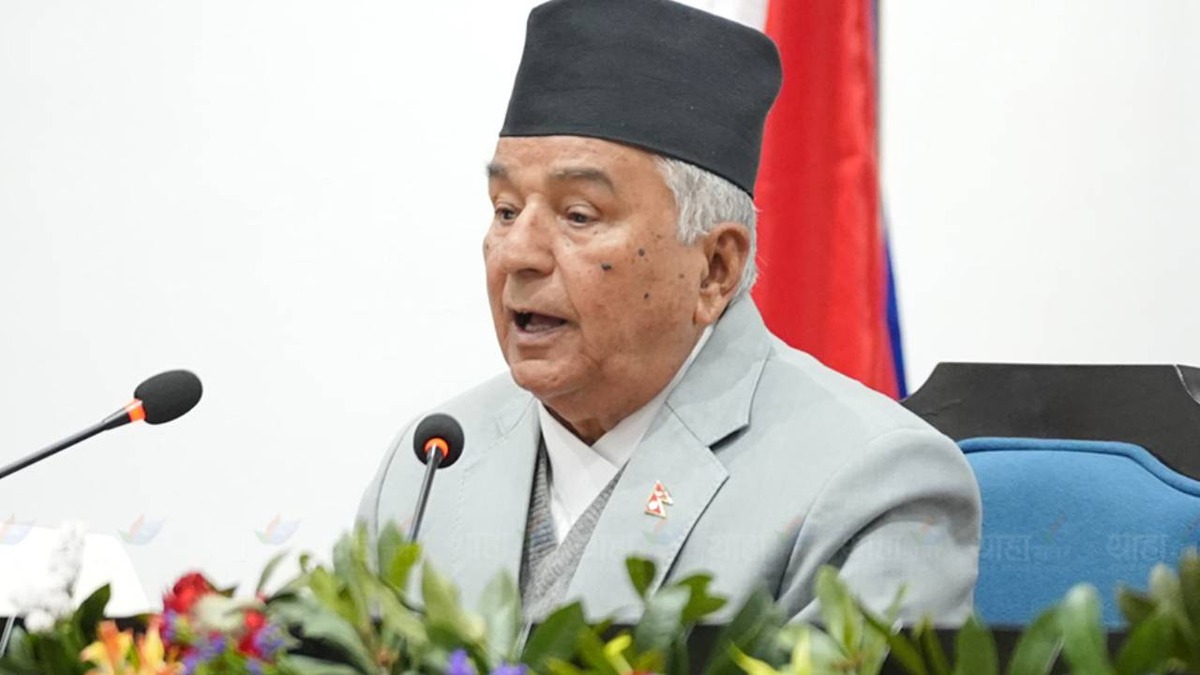
In a significant political development, Nepal’s President Ramchandra Paudel has formally promulgated an ordinance related to the Constitutional Council, ending days of institutional back-and-forth between the presidency and the government. The move comes after the Cabinet resent the proposal without any revisions, despite earlier objections raised by the head of state.
The ordinance, titled the Constitutional Council (Functions, Duties, Powers and Procedures) (First Amendment), was issued under constitutional provisions that allow the executive to recommend laws when Parliament is not in session.
The ordinance had initially been sent to the President for approval but was returned for reconsideration, with concerns raised over its provisions.
President Paudel’s reservations centered on governance and constitutional interpretation, particularly regarding how decisions within the Constitutional Council would be made. The government, however, chose not to amend the proposal and instead resent it in its original form following a Cabinet decision.
Under constitutional practice, once the executive resubmits an ordinance, the President is generally expected to act on it. Consequently, the ordinance was authenticated soon after it was returned to the President’s Office for a second time.
The ordinance introduces changes to the functioning of the Constitutional Council — a crucial constitutional body responsible for recommending appointments to key state positions. These include:
Chief Justice and Supreme Court judges
Heads and members of constitutional commissions
Ambassadors and other senior officials
One of the most debated provisions relates to decision-making within the council. The revised framework allows meetings to proceed with a smaller number of members and enables decisions to be taken by a reduced majority.
Critics argue that such provisions could weaken consensus-based decision-making and alter the balance of power within the council.
The ordinance has sparked strong reactions across Nepal’s political spectrum. Opposition parties have accused the government of attempting to bypass parliamentary scrutiny by pushing through significant legal changes via ordinance.
Legal experts and constitutional scholars have also expressed concerns about whether the revised provisions align with the spirit of the Constitution, particularly regarding majority requirements and institutional checks and balances.
President Paudel himself had reportedly consulted legal advisors and constitutional experts before taking a final decision, highlighting the sensitivity and complexity of the issue.
The Constitutional Council plays a pivotal role in Nepal’s governance framework. Chaired by the Prime Minister, it includes top constitutional office-bearers such as the Speaker, Chief Justice, and Leader of the Opposition.
Its recommendations influence appointments across critical institutions, making any change to its functioning highly consequential for governance, judicial independence, and institutional integrity.
With the ordinance now in force, attention is likely to shift to its implementation and potential legal challenges. Opposition parties and civil society groups may seek judicial review, while political tensions surrounding governance reforms are expected to persist.
The episode underscores ongoing friction between Nepal’s executive and constitutional institutions, raising broader questions about legislative processes, executive authority, and democratic accountability in the country.