
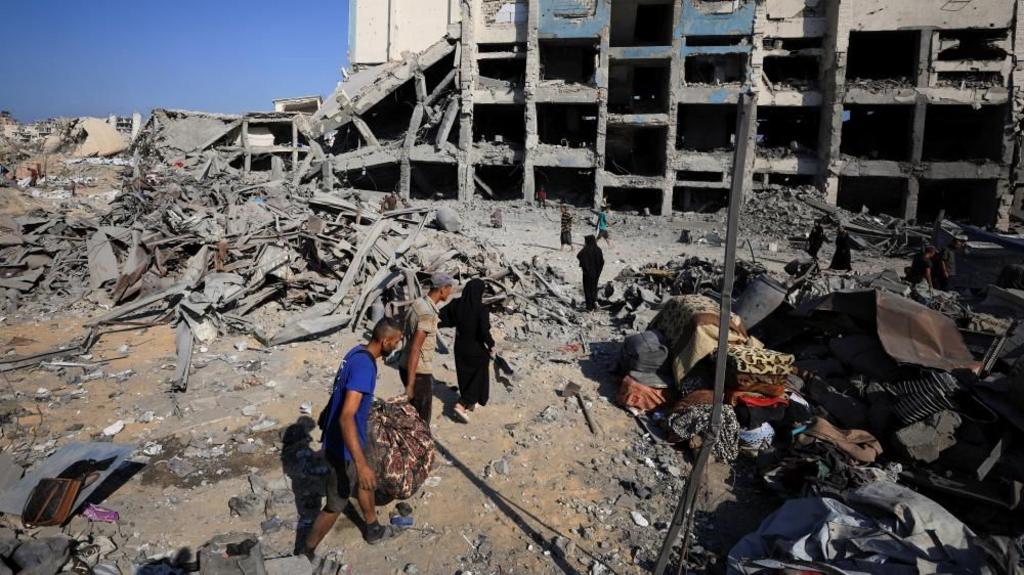
Israel’s Security Cabinet has sanctioned a strategy to seize Gaza City, according to Prime Minister Benjamin Netanyahu’s office. This decision, made early Friday, signifies another intensification of Israel’s 22-month campaign initiated in response to Hamas’ attack on October 7.
The conflict has resulted in the deaths of tens of thousands of Palestinians, devastated much of Gaza, and driven the region’s approximately 2 million residents towards famine. Prior to the Security Cabinet meeting, which commenced Thursday and continued overnight, Netanyahu stated that Israel intended to regain control over the entire area and ultimately transfer it to allied Arab forces opposed to Hamas.
However, the proposed plans fall short of this goal, possibly indicating the concerns of Israel’s chief general, who allegedly cautioned that such actions could jeopardize the remaining 20 or so hostages held by Hamas and further strain Israel’s military after nearly two years of regional conflicts. Many families of hostages also express opposition, fearing that further escalation could endanger their loved ones.
Israel has consistently bombarded Gaza City and conducted numerous operations there, only to return to various neighborhoods repeatedly as militants regroup. Currently, it remains one of the few parts of Gaza that has not been converted into an Israeli buffer zone or subjected to evacuation orders.
A significant ground operation in the area could displace tens of thousands and further hinder efforts to provide food to the region. The exact population of the city, which was the largest in Gaza before the conflict, remains uncertain. Hundreds of thousands evacuated Gaza City during the initial weeks of the war, but many returned during a ceasefire at the beginning of this year.
Increasing military actions in Gaza would endanger the lives of countless Palestinians and the approximately 20 remaining Israeli hostages while further isolating Israel on the international stage. Israel currently controls about three-quarters of the ravaged territory.
Families of hostages in Gaza are anxious that an escalation could jeopardize their loved ones, prompting some to protest outside the Security Cabinet meeting in Jerusalem. Former high-ranking Israeli security officials have also voiced their opposition to the plan, cautioning that it could lead to a quagmire with minimal military advantage.
An Israeli official previously stated that the Security Cabinet would deliberate on strategies to seize control of all or parts of Gaza that remain outside Israeli authority. The official, who requested anonymity until a formal decision is made, indicated that any approved actions would be executed gradually to intensify pressure on Hamas.
The ongoing air and ground operations by Israel have resulted in the deaths of tens of thousands in Gaza, displaced the majority of its residents, devastated extensive areas, and triggered severe and widespread hunger. Palestinians are preparing for additional suffering.
“There is nothing left to occupy,” remarked Maysaa al-Heila, currently residing in a displacement camp. “There is no Gaza left.”
On Thursday, local hospitals reported that at least 42 Palestinians lost their lives due to Israeli airstrikes and shootings throughout southern Gaza. In an interview with Fox News prior to the Security Cabinet meeting, when asked if Israel would “take control of all of Gaza,” Netanyahu responded: “We intend to, in order to ensure our security, eliminate Hamas there, and allow the population to be liberated from Gaza.”
“We do not wish to retain it. Our goal is to establish a security perimeter,” Netanyahu elaborated in the interview. “We aim to transfer control to Arab forces that will manage it effectively without posing a threat to us and providing Gazans with a better quality of life.”
According to Israeli media, the Security Cabinet, which must authorize such a decision, commenced its meeting on Thursday evening, with expectations that it would continue late into the night. Israel’s military chief of staff, Lt. Gen. Eyal Zamir, cautioned against the occupation of Gaza, stating that it would jeopardize the hostages and further burden the military after nearly two years of conflict, as reported by Israeli media.
Hamas-led militants kidnapped 251 individuals and caused the deaths of approximately 1,200 during the attack on October 7, 2023, which initiated the conflict. While most hostages have been freed during ceasefires or through other agreements, 50 individuals remain in Gaza, with around 20 believed to be alive by Israel.
On Thursday, nearly two dozen relatives of the hostages departed from southern Israel, heading towards the maritime border with Gaza, where they transmitted messages using loudspeakers.
Yehuda Cohen, the father of Nimrod Cohen, an Israeli soldier currently held in Gaza, expressed from the boat that Netanyahu is extending the war to appease extremists within his governing coalition. Netanyahu’s far-right allies are advocating for an escalation of the conflict, the relocation of a significant portion of Gaza’s population to other nations, and the reinstatement of Jewish settlements that were dismantled in 2005. “Netanyahu is acting solely in his own interest,” Cohen stated.
According to Gaza’s Health Ministry, Israel’s military operations have resulted in the deaths of over 61,000 Palestinians, although the ministry does not specify how many were combatants or civilians. This ministry operates under the Hamas-led government and is staffed by medical professionals who maintain and disseminate comprehensive records. The United Nations and independent analysts regard the ministry’s statistics as the most credible estimate of casualties. Israel has contested these figures but has not provided its own casualty count.
Among the 42 individuals who lost their lives on Thursday, at least 13 were attempting to obtain aid in an Israeli military zone in southern Gaza, where U.N. aid convoys are frequently overwhelmed by looters and desperate crowds. Additionally, two more individuals were killed on roads leading to nearby locations managed by the Israeli-supported Gaza Humanitarian Foundation, an American contractor, as reported by Nasser Hospital, which received the deceased.
The Gaza Humanitarian Foundation stated that there were no violent occurrences at or near its facilities on Thursday. The Israeli military did not provide an immediate response. The military zone, referred to as the Morag Corridor, is restricted to independent media.
In recent weeks, hundreds of individuals have lost their lives while attempting to reach GHF sites and amidst the chaotic scenes surrounding U.N. convoys, which are often overwhelmed by looters and desperate crowds. According to the U.N. human rights office, witnesses, and health officials, Israeli forces have frequently opened fire on these crowds since May, when Israel lifted a complete blockade that had lasted for 2 1/2 months.
The military claims that it has only fired warning shots when crowds approach its personnel. GHF asserts that its armed contractors have only resorted to using pepper spray or firing into the air on certain occasions to avert deadly stampedes.
Doctors Without Borders, known by its French acronym MSF, released a scathing report criticizing the GHF distribution system. “This is not aid. It is orchestrated killing,” the report stated. MSF operates two health centers in close proximity to GHF sites in southern Gaza and reported treating 1,380 individuals injured near these sites between June 7 and July 20, including 28 who were deceased upon arrival. Among these, at least 147 had sustained gunshot wounds, including at least 41 children.
MSF indicated that hundreds more had suffered injuries from physical assaults during the chaotic rush for food at the sites, including head injuries, suffocation, and numerous patients with severely aggravated eyes after being sprayed at close range with pepper spray. The organization noted that the cases it encountered represented only a small fraction of the total casualties associated with GHF sites; a nearby Red Cross field hospital has independently reported treating thousands of individuals wounded by gunfire while seeking assistance.
“The level of mismanagement, chaos, and violence at GHF distribution sites constitutes either gross negligence or a deliberately engineered death trap,” the report concluded. GHF responded by stating that the “accusations are both false and disgraceful” and accused MSF of “amplifying a disinformation campaign” orchestrated by Hamas.
The United States and Israel played a role in establishing the GHF system as a substitute for the U.N.-managed aid delivery system that has supported Gaza for many years, alleging that Hamas has been misappropriating aid. The U.N. refutes any claims of widespread diversion by Hamas. It charges that GHF compels Palestinians to endanger their lives in order to obtain food and argues that it promotes Israel’s agenda for additional mass displacement.