
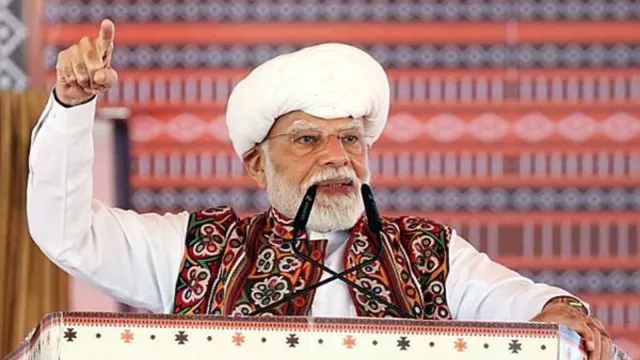
The Prime Minister made the remarks during an event organised at the Parade Ground in Ekta Nagar, Narmada district, to mark the 151st birth anniversary of Sardar Vallabhbhai Patel. The annual National Unity Day celebrations honour Patel’s contribution to India’s independence movement and, more importantly, his role in integrating hundreds of princely states into the Indian Union after independence.
PM Modi Criticises Opposition’s Role in National Politics
During his address, Modi said that the Opposition had moved beyond its constitutional responsibility of questioning the government and had increasingly become an obstacle to the country’s development.
Expressing concern over the current political environment, he said it was unfortunate that the Opposition had turned into an “Avrodh Paksh” instead of functioning as a “Virodh Paksh”.
The Prime Minister’s remarks highlighted the continuing political differences between the ruling Bharatiya Janata Party (BJP) and opposition parties, particularly the Congress. His comments also reflected the government’s criticism of opposition strategies on issues related to national security, governance and India’s international image.
Modi emphasised that political disagreements should not weaken the country’s unity. According to him, differences between political parties must not come at the cost of national interests, and the country needs to remain united while addressing challenges that could affect its security and development.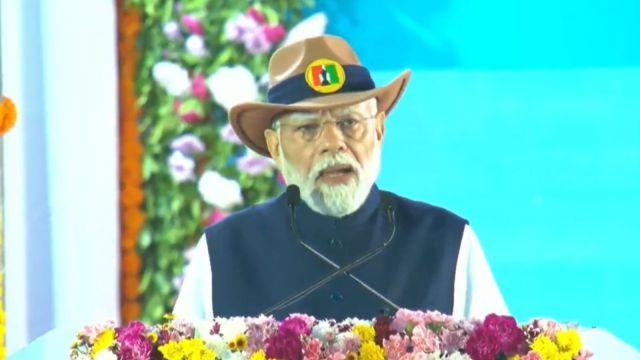
PM Raises Questions Over Foreign Connections and Rahul Gandhi
Without directly naming Congress leader Rahul Gandhi, the Prime Minister made indirect references to his foreign visits and raised questions about alleged meetings involving individuals and organisations opposed to India’s interests.
During his speech, Modi questioned who was secretly meeting whom in foreign countries and asked which individuals were receiving support from forces hostile to India.
He also questioned why certain political voices were allegedly using language similar to that of India’s adversaries.
Although the remarks were directed at the Opposition without presenting specific evidence during the address, they added another dimension to the ongoing political confrontation between the BJP and Congress.
The comments are significant in the context of the broader political debate over India’s foreign policy, national security and the responsibilities of political leaders when representing the country on international platforms.
Social Media and Misinformation Also Come Under PM’s Criticism
Modi also expressed concern over the growing use of social media to spread rumours and influence public opinion.
He alleged that certain forces were using digital platforms as weapons to create confusion among citizens and damage India’s reputation.
According to the Prime Minister, misinformation and misleading narratives can weaken public trust and create divisions within society. He stressed the need for people to remain alert against information that could encourage hostility or create unnecessary tensions.
His remarks brought attention to the increasing influence of social media in political communication and public discourse.
With digital platforms playing a major role in shaping opinions, the spread of unverified information has become an important concern for governments, political parties and media organisations.
The Prime Minister’s comments also highlighted the importance of responsible communication and the need to distinguish between legitimate political criticism and the deliberate circulation of misinformation.
Modi Says Threat of ‘Ideological Naxalism’ Remains
Addressing the issue of internal security, Modi referred to his earlier commitment to eliminate Naxalism and Maoism from the country.
He said that the government had fulfilled its promise to end the threat posed by armed Naxalite groups, adding that the challenge of what he described as “dimagi Naxals” continued to remain significant.
The expression was used by the Prime Minister to describe what he considers ideological forces that continue to challenge the country’s interests.
His remarks suggested that, despite progress against armed insurgency, the government believes that ideological challenges and extremist thinking remain areas of concern.
The issue of Naxalism has remained an important part of India’s internal security discussions, particularly in regions that have historically experienced Maoist violence. The government’s approach has involved security operations, development initiatives and efforts to improve governance in affected areas.
Border Security, Infiltration and Uniform Civil Code Among Future Priorities
The Prime Minister also outlined several areas that he described as important for India’s next phase of national development.
He said the country must work towards securing its borders completely and preventing infiltration. He also raised concerns about demographic changes, presenting them as issues that require attention in the context of national security.
Another important issue mentioned in his speech was the move towards a secular civil code, reflecting the government’s continued emphasis on discussions surrounding the Uniform Civil Code.
These subjects have remained part of wider political and constitutional debates in India. While the government has highlighted national security and legal uniformity as important priorities, opposition parties and other stakeholders have raised different arguments regarding their implementation and possible implications.
By including these issues in his National Unity Day address, Modi connected the themes of national integration and internal security with the government’s broader political and development agenda.
‘Ek Bharat Shreshtha Bharat’ and ‘Viksit Bharat’ Remain Key Goals
Concluding his address, Modi reiterated two major national goals: ‘Ek Bharat Shreshtha Bharat’ and ‘Viksit Bharat’.
The Prime Minister said that India must continue moving towards greater unity, stronger national integration and overall development.
He also referred to the vision and contribution of Sardar Vallabhbhai Patel, stating that the country was progressing along the path shown by the country’s first Deputy Prime Minister.
Patel played a historic role in bringing together hundreds of princely states following independence in 1947. His political leadership and efforts towards national integration laid the foundation for the territorial and administrative unity of modern India.
National Unity Day, observed every year on October 31, commemorates his birth anniversary and highlights the importance of national solidarity.
National Unity Day Provides Political and Historical Context
The Rashtriya Ekta Diwas celebrations in Ekta Nagar carry both historical and national significance. The event serves as a reminder of Patel’s contribution to India’s unity while providing an opportunity to highlight contemporary challenges related to national security, social harmony and development.
Modi’s address combined tributes to Patel with criticism of the political Opposition and a discussion of the government’s future priorities.
His remarks are also likely to remain part of the broader political debate between the BJP and opposition parties, particularly over questions of national unity, democratic accountability, social media misinformation and the country’s security.
The central message of the Prime Minister’s speech was that India needs collective strength and national unity to achieve its development goals. At the same time, his criticism of the Opposition once again brought the political differences between the ruling party and its rivals into focus.