
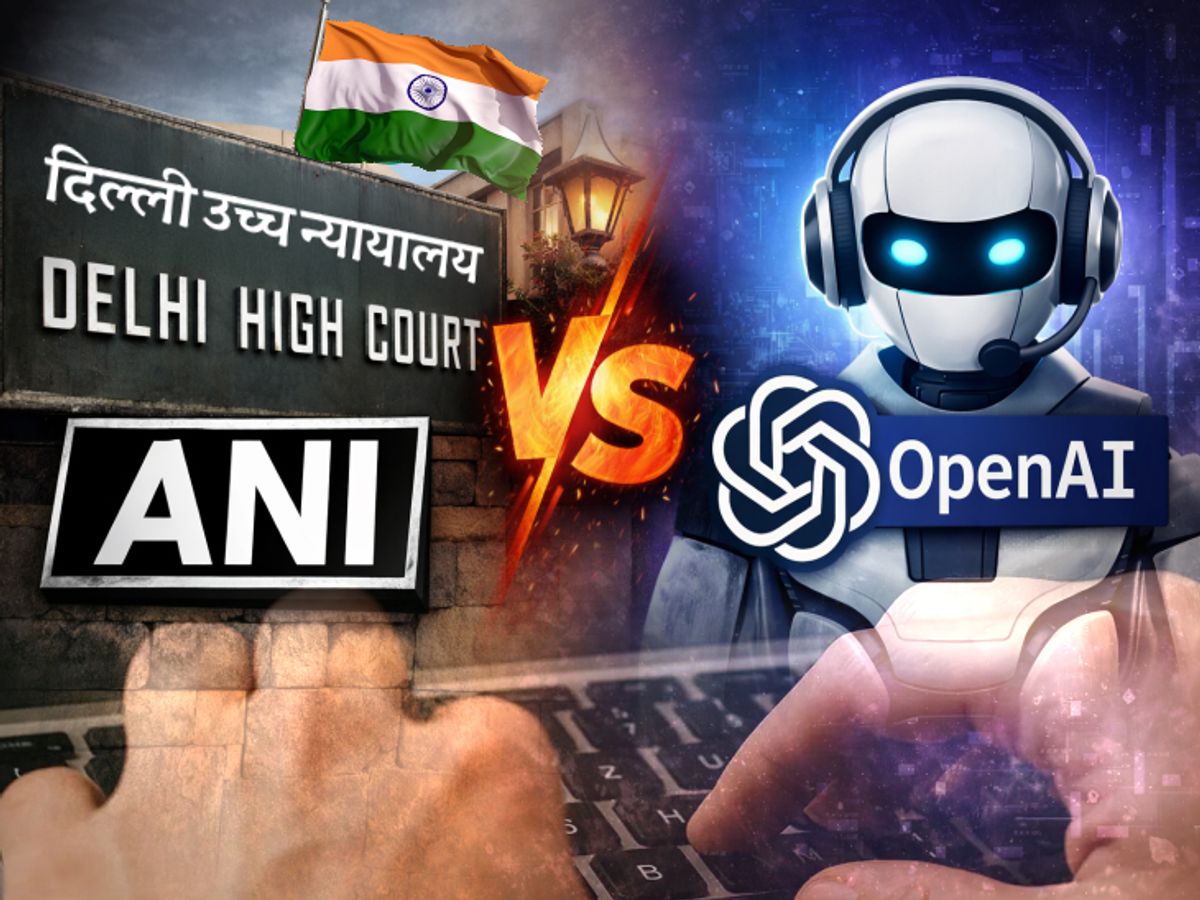
Asian News International (ANI) has approached the Delhi High Court’s Division Bench challenging a single-judge order that denied the news agency interim relief in its copyright infringement case against OpenAI, intensifying a significant legal dispute over the use of copyrighted news material for artificial intelligence training.
The appeal marks another important stage in a case that has drawn considerable attention because it involves questions surrounding copyright protection, artificial intelligence, news content and the legality of using copyrighted material to train large language models.
ANI has challenged the earlier decision in which the single judge declined to grant an interim injunction against OpenAI. The appeal was listed before a Division Bench headed by Justice V. Kameswar Rao. However, the bench did not assemble on the scheduled date, and the matter has now been listed for hearing on September 14.
The dispute stems from ANI’s allegations that its original journalistic content has been used by OpenAI in connection with the development and operation of its artificial intelligence systems, including ChatGPT. ANI has maintained that its news reports and other original journalistic works were being commercially exploited without proper authorisation.
At the centre of the case are broader questions about how copyright law should apply to artificial intelligence. One of the key issues is whether copyrighted news material can be used to train AI models without obtaining permission from the copyright holder. Another important question concerns the circumstances in which AI-generated responses could amount to copyright infringement if they reproduce or closely resemble material created by a news organisation.
ANI had argued before the single judge that ChatGPT could generate responses containing portions of its original news material when users made certain queries. The agency also raised concerns about instances in which the AI system allegedly attributed information or statements to ANI that had not actually been published or reported by the organisation.
OpenAI has disputed ANI’s allegations and has opposed the claims made against it. The company has argued, among other things, that its AI models were not trained in India and that its relevant computing infrastructure is located outside the country. It has also maintained that the machine-learning process involves analysing information and extracting broader linguistic and statistical patterns rather than simply reproducing individual copyrighted works.
The single-judge ruling delivered on July 24 examined several complicated legal and technological questions arising from the use of copyrighted works in artificial intelligence systems.
A major issue considered by the court was the distinction between facts and the expression of those facts. Copyright law does not generally protect facts or information merely because they have been reported by a particular organisation. However, the manner in which those facts are expressed through original writing can receive copyright protection.
This distinction is particularly important in journalism because news reports generally contain two different elements: the underlying information about an event and the specific language, structure and presentation used by a journalist to report that information.
The court considered ANI’s examples of allegedly infringing responses generated by ChatGPT. At the interim stage, however, it found that the material presented before it did not establish sufficient evidence of substantial reproduction of ANI’s copyrighted expression to justify the requested interim injunction.
The judgment also examined how large language models are trained. AI systems are developed using large quantities of text and other forms of data. During training, information is processed to help the model identify patterns in language and develop the ability to generate responses.
This technological process created a difficult legal question for the court because traditional copyright legislation was drafted long before the emergence of modern generative AI systems.
The case therefore requires the courts to examine how existing copyright principles can be applied to technologies that were not specifically contemplated when the relevant provisions of the Copyright Act were enacted.
Another issue considered by the court was whether the storage and processing of copyrighted material during AI training could itself constitute copyright infringement.
The court examined the various stages involved in AI training and considered whether the technical processes used by AI developers could fall within existing copyright restrictions or statutory exceptions.
The ruling ultimately did not grant ANI the interim protection it had sought. However, the broader questions raised by the dispute remain significant and could require further examination as the case progresses.
ANI’s decision to approach the Division Bench means that the legal battle over the use of its content by AI systems will continue.
The appeal could have implications beyond the two parties involved. Publishers, news agencies, journalists, technology companies and copyright holders are closely watching the development of legal principles governing artificial intelligence and copyrighted material.
For the media industry, the dispute touches upon concerns about the economic value of original journalism. News organisations spend substantial resources on reporting, gathering information, conducting interviews, verifying facts and producing original stories. They have increasingly raised questions about whether AI companies should be permitted to use such material to develop commercial AI products without licensing agreements or compensation.
The issue has become more significant as generative AI tools become increasingly capable of answering questions that previously required users to visit news websites or search through original articles.
If AI systems can provide users with detailed information based on journalistic content without directing them to the original source, publishers could potentially face challenges involving traffic, advertising revenue, subscriptions and the broader commercial value of their content.
AI developers, on the other hand, argue that training an AI model is fundamentally different from publishing or redistributing an original article. Their position is that AI training involves processing large datasets to learn general patterns and relationships rather than creating a database intended to reproduce individual works.
The legal dispute therefore involves a fundamental conflict between two competing interests: protecting the rights and economic interests of content creators while allowing technological development and innovation to continue.
The case also raises questions about the limits of copyright protection in the digital age. If copyright were interpreted broadly enough to prevent AI systems from analysing or processing large quantities of publicly available information, developers could face significant restrictions on the creation of future AI technologies.
At the same time, a narrow interpretation of copyright could create concerns among journalists, writers, publishers and other creators who fear that their work could be used commercially without permission or compensation.
The Delhi High Court proceedings could consequently become an important reference point for future disputes involving artificial intelligence and intellectual property in India.
The case is also significant because India does not yet have a comprehensive AI-specific copyright framework governing every stage of AI development and training. Courts are therefore being required to interpret existing legal provisions in the context of rapidly evolving technology.
The Division Bench will now have an opportunity to examine ANI’s challenge to the earlier order. Its consideration of the appeal could determine whether ANI receives any interim protection while the wider copyright dispute continues.
The proceedings will be closely watched by the media and technology sectors because any clarification from the court could influence future disputes involving AI-generated content, copyrighted journalism and the training of large language models.
For now, ANI’s appeal keeps the copyright dispute with OpenAI active before the Delhi High Court. The next stage of the proceedings could provide further insight into how Indian courts intend to balance copyright protection, technological innovation, public access to information and the commercial interests of content creators in the rapidly developing era of generative artificial intelligence.