
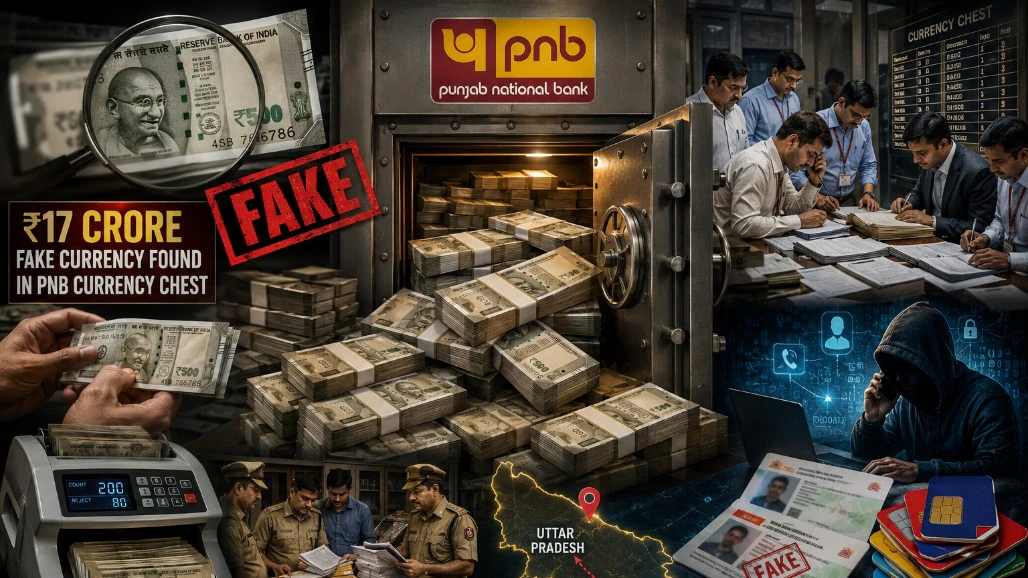
The National Investigation Agency (NIA) has arrested a Punjab National Bank (PNB) manager in connection with the recovery of suspected counterfeit Indian currency worth ₹17.29 crore from a currency chest in Saharanpur, Uttar Pradesh. The arrest marks a major development in an investigation that is examining how such a large quantity of suspected fake notes reached a secure banking facility.
The accused, identified as Amit Kumar, was reportedly serving as a manager associated with the PNB currency chest and was one of the officials responsible for the custody and handling of cash. He was arrested from Chandigarh as investigators widened their probe into the suspected counterfeit currency operation.
The case has raised serious questions about the movement of fake currency through the formal banking system and whether individuals with access to bank cash-handling facilities played a role in the alleged operation.
NIA intensifies investigation
The counterfeit currency case first came to light after suspected fake notes were detected at a PNB currency chest in Saharanpur. The discovery prompted an investigation into the origin of the notes and the procedures through which cash was received, stored, counted and transferred.
The case was initially registered by local police before the investigation was taken over by the NIA. The central agency is now examining the wider circumstances surrounding the recovery and is attempting to determine whether the incident was an isolated case or part of a larger organised network.
Investigators are expected to examine bank records, cash registers, transaction documents, CCTV footage and electronic devices as part of efforts to reconstruct the movement of the suspected counterfeit currency.
PNB officials under scrutiny
Several PNB officials have come under investigation following the recovery. The officials were reportedly responsible for different aspects of the bank’s currency-handling operations.
A currency chest is a specialised facility used by banks for storing and managing large amounts of cash. Because of the large volume of currency handled at such facilities, strict procedures are generally followed for counting, verification, custody and transportation.
The involvement of a bank official has therefore become a significant aspect of the investigation. Authorities are trying to determine whether the accused allegedly acted alone or whether other individuals were involved in the suspected operation.
The investigation will also seek to establish whether the suspected counterfeit notes were introduced into the currency chest deliberately and, if so, at what stage of the cash-handling process this may have happened.
₹17.29 crore in suspected counterfeit currency
The recovery of suspected counterfeit currency valued at ₹17.29 crore has become the central focus of the investigation.
Authorities are examining the physical notes to determine their origin and characteristics and are also attempting to establish how they entered the banking system.
Investigators will need to trace the movement of the cash before it reached the currency chest. This includes identifying where the currency was received from, which officials handled it, how it was counted and whether discrepancies appeared in the bank’s records.
The cash trail could prove crucial in determining whether the suspected counterfeit notes were introduced at the currency chest or entered the banking system at an earlier stage.
Large cash consignment also being examined
Investigators are also looking into the movement of a large cash consignment from the Saharanpur area to another banking facility.
The movement of substantial amounts of currency has become relevant to the investigation because authorities are trying to establish whether any suspected counterfeit notes could have been mixed with genuine currency during transportation or processing.
Investigators are expected to compare official records with the actual cash handled at different stages. Any unexplained discrepancy could provide an important lead in determining how the suspected counterfeit notes entered the system.
However, the investigation is still underway, and no final conclusion has been established regarding the exact route through which the suspected fake currency reached the PNB currency chest.
Possible wider network under investigation
The NIA is also examining whether the case could have links to a wider counterfeit currency network.
Authorities are reportedly investigating the contacts, movements and financial activities of individuals connected with the case. They are also examining whether there were connections with people operating outside the immediate area.
A possible cross-border angle is among the aspects being examined by investigators. However, such links remain part of the ongoing investigation and should not be treated as established facts unless supported by evidence.
The agency is expected to examine digital communications, financial transactions, travel records and other evidence to identify any additional individuals who may have been involved.
Digital and documentary evidence could prove important
Apart from the suspected counterfeit notes, investigators are expected to rely heavily on documentary and electronic evidence.
Bank records can help establish when cash entered and left the currency chest, while CCTV footage may provide information about individuals who accessed the facility. Electronic devices recovered during searches could potentially reveal communications or transactions relevant to the investigation.
Investigators are also likely to compare statements given by bank employees with documentary records and digital evidence.
The objective is to establish a clear timeline showing how the currency was received, handled, stored and transferred.
Questions surrounding banking security
The case has raised concerns about the security mechanisms used in handling large amounts of cash within the banking system.
Currency chests operate under strict controls because they handle significant quantities of cash that are subsequently distributed to branches, ATMs and other financial institutions. The discovery of such a large amount of suspected counterfeit currency inside one therefore raises questions about verification and monitoring procedures.
The investigation could eventually provide information about whether established safeguards were bypassed or whether the suspected counterfeit currency entered the system through another route.
What happens next?
The arrest of the PNB manager is expected to help investigators obtain further information about the suspected counterfeit currency operation. The agency will now focus on determining the accused’s alleged role and identifying any other individuals who may have participated in the suspected network.
Forensic examination of the currency, analysis of financial records and scrutiny of electronic evidence are likely to remain important parts of the investigation.
The authorities will also have to establish the source of the suspected counterfeit notes and determine whether any of them had already entered circulation outside the bank.
At this stage, the investigation remains ongoing. The arrest is an important development, but the complete chain behind the ₹17.29 crore suspected counterfeit currency recovery is yet to be established.
The case could become significant for investigators seeking to understand how counterfeit currency can penetrate formal financial channels and whether organised networks are exploiting vulnerabilities in large-scale cash-handling systems.