
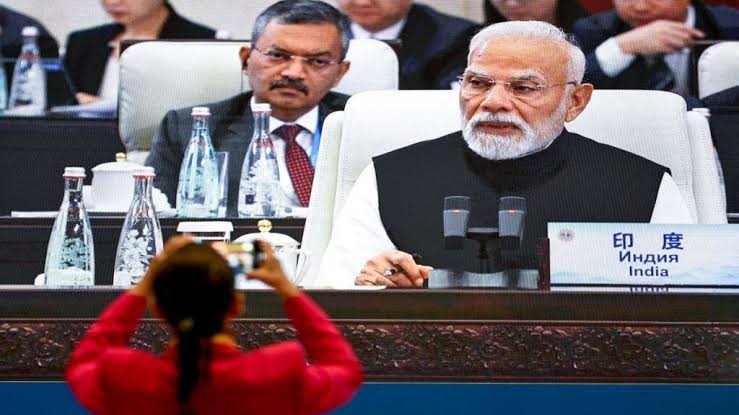
Prime Minister Narendra Modi has called on the Shanghai Cooperation Organisation (SCO) to adopt a united and uncompromising approach against terrorism, urging member states to dismantle the entire ecosystem that enables terrorist activities.
Addressing the 26th SCO Leadership Summit in Bishkek, Kyrgyzstan, Modi said the international community must go beyond targeting individual terrorist organisations and focus on the wider networks that sustain terrorism. His remarks came in the presence of several regional leaders, including Pakistan Prime Minister Shehbaz Sharif, Chinese President Xi Jinping, Russian President Vladimir Putin and Iranian President Masoud Pezeshkian.
Modi stressed that the fight against terrorism must include action against its financing, recruitment, radicalisation and safe havens. He argued that a coordinated response is necessary because terrorist networks increasingly operate across borders and depend on interconnected systems of money, manpower, ideology and logistical support.
The prime minister also delivered a pointed message to countries that, according to India, use terrorism as an instrument of state policy. He said such countries must face a clear international response and emphasised that terrorism should never be allowed to become a strategic tool or source of political advantage.
Modi calls for unified action against terrorism
At the summit, Modi underlined the need for SCO members to work collectively to eliminate the conditions that allow terrorism to survive and expand.
He said dismantling the terror ecosystem requires addressing several interconnected elements, including terrorist financing, recruitment networks, radicalisation mechanisms and safe havens. Such an approach, he suggested, would make it more difficult for terrorist organisations to rebuild their infrastructure even after individual operatives or groups are targeted.
The message was particularly significant because India and Pakistan are both members of the SCO and have sharply differing positions over cross-border terrorism. The presence of the Pakistani prime minister at the summit gave Modi’s comments additional diplomatic significance, although he framed his remarks within the broader responsibility of the SCO rather than limiting them to bilateral relations.
India has consistently maintained that terrorism cannot be separated from the networks and infrastructure that support it. New Delhi has also argued at international forums that countries accused of providing financial, political or logistical backing to terrorist groups should be held accountable.
‘No double standards’ in the fight against terror
A central theme of Modi’s intervention was the need to avoid what India describes as double standards in dealing with terrorism.
The prime minister’s position was that international organisations cannot effectively combat terrorism if the same activity is condemned in one situation but tolerated or justified in another. He called for a consistent approach in which terrorist activity, its financing and support systems are treated as security threats regardless of political circumstances.
Modi’s remarks also reinforced India’s longstanding demand for stronger international cooperation against terrorist networks. The emphasis on financing and recruitment reflects a broader understanding of terrorism in which attacks are only one part of the problem, while the infrastructure supporting militants can extend across jurisdictions.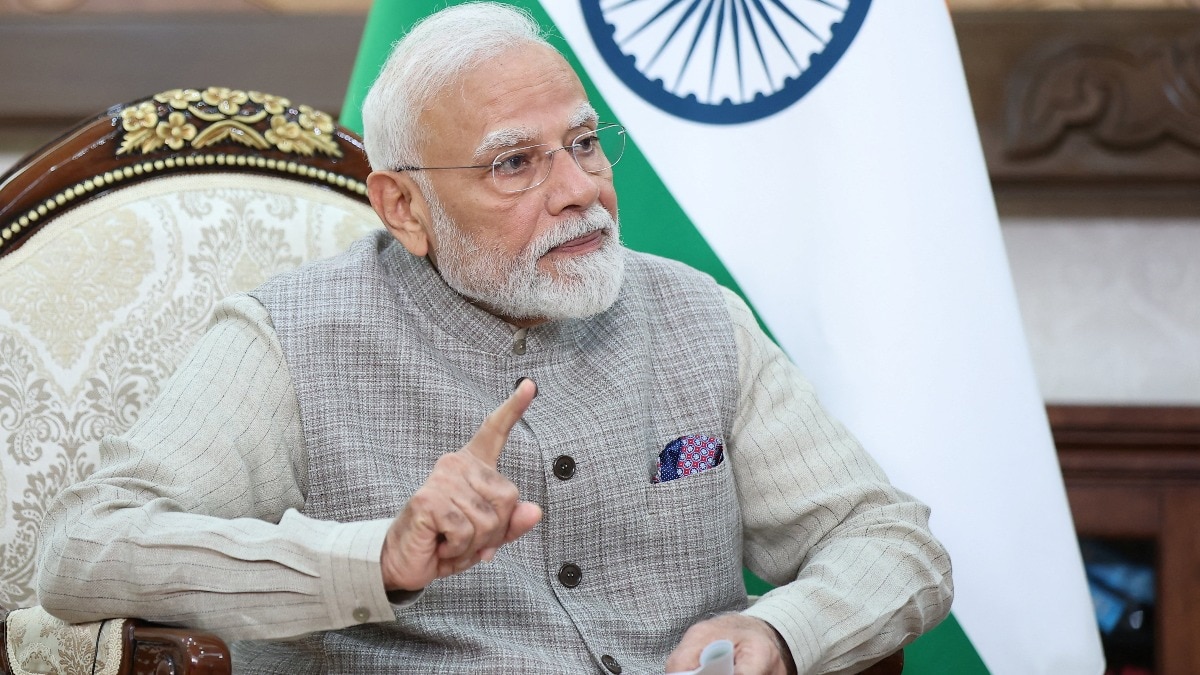
Terrorism and regional security remain key SCO concerns
The SCO has traditionally placed regional security and counter-terrorism among its major areas of cooperation. Its membership includes several countries facing serious security challenges linked to terrorism, extremism and instability.
Against this backdrop, Modi argued that the organisation must translate years of dialogue into concrete action. He called for greater cooperation among member states to address common security threats while also strengthening regional connectivity and economic opportunities.
The prime minister presented India’s approach to the SCO around three broad pillars: security, connectivity and opportunity. He said these principles should move beyond being broad objectives and produce tangible outcomes for people across the region.
According to Modi, the countries of the SCO share geography as well as many common economic and security interests. Greater cooperation, he said, could help transform this shared geography into shared opportunities while contributing to stability during a period of growing global uncertainty.
Modi backs dialogue and diplomacy to resolve conflicts
Alongside his remarks on terrorism, Modi called for the peaceful resolution of international conflicts through dialogue and diplomacy.
He said wars and armed conflicts cannot provide lasting solutions and emphasised the importance of negotiations in resolving disputes. The comments reflected India’s broader diplomatic position that international disagreements should be addressed through peaceful engagement rather than prolonged military confrontation.
Modi also linked regional stability with economic development. He stressed that connectivity projects should respect the sovereignty and territorial integrity of all countries, an issue of particular importance in a region where major infrastructure initiatives often have geopolitical implications.
Connectivity, trade and economic opportunities on SCO agenda
The prime minister also urged SCO countries to strengthen economic cooperation and improve regional connectivity. He argued that stronger links between countries could create new opportunities for trade, investment and people-to-people contacts.
For India, connectivity has increasingly become an important part of its engagement with Central Asia and other SCO members. New Delhi has advocated infrastructure and transport links that can improve access to regional markets while respecting the sovereignty and territorial integrity of participating countries.
Modi’s emphasis on connectivity was therefore closely linked to his wider vision of an SCO that is not focused exclusively on security issues but also contributes to economic growth and development.
A significant diplomatic setting
The 26th SCO summit brought together leaders and representatives from the organisation’s member states, along with partner and observer countries. The presence of major regional powers made the meeting an important platform for discussions on security, terrorism, economic cooperation and global conflicts.
Modi’s intervention placed terrorism firmly at the centre of India’s security message. His remarks also demonstrated New Delhi’s effort to use multilateral forums to push for stronger international action against terrorist financing, recruitment and support networks.
The participation of Pakistan’s prime minister was particularly notable given the longstanding tensions between New Delhi and Islamabad. India has repeatedly raised concerns over cross-border terrorism, while Pakistan has rejected Indian allegations regarding its role in supporting militant groups.
Rather than restricting his remarks to bilateral differences, Modi presented the issue as a wider international challenge requiring collective action by the SCO.
India seeks concrete outcomes from SCO
Modi also called on SCO members to build upon the organisation’s decades of dialogue and cooperation and focus on measurable results.
His broader message was that regional organisations must demonstrate their relevance by addressing issues that directly affect the security and prosperity of their populations. For India, that includes counter-terrorism cooperation, secure connectivity, economic development and peaceful resolution of conflicts.
The prime minister’s intervention thus combined a strong security message with a broader vision for regional cooperation. While terrorism remained a central concern, he also highlighted the importance of economic opportunity and connectivity in building a more stable region.
The summit provided India with an important diplomatic platform to reiterate its opposition to terrorism and to press for a coordinated international response. Modi’s call to dismantle the entire terror ecosystem also underscored India’s position that defeating terrorism requires action not only against perpetrators but against the financial, ideological and logistical structures that allow such networks to function.
As SCO members continue discussions on regional security and cooperation, India’s emphasis remains clear: terrorism must be confronted consistently, its support systems must be dismantled, and no country should be permitted to treat terrorism as a strategic instrument.