
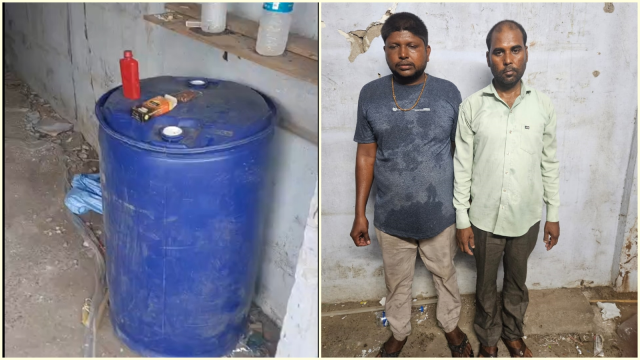
Police in Gujarat’s Kutch district have uncovered a suspected illegal liquor manufacturing operation in Adipur, seizing around 10,000 liquor flasks, more than 600 litres of an unidentified chemical and equipment allegedly used to prepare counterfeit liquor. Two men have been detained in connection with the operation.
The raid was conducted on Tuesday at a shop situated in a busy marketplace near the railway tracks in Adipur, within the Gandhidham Municipal Corporation area. The operation was carried out by a team working under the supervision of Border Range Inspector General of Police Chirag Koradia.
According to police officials, the seizure included 9,400 empty flasks and 600 red flasks containing approximately 180 ml of suspected finished liquor each. Officers also recovered around 200 litres of finished liquid stored in a barrel, along with more than 600 litres of an unidentified chemical believed to have been intended for the preparation of the suspected duplicate liquor.
The scale of the seizure has raised concerns because the recovered flasks had a combined capacity of approximately 1,800 litres. If filled completely, the containers could hold the equivalent of nearly 2,400 standard 750-ml liquor bottles.
Police are investigating whether the material was intended to be used for the large-scale production and distribution of counterfeit Indian Made Foreign Liquor. The exact nature and composition of the chemical recovered during the raid have not yet been established.
Authorities have sent samples of the unidentified chemical to the Forensic Science Laboratory for detailed examination. The forensic analysis is expected to determine the substance’s chemical composition and establish whether it contains methanol or any other toxic compound that could pose a serious threat to consumers.
The seizure assumes particular significance because it comes shortly after a deadly spurious liquor incident in Bhavnagar district. That incident reportedly left 13 people dead and affected more than 60 others after they consumed liquor containing methanol. The suspected illicit liquor had reportedly been packaged in bottles carrying the branding of a recognised liquor product.
Against this backdrop, the discovery of another suspected counterfeit liquor operation has intensified concerns over the risks associated with illegally manufactured and adulterated alcohol. Authorities are likely to examine whether the Kutch operation was connected in any way to wider networks involved in the supply of chemicals, bottles or counterfeit liquor.
The investigation is also expected to focus on the source of the chemical, the intended distribution network and the possible destination of the seized liquor. Police will also seek to establish how long the premises had been used for the suspected operation and whether additional people were involved.
Inspector General Chirag Koradia said two men were detained during the raid. They were identified as Hitesh Kheema Bamaniya, a resident of Santacruz in Mumbai, and Bijnedra Lalchand Jat, a resident of Mathura in Uttar Pradesh.
The detention of the two suspects is part of the preliminary investigation, and further legal action is expected to depend on the evidence collected during the probe and the findings of the forensic examination.
The case highlights the challenges posed by illicit liquor production in Gujarat, where prohibition laws prohibit the manufacture, sale and consumption of alcohol. Illegal liquor networks can pose not only a law-and-order challenge but also a major public health risk when unknown chemicals are used in the production process.
Forensic testing will therefore be a crucial component of the investigation. Determining the exact chemical composition of the seized liquid could help investigators establish how the suspected liquor was being prepared and assess the potential danger it posed to consumers.
The authorities are continuing their investigation into the seized material, the suspected manufacturing process and the wider supply chain. The findings could provide further information about whether the Adipur premises were being used as part of a larger counterfeit liquor network operating across state borders.