
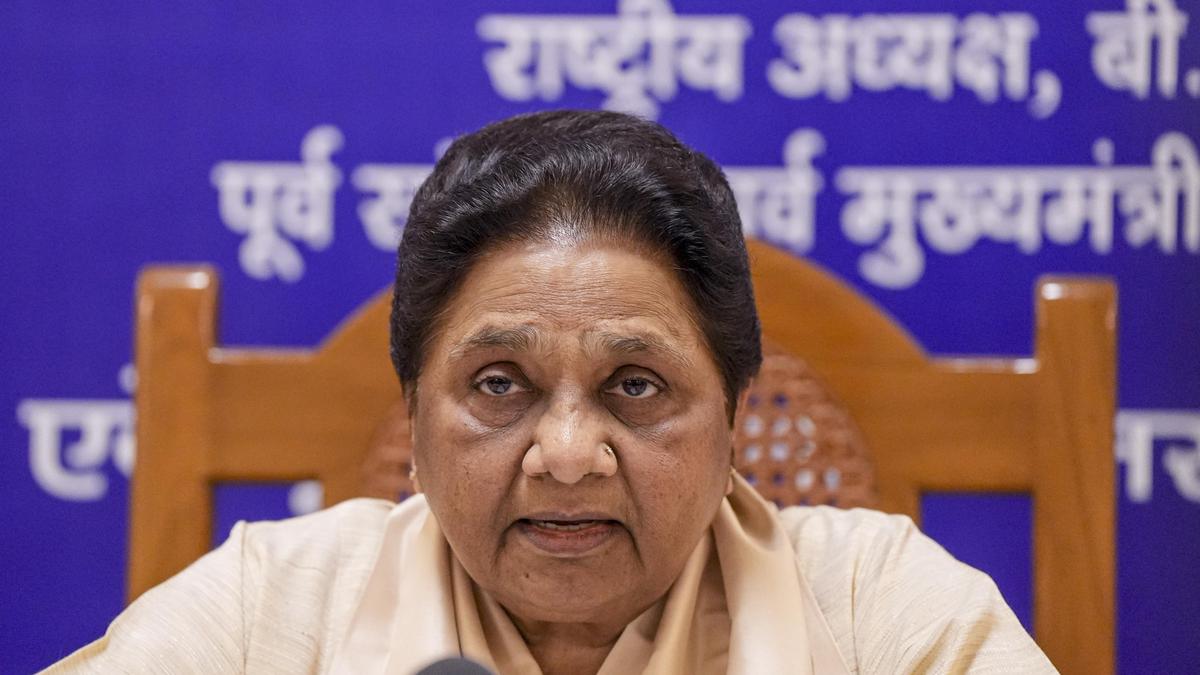
Bahujan Samaj Party (BSP) chief Mayawati has called for restraint and dialogue amid the ongoing controversy over wearing the hijab in schools in Uttar Pradesh, urging authorities and school managements to resolve such sensitive matters locally rather than allowing them to become prolonged legal or political disputes.
Mayawati said issues involving religious customs and practices should be handled with sensitivity and mutual understanding. She cautioned political parties and other stakeholders against using such disputes for what she described as “narrow politics”.
In a statement posted on social media on Wednesday, the former Uttar Pradesh Chief Minister emphasised the constitutional principle of equal rights for people belonging to different religions and communities. Referring to the constitutional framework associated with Dr B.R. Ambedkar, she said India’s secular Constitution provides equal and dignified rights to citizens irrespective of their religious identity.
Mayawati stressed that people should be allowed to live peacefully while following the religious scriptures, customs and beliefs of their respective faiths. At the same time, she urged everyone to respect the sanctity of religious practices and avoid unnecessary confrontation over sensitive religious issues.
Mayawati favours local resolution
Addressing the dispute over the hijab and school uniforms, Mayawati argued that such matters should not automatically be turned into court cases. Instead, she suggested that school authorities, the government and local administration should sit together and attempt to find practical solutions through dialogue.
According to her position, disputes concerning uniforms, veils or hijabs can often be addressed through mutual understanding and administrative consultation before they escalate into larger legal or political controversies.
She maintained that giving excessive importance to such disputes could deepen tensions between communities and create opportunities for political actors to exploit religious sensitivities.
Mayawati therefore appealed to all concerned parties to exercise restraint and deal with the issue with maturity and wisdom.
Remarks follow Allahabad High Court ruling
Her comments come against the backdrop of a recent ruling by the Allahabad High Court concerning a Muslim student who had sought permission to wear a hijab as part of her school attire.
The student, who studies in Class 11 at a private school in Prayagraj, had approached the court seeking permission to wear the hijab with her school uniform. The court dismissed the petition, bringing the issue into wider public and political debate.
The ruling has triggered differing reactions from political leaders and Muslim organisations. While some have criticised the court’s position, others have argued that schools have the authority to prescribe uniform rules that apply to students.
The All India Muslim Personal Law Board has indicated that it may challenge the ruling. AIMPLB member and cleric Khalid Rasheed Firangi Mahali has maintained that hijab is an integral part of Islamic practice and that the organisation intends to present its position before a higher court.
The developments have consequently turned what began as a dispute concerning a school uniform into a wider discussion about religious freedom, educational regulations, constitutional rights and the limits of institutional rules.
Call for respect for religious beliefs
Mayawati’s intervention has focused less on taking a direct legal position on the court ruling and more on urging all sides to avoid escalation.
She said sensitive matters involving religious scriptures, traditions and beliefs should not be treated casually. Political leaders and public figures, she suggested, should exercise particular caution when commenting on issues that have the potential to affect communal relations.
Her broader argument was that India’s constitutional framework is intended to protect people from different religious and social backgrounds while ensuring equality before the law.
The BSP chief also described her party as an Ambedkarite political organisation committed to protecting the rights and security of different sections of society, including their lives, property and religious practices.
Mayawati raises Budaun Ambedkar statue dispute
In the same context, Mayawati also urged the Uttar Pradesh government and administration to take immediate steps to settle a separate dispute involving the installation of an Ambedkar statue in Budaun district.
The disagreement over the statue escalated on Tuesday evening, when stone-pelting was reported in the area. Several people, including police personnel and a villager, were injured, while multiple vehicles were damaged. Authorities also detained several people for questioning.
According to the administration, the statue had been installed on restricted government land and was subsequently moved to the tehsil complex.
Mayawati called for a peaceful and appropriate settlement of the dispute, stressing the need to restore calm in the area. Her comments reflected her broader appeal for administrative intervention before local disputes develop into prolonged confrontations.
Focus on constitutional values
Mayawati’s comments place the hijab controversy within a wider argument about constitutional equality, religious freedom and social harmony. Rather than encouraging further confrontation, she has urged authorities and community representatives to explore solutions through discussion.
The controversy is likely to remain a subject of legal and political debate, particularly if the court ruling is challenged before a higher judicial forum. For now, Mayawati’s intervention has highlighted the importance of dialogue at the local level and warned against allowing religious disputes to become instruments of political mobilisation.
Her appeal also underlines the continuing tension between individual religious practices and institutional rules in educational settings. As such questions increasingly reach courts and enter political discourse, the debate is likely to involve not only questions of school discipline but also broader considerations of constitutional rights, religious freedom and communal harmony.