
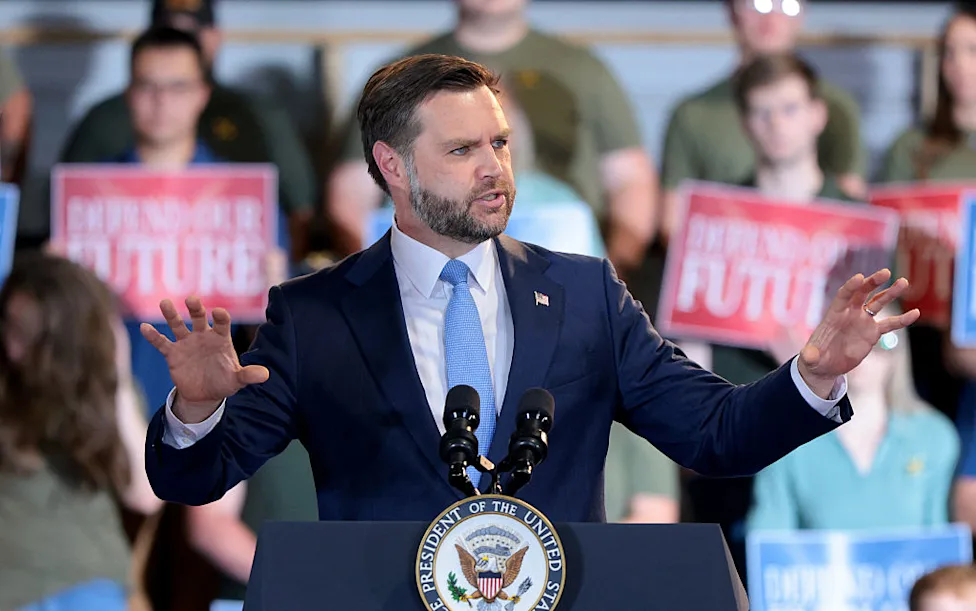
US Vice President JD Vance sparked attention during a political appearance in Maine after referring to Canada as a “state” while discussing increasingly tense trade relations between Washington and Ottawa.
Vance made the remark on Monday, August 24, during an event in Brewer, Maine, as he defended the Trump administration’s increasingly aggressive position on Canadian trade practices. He immediately corrected himself, describing the wording as a “Freudian slip” and insisting that calling Canada a state had been accidental.
The brief verbal mistake came at a particularly sensitive moment in US-Canada relations. Negotiations between the two countries have deteriorated in recent days, with both sides accusing the other of making unreasonable demands. The Trump administration has also intensified its criticism of Canada over tariffs, defence spending and trade policies.
The comment drew laughter from people attending the event, but its timing gave the remark added significance because President Donald Trump has repeatedly spoken about Canada in terms of becoming part of the United States.
Vance quickly corrects himself
While addressing the gathering in Maine, Vance was discussing Canada’s trade policies when he referred to the country as a state.
He immediately stopped and corrected himself, saying it was a “Freudian slip” and then emphasizing that the mistake was accidental.
Although the remark lasted only a few seconds, it quickly attracted attention because of the broader political debate surrounding Canada’s sovereignty and its relationship with the United States.
Vance then returned to his main argument, criticizing Canada over what he described as unfair treatment of American products and accusing Ottawa of maintaining trade policies that disadvantage producers in states such as Maine.
Trade dispute remains at the centre of tensions
Vance used the Maine event to defend the Trump administration’s approach to the ongoing trade dispute with Canada.
He argued that Canadian trade policies have placed American producers at a disadvantage, particularly farmers and businesses seeking to sell their products across the northern border. He highlighted differences in tariffs on dairy products as an example of what he considers an unequal trading relationship.
Vance also criticized Canada over its defence spending and reliance on the United States for military protection. He argued that Washington provides a broader security umbrella for Canada while Canadian trade policies, in his view, do not provide comparable benefits to American businesses.
The vice president said the United States was prepared to respond more forcefully to what he characterized as unfair trade practices.
His comments reflected the broader position of the Trump administration, which has increasingly portrayed Canada as an economic partner that has benefited from access to the US market while failing to provide sufficient concessions in return.
Breakdown in negotiations adds pressure
Vance’s comments came after the latest round of US-Canada trade negotiations failed to produce an agreement.
The two countries have offered sharply different accounts of why the discussions broke down. US officials have accused Canada of introducing unreasonable demands at the final stage of negotiations, while Canadian officials have argued that Washington sought conditions Ottawa could not accept.
Canadian Prime Minister Mark Carney has maintained that Canada remains willing to negotiate but will not accept an arrangement that undermines the country’s economic interests or sovereignty.
Carney has also rejected the idea that Canada should approach negotiations as though it were subordinate to the United States. His government has stressed that Canada is an independent country and that any trade agreement must reflect that relationship.
The disagreement has made the language used by senior American officials particularly consequential.
Trump’s repeated comments about Canada add context
Vance’s slip also comes against the backdrop of Trump’s repeated comments about Canada and its possible relationship with the United States.
Trump has previously described Canada as potentially becoming the “51st state” and has argued that the country would benefit economically from closer integration with the United States.
Canadian leaders have repeatedly rejected that idea, emphasizing Canada’s sovereignty and independent political identity.
Against this backdrop, Vance’s accidental use of the word “state” was immediately notable. His decision to describe it as a Freudian slip appeared intended to distinguish the mistake from any formal policy position.
Nevertheless, the episode was bound to attract attention because it occurred while Vance was simultaneously criticizing Canada and discussing the strained relationship between the two countries.
Maine has a particularly close relationship with Canada
The location of Vance’s remarks also matters. Maine shares a long border and extensive economic, cultural and social connections with Canada.
Businesses and communities in the state depend on cross-border trade, making changes in tariffs and other trade restrictions a significant local issue.
Vance specifically framed the dispute around Maine’s economic interests, arguing that Canadian trade policies hurt producers in the state.
However, not every prominent Maine Republican has supported the administration’s tariff strategy. Senator Susan Collins has expressed concern about the potential consequences of higher tariffs for Maine businesses, communities and families and has called for a fair agreement with Canada.
That difference highlights the political sensitivity of the dispute in a state where Canada is not simply a distant trading partner but a neighbouring country with longstanding economic links.
Canada pushes back against US accusations
Canadian officials have rejected the characterization that Ottawa is responsible for the breakdown in negotiations.
Carney has said Canada could not accept the terms presented by the United States, particularly where they could disadvantage Canadian industries or constrain the country’s ability to pursue independent trade relationships.
The Canadian government has also emphasized that any future agreement must be based on mutual respect rather than an assumption that Canada is economically or politically subordinate to the United States.
The disagreement has therefore expanded beyond individual tariffs. It now involves questions about national sovereignty, economic policy, defence responsibilities and the future structure of one of the world’s most important bilateral trading relationships.
Broader implications for US-Canada relations
Vance’s slip may have been brief, but it occurred against a much larger deterioration in relations between Washington and Ottawa.
Trade negotiations have become increasingly confrontational, while senior officials on both sides have adopted tougher language. The possibility of additional tariffs has raised concerns among businesses that rely on cross-border supply chains and consumers who could ultimately face higher prices.
The dispute is also politically significant as both countries prepare for consequential political contests and attempt to protect domestic industries.
For the Trump administration, pressure on Canada is being presented as part of a broader effort to renegotiate what it considers unfair international trade arrangements. For Canada, the dispute has become a test of how far Ottawa is willing to compromise while protecting its economic interests and sovereignty.
Vance’s “state” remark therefore became more than a simple verbal stumble. His immediate clarification made clear that he did not intend to formally describe Canada as part of the United States, but the incident nonetheless underscored the unusual political atmosphere surrounding the two countries’ relationship.
As negotiations remain unsettled and tariff threats continue, the relationship between the United States and Canada is likely to remain under close scrutiny. The brief moment in Maine offered another glimpse of how charged that relationship has become.