
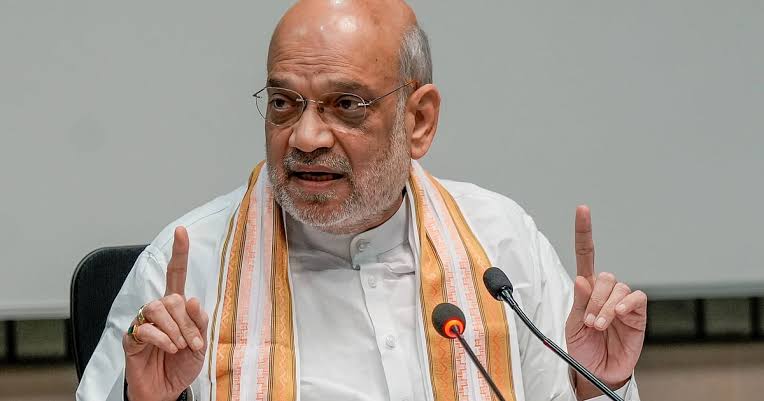
Union Home Minister Amit Shah has directed the country’s senior security and intelligence leadership to adopt a tougher approach towards infiltration, terrorism and other threats to India’s internal security. The directive came during the National Security Strategies Conference in New Delhi, where senior officials reviewed a wide range of challenges, including illegal immigration, terrorism, cybercrime, intelligence coordination and proxy warfare.
The two-day conference brought together the heads of central security and intelligence agencies along with around 850 officers from across the country. The meeting provided a platform for officials to assess existing security challenges and discuss ways to improve coordination between agencies at the national and state levels.
A major focus of the discussions was the detection and deportation of illegal immigrants. Shah stressed the need for stronger and more effective measures to identify infiltration and deal firmly with those entering the country illegally.
Greater Focus on Preventing Infiltration
The Home Minister’s instructions reflect the government’s continued emphasis on strengthening border security and preventing illegal entry into the country. Security agencies were asked to intensify their efforts against infiltration and improve coordination in identifying individuals and networks involved in facilitating illegal migration.
The issue has remained a significant concern for India’s security establishment because illegal entry can have implications extending beyond immigration. Authorities have increasingly focused on examining possible links between infiltration, organised networks, document fraud, human trafficking and other forms of cross-border criminal activity.
The latest directions seek to ensure that intelligence inputs are converted into timely operational action. Agencies have been encouraged to strengthen information sharing and develop a coordinated response rather than dealing with infiltration-related cases in isolation.
Counter-Terrorism Strategy Gets Greater Attention
Terrorism and radicalisation were also central to the discussions at the conference. Shah emphasised the need for better preparedness and specialised training to implement the government’s Prahaar counter-terrorism and counter-radicalisation framework.
The approach seeks to strengthen India’s response to terrorism by improving coordination, investigation, intelligence gathering and preventive measures. The emphasis on training indicates the government’s intention to ensure that security personnel have a clear understanding of the framework and are equipped to respond to evolving forms of extremist activity.
Shah also called for a comprehensive and integrated approach while investigating cases registered under the Unlawful Activities (Prevention) Act, commonly known as the UAPA. The objective is to ensure that investigations into terrorism-related cases are conducted efficiently and that different agencies involved in such cases work in close coordination.
Push to Bring Fugitives Back to India
Another important issue discussed at the conference was the prosecution of fugitives who remain outside India. Shah called for efforts to accelerate the process of bringing such accused persons back to the country so that legal proceedings can move forward.
The Home Minister also highlighted the use of trial in absentia provisions for fugitives who are hiding in foreign jurisdictions. Such legal provisions provide authorities with an additional mechanism to proceed with trials in certain cases even when accused individuals remain outside the country.
The issue is particularly significant in terrorism and cross-border crime cases, where accused persons may attempt to evade Indian law enforcement agencies by moving to another country. Faster legal proceedings and stronger international cooperation are therefore expected to remain important components of India’s broader counter-terrorism strategy.
Intelligence Sharing and Multi-Agency Coordination
The conference also focused on improving the use of intelligence through the Multi-Agency Centre, or MAC. The platform is designed to facilitate the sharing and analysis of intelligence among different security and investigative organisations.
Shah stressed the importance of turning intelligence into actionable information. The emphasis is not only on collecting intelligence but also on analysing it effectively and ensuring that relevant agencies receive critical inputs without unnecessary delays.
Better intelligence fusion can help agencies identify patterns, connect seemingly unrelated incidents and detect emerging threats at an earlier stage. This approach is increasingly important as security threats become more complex and involve networks operating across multiple jurisdictions.
Cybercrime and Proxy Warfare on Security Agenda
India’s security establishment is also paying greater attention to threats that extend beyond traditional terrorism and conventional warfare. Cybercrime and proxy warfare were among the issues discussed during the conference.
The growing use of digital technologies has created new avenues for criminal and hostile activities. Cyber networks can be used for financial fraud, espionage, disinformation, disruption of critical infrastructure and other forms of hostile activity.
Officials also discussed the need for a policy framework to deal with cybercrime and proxy warfare linked to Pakistan. The inclusion of these issues in the national security discussions highlights the changing nature of threats facing India, where physical security and digital security are increasingly interconnected.
Need for a Coordinated National Security Response
The participation of senior officials from central agencies and security organisations underlined the importance of coordination in dealing with India’s security challenges. Modern threats frequently cross administrative and jurisdictional boundaries, making cooperation between agencies essential.
A coordinated approach can allow intelligence agencies, investigative bodies, border forces and state police organisations to respond more effectively to threats. It can also reduce delays in investigations and help authorities identify connections between terrorism, illegal immigration, organised crime and other forms of cross-border activity.
The conference therefore served not only as a review of existing threats but also as a platform for developing a more integrated security response.
Broader Internal Security Priorities
The discussions at the conference demonstrate that India’s internal security priorities are expanding beyond traditional counter-terrorism operations. Infiltration, illegal immigration, radicalisation, cybercrime, narcotics, proxy warfare and fugitives operating from foreign countries are increasingly being examined as interconnected challenges.
The government is seeking to combine stronger intelligence capabilities with legal mechanisms, specialised training and closer coordination among security agencies. Technology and intelligence analysis are expected to play an increasingly important role in this process.
The emphasis on illegal immigration and infiltration also indicates that border management remains a key component of the country’s internal security strategy. Preventing unauthorised entry, identifying those who facilitate infiltration and ensuring appropriate legal action are likely to remain major priorities for security agencies.
Strengthening India’s Security Architecture
Amit Shah’s directions come at a time when India’s security agencies are preparing to deal with increasingly diverse and rapidly changing threats. From cross-border infiltration to cybercrime and radicalisation, the nature of security challenges has become more complicated, requiring agencies to work together and respond more quickly.
The National Security Strategies Conference provided an opportunity for senior officials to assess these challenges and strengthen the country’s overall security framework. The emphasis on tougher action against infiltration, improved intelligence coordination, stronger counter-terrorism measures and faster prosecution of fugitives reflects the government’s broader objective of creating a more coordinated and responsive national security system.
The focus on prevention, intelligence-led operations and effective legal action is expected to remain central to India’s approach as security agencies confront both conventional and emerging threats.