
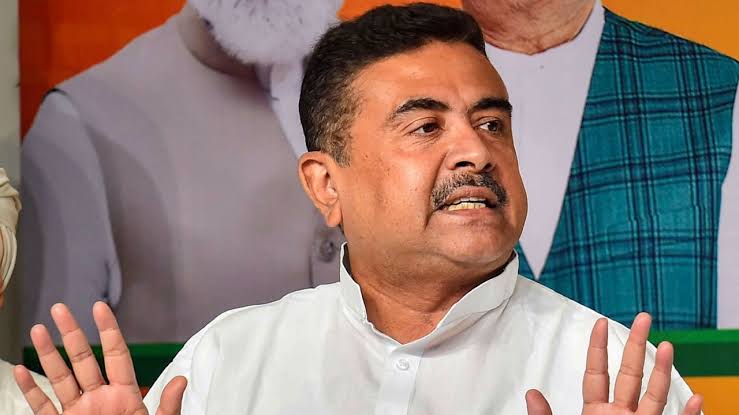
West Bengal Chief Minister Suvendu Adhikari has intensified the political controversy surrounding recent unrest at Jadavpur University by declaring that anyone who wants to remain in West Bengal will have to sing “Vande Mataram”.
The statement came amid heightened tensions on the university campus following clashes between Left-leaning student organisations and activists associated with the Rashtriya Swayamsevak Sangh-backed Akhil Bharatiya Vidyarthi Parishad (ABVP). The confrontation has triggered protests, political accusations and renewed debate over the role of ideology and political organisations in university affairs.
Addressing beneficiaries of the Annapurna scheme at an event in his Bhabanipur constituency, Adhikari launched a sharp attack on what he described as “anti-national” elements at Jadavpur University. He said his government would work to establish what he called nationalism both inside and outside the university campus.
Adhikari argued that national symbols and patriotic expressions should not be restricted or opposed within an educational institution. He specifically referred to Vande Mataram and the national flag while accusing sections of the university community of preventing or discouraging their use.
Jadavpur University Clashes Trigger Political Escalation
The chief minister’s remarks followed a series of confrontations between rival student groups at Jadavpur University. The clashes reportedly involved Left-leaning organisations and ABVP activists and resulted in injuries, protests and allegations of vandalism.
The dispute began amid tensions surrounding a meeting organised by Left-backed student groups and the Faculty of Engineering and Technology Students Union. ABVP activists questioned the legitimacy of holding such a meeting in the absence of an elected students’ union and protested against the gathering.
The confrontation subsequently escalated, with both sides accusing the other of provoking violence and bringing people from outside the campus. Police were called in as tensions increased, while several students from both camps reportedly suffered injuries.
The developments have placed the university administration under increasing pressure to restore normalcy and prevent further clashes.
Adhikari Says Nationalism Will Be Established on Campus
Adhikari used the Jadavpur University dispute to make a broader political argument about nationalism and patriotism in West Bengal.
He accused sections of the campus of being hostile to national symbols and alleged that some groups did not properly observe Independence Day and Republic Day celebrations. He also criticised what he described as “anti-national” and separatist elements.
The chief minister said his government would not compromise on nationalism or patriotism. He further linked his political position to the legacy of Syama Prasad Mookerjee and said his administration would seek to promote Indian cultural and nationalist values.
The remarks represent a significant escalation in the political narrative surrounding Jadavpur University. Rather than treating the recent incidents solely as a conflict between student groups, Adhikari has presented them as part of a larger ideological struggle over nationalism and the character of educational institutions.
Vande Mataram Becomes Central to the Debate
Vande Mataram has once again emerged as a politically sensitive issue. The song, which played an important role during India’s freedom movement, has long carried strong symbolic significance in the country’s political and cultural history.
Adhikari’s statement has brought the song into the centre of the Jadavpur University controversy. His assertion that people living in West Bengal must sing Vande Mataram has sparked questions about the relationship between patriotic expression, individual freedom and political identity.
The remark is also likely to intensify the existing political divide between the BJP and Left-oriented groups in the state. While supporters of Adhikari may view his position as an assertion of national unity and respect for national symbols, critics could argue that patriotism cannot be imposed through political declarations.
The controversy therefore extends beyond the immediate university dispute and touches upon wider questions concerning freedom of expression, pluralism and the nature of nationalism in a democratic society.
Allegations Over National Flag and Campus Administration
During his address, Adhikari also raised several issues concerning the functioning of Jadavpur University. He questioned whether Vande Mataram was allowed to be sung on campus, whether the national flag was properly displayed and whether state education officials had adequate access to the university.
He also referred to the installation of CCTV cameras, suggesting that efforts to strengthen surveillance and security on campus had faced resistance.
These claims have become part of the wider political argument over the university’s administration and security arrangements. The controversy comes at a time when campus authorities are already under pressure to respond to allegations of violence and vandalism.
The issue of CCTV surveillance is particularly significant following the recent clashes, as visual evidence could play an important role in identifying those involved and determining how the confrontation escalated.
Rival Student Groups Blame Each Other
The conflict at Jadavpur University has been marked by competing allegations from the student organisations involved.
ABVP supporters have accused Left-leaning student groups of organising activities without proper authorisation and have questioned the legitimacy of meetings held on campus in the absence of an elected student union.
Left-oriented organisations, meanwhile, have accused ABVP activists of entering the campus and engaging in violence and vandalism. Each side has sought to portray itself as responding to provocation rather than initiating the confrontation.
The conflicting claims have complicated efforts to establish a single narrative about the incidents. Police and university authorities are expected to examine available evidence, including CCTV footage and other material, to determine the sequence of events and identify those responsible for any offences.
Political Battle Extends Beyond the University
The Jadavpur University dispute has become another point of confrontation in West Bengal’s broader political landscape.
Universities have historically been important centres of political activity in the state, with student organisations often reflecting the ideological divisions of mainstream politics. Jadavpur University, in particular, has a long history of strong student activism and political engagement.
The recent clashes have therefore attracted considerable attention from political parties and leaders. The university is no longer being discussed simply in terms of student disagreements; it has become a symbol in a larger political contest involving nationalism, ideology and the influence of political organisations on campuses.
Adhikari’s intervention has further expanded the issue by placing Vande Mataram and national identity at the centre of the debate.
Concerns Over Political Influence on Academic Institutions
The latest controversy has also revived concerns about political interference in educational institutions.
While political participation and ideological discussion have traditionally been part of student life, violence and vandalism can severely disrupt academic activities. Faculty members, students and alumni have expressed concern over the impact of repeated confrontations on the university’s academic environment.
The challenge for the administration is to protect students and staff while ensuring that legitimate political expression is not unnecessarily restricted. Maintaining campus security without suppressing democratic debate will be particularly important as tensions remain high.
The university is also likely to face pressure to improve security mechanisms and establish clearer procedures for student meetings, rallies and demonstrations.
A Larger Debate Over Patriotism
Adhikari’s comments have turned the Jadavpur University controversy into a broader debate about the meaning and expression of patriotism.
The chief minister’s position reflects the view that national symbols should be respected and that educational institutions should promote national unity. His critics, however, may question whether participation in patriotic rituals can be treated as a requirement for residents of a state.
This distinction is important because the controversy involves both political messaging and questions about individual choice. The debate over Vande Mataram is therefore likely to continue well beyond the immediate clashes at Jadavpur University.
The issue also demonstrates how quickly campus disputes can become part of larger political campaigns when they intersect with questions of nationalism and ideological identity.
What Lies Ahead for Jadavpur University
The immediate challenge for the authorities will be to prevent another confrontation between rival student groups and ensure that academic activities continue without disruption.
The university administration has already taken steps to involve the police following the unrest. Further investigation could determine the circumstances surrounding the clashes and establish accountability for alleged violence or damage to property.
At the political level, however, the controversy is unlikely to disappear quickly. Adhikari’s strong remarks have ensured that the Jadavpur University dispute remains connected to the larger political debate over nationalism in West Bengal.
For the university, restoring peace will require more than increased security. It will also require political and student organisations to prevent ideological differences from turning into physical confrontation.
The controversy surrounding Vande Mataram, meanwhile, is expected to remain a significant political issue. Adhikari’s declaration has transformed an already contentious campus dispute into a wider argument over patriotism, national symbols and political identity in West Bengal.
As investigations into the recent campus violence continue, Jadavpur University remains at the centre of a politically charged debate that could have implications far beyond its campus.