
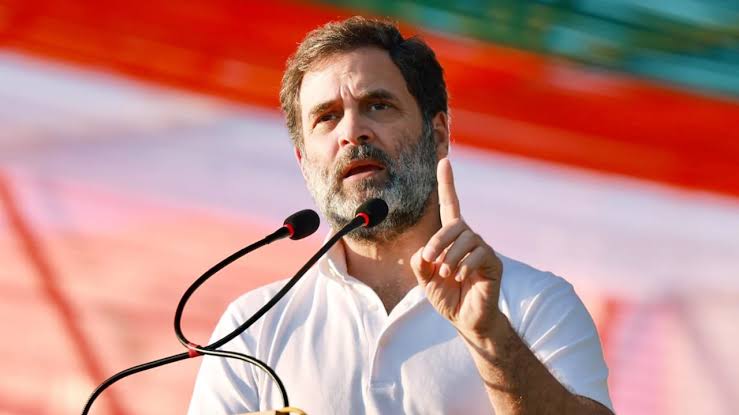
Congress leader and Leader of Opposition in the Lok Sabha Rahul Gandhi used his “Chhatron Ki Goonj” outreach programme in Pune to launch a sharp attack on patriarchal social norms, criticise the traditional interpretation of women’s roles and question Prime Minister Narendra Modi’s recent remarks about abusive language allegedly used by girls during a protest.
Addressing a large gathering of female students and young professionals on Saturday, Gandhi said women should not be defined solely through their relationships with fathers, husbands or sons. He argued that women possess an independent identity and should have the freedom to determine their own choices, careers and futures.
The Congress leader also invoked the Manusmriti while making his argument against what he described as a deeply entrenched patriarchal mindset. Referring to a traditional prescription in the ancient text concerning a woman’s dependence on male relatives at different stages of her life, Gandhi called the idea unacceptable and said such thinking should be challenged in modern India.
Gandhi urges women to assert their independence
Gandhi told the gathering that women are not possessions of their families and should not be treated as individuals whose lives must remain under male control. He stressed that being a daughter, wife or mother can be an important part of a woman’s life but should not become the entirety of her identity.
He described India’s women as one of the country’s greatest strengths and pointed to the aspirations, experiences and ambitions of millions of women across the country. According to Gandhi, women should have the confidence to pursue their own goals and demand equal space in society.
He urged the young women attending the programme to reject fear and social restrictions and encouraged them to speak openly about their concerns.
Gandhi’s central message was that women must be allowed to make independent decisions rather than being confined by expectations imposed by family or society.
Attack on what Gandhi called a patriarchal mindset
The Congress leader broadened his criticism beyond the Manusmriti, arguing that patriarchal attitudes continue to influence the way Indian society treats men and women differently.
He said a mindset still exists in which women are expected to remain controlled, stay within traditional boundaries and accept restrictions that are not imposed on men to the same extent.
Gandhi argued that such double standards affect women’s freedom in several areas, including education, employment, economic independence and personal expression.
He said society must move towards a system in which both men and women receive equal respect and opportunities.
“Patriarchy,” he argued, can operate through fear, social pressure and restrictions on opportunities. He called upon women to challenge those barriers rather than accept them as inevitable.
Rahul Gandhi questions PM Modi’s ‘cultural shock’ remark
Gandhi also directly targeted Prime Minister Narendra Modi over remarks concerning abusive language allegedly used by young women during a recent protest at Jantar Mantar over examination-related issues.
During the Pune programme, Gandhi played a video in which Modi referred to abusive language reportedly directed at him and his late mother. Modi had expressed surprise that girls were among those using such language and described the situation as a “cultural shock.”
Gandhi challenged what he described as a gender-based double standard in the reaction.
He said both male and female protesters had used abusive language during the agitation, but questioned why the participation of girls in such behaviour should be viewed differently from that of boys.
According to Gandhi, the issue illustrated a broader social attitude in which certain forms of behaviour are tolerated when associated with men but considered unacceptable or shocking when associated with women.
He used the episode to reinforce his argument that women should not be judged according to separate and unequal standards.
Manusmriti becomes central to Gandhi’s argument
Gandhi’s references to the Manusmriti formed one of the most significant parts of his address.
He cited a traditional passage that describes women as being under the authority of their fathers during childhood, husbands during adulthood and sons after the death of their husbands. Gandhi rejected this conception of women’s independence and described such ideas as incompatible with the principles of equality.
His remarks placed the discussion within a broader political debate over the role of tradition, social reform and gender equality in contemporary India.
Rather than treating women’s identities primarily through family relationships, Gandhi argued that women should be recognised as individuals with their own ambitions, abilities and rights.
He also said that India’s progress would depend heavily on the ability of women to participate fully in social, economic and political life.
Women’s safety and economic independence highlighted
Gandhi also spoke about the different forms of pressure and violence experienced by women. He referred not only to physical violence but also to restrictions on opportunities and economic dependence.
According to his argument, discrimination can occur even when there is no direct physical assault. Preventing women from studying, working or becoming financially independent can also limit their freedom and ability to make decisions.
He urged women to recognise these barriers and fight for greater opportunities.
The Congress leader also argued that women often face social expectations that require them to prioritise family responsibilities while placing fewer restrictions on men.
He said such unequal expectations must change if India is to achieve genuine gender equality.
Interaction with students and young professionals
The Pune programme was structured around interaction with young women rather than being limited to a conventional political speech. Gandhi listened to students and young professionals and discussed issues affecting their lives and ambitions.
The event was part of the wider “Chhatron Ki Goonj” outreach initiative, through which Gandhi has been engaging with young people and discussing issues such as education, examinations, employment and social concerns.
The Pune gathering placed particular emphasis on women and their experiences.
The event also featured Bhojpuri singer and public figure Neha Singh Rathore, who spoke about her experiences of facing criticism and abuse after questioning the government on issues she considered important.
Rathore questioned how democratic participation can function effectively if citizens are discouraged from asking difficult questions to those in power.
Her remarks added another dimension to the programme, linking women’s experiences with broader questions about freedom of expression and political accountability.
Wider political context
Gandhi’s comments come amid an increasingly intense political debate between the Congress and the BJP over social issues, youth concerns, women’s rights and the role of traditional values in contemporary India.
By placing patriarchy and women’s autonomy at the centre of his Pune address, Gandhi sought to frame gender equality as a political and social issue rather than simply a question of individual rights.
His criticism of the Prime Minister also gave the programme a direct political dimension. The reference to Modi’s comments about the Jantar Mantar protest allowed Gandhi to connect a recent political controversy with his larger argument about unequal standards applied to men and women.
The Congress leader also referred to earlier controversial comments attributed to senior figures associated with the BJP and RSS while arguing that patriarchal attitudes remain a wider problem.
He said the objective should not be to restrict one gender while giving greater freedom to another, but to ensure equal dignity and opportunity for everyone.
Focus on a new understanding of women’s identity
A recurring theme throughout Gandhi’s address was the distinction between a woman’s relationships and her individual identity.
He acknowledged that being a daughter, wife or mother can be meaningful, but argued that these relationships should not determine the limits of a woman’s ambitions.
For Gandhi, women’s empowerment requires more than legal equality. It also requires changes in social attitudes that determine what women are expected or permitted to do.
He called upon young women to be confident, assertive and willing to challenge restrictions that prevent them from achieving their goals.
The address therefore combined criticism of traditional social norms with a broader political message about equality, opportunity and individual freedom.
Conclusion
Rahul Gandhi’s Pune appearance turned the “Chhatron Ki Goonj” programme into a prominent discussion on women’s autonomy, patriarchy and gender equality. His criticism of the Manusmriti’s traditional prescriptions for women, coupled with his attack on Prime Minister Narendra Modi’s “cultural shock” remark, placed questions of social attitudes and double standards at the centre of the event.
Gandhi’s message to the young women in attendance was that they should not allow family roles or patriarchal expectations to define the boundaries of their lives. He argued that women must have the freedom to shape their own identities, pursue education and careers, speak openly and participate equally in society.
The remarks are likely to add to the continuing political debate over women’s rights, traditional social structures and the competing visions of equality and cultural values being advanced by India’s major political parties.