
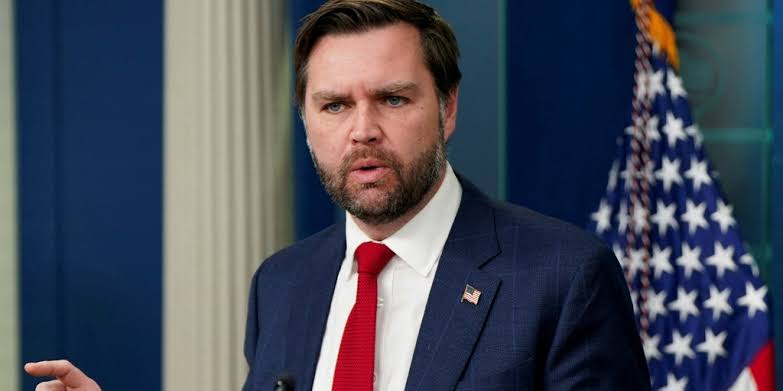
US Vice President JD Vance has intensified his criticism of outsourcing, foreign labor and immigration policies, arguing that decades of economic decisions weakened American manufacturing and left working-class communities struggling with job losses and social disruption.
Speaking in his hometown of Middletown, Ohio, Vance presented the decline of American industry as part of a broader economic and political failure. He argued that companies moving production overseas, combined with the increased use of foreign labor, had contributed to the erosion of stable employment opportunities for American workers.
His remarks have also revived debate over the H-1B visa programme, particularly among Americans who believe that foreign workers are sometimes used by companies to reduce labour costs or replace domestic employees.
Vance links outsourcing to the decline of American manufacturing
During his speech, Vance recalled stories from his childhood and school years involving families in Middletown whose livelihoods were affected when factories moved operations outside the United States.
He described the consequences as extending beyond the loss of individual jobs. According to Vance, some workers who lost their positions after companies shifted operations overseas later encountered another difficult situation: they were asked to train foreign workers who would take over their responsibilities before they themselves left the company.
Vance used such examples to argue that the effects of globalisation should not be measured only through corporate profits, trade figures or employment statistics. In his view, the disappearance of manufacturing jobs also damaged communities that had traditionally relied on factories and industrial employment for economic stability.
The vice president presented Middletown as an example of what he sees as the long-term consequences of industrial decline. His own family history is closely connected with the area’s steel industry, and he referred to his grandfather’s years working at a local steel plant while describing the community’s economic transformation.
Vance recounts programmer’s death
One of the most emotional parts of Vance’s speech involved the story of Kevin Flanagan, a computer programmer whose case he said had remained with him.
Vance said Flanagan was informed that he would receive his severance package only after training a foreign replacement at the bank where he worked. According to Vance’s account, Flanagan completed the training and died by suicide on his final day at the company.
Vance used the case to illustrate what he considers the human consequences of labour displacement. Rather than portraying outsourcing simply as an economic issue, he argued that losing a job under such circumstances can have severe effects on workers’ dignity, financial security and mental wellbeing.
The story has previously circulated in discussions about American employees being replaced by foreign workers. Vance’s decision to highlight it during a speech about manufacturing and immigration placed the issue of worker displacement at the centre of his broader economic argument.
Opioid crisis and economic decline
Vance also connected the loss of industrial employment with wider social problems in communities that once depended heavily on manufacturing.
He referred to research concerning the relationship between the decline of industrial employment and the opioid crisis, describing deaths associated with such social and economic deterioration as “deaths of despair.”
Vance argued that when well-paying industrial jobs disappear, communities can experience consequences that extend beyond unemployment. Reduced economic opportunities can affect families, local businesses and social institutions, while prolonged financial insecurity can contribute to broader social problems.
He also linked immigration and border policies to the fentanyl crisis, arguing that inadequate border controls had provided opportunities for criminal organisations involved in the drug trade.
Vance presented these issues as interconnected elements of what he described as the long-term cost of economic and immigration policies. His argument was that the consequences of labour-market changes and border policy should be evaluated not only in terms of economic growth but also through their impact on American communities.
Criticism of corporate America and globalisation
Vance directed some of his strongest criticism at corporate executives and political leaders whom he accused of prioritising profits over American workers.
He argued that businesses benefited financially by shifting production abroad or seeking cheaper sources of labour, while the communities that had historically depended on manufacturing were left to deal with factory closures and declining economic opportunities.
The vice president also criticised supporters of freer labour movement, presenting their approach as part of a broader economic consensus that had placed globalisation ahead of the interests of American workers.
He argued that the replacement of American workers with foreign labour was not simply the unintended result of economic forces but part of a system that, in his view, had been encouraged by sections of the political and corporate establishment.
That argument is particularly significant in the context of the continuing debate over high-skilled immigration. The H-1B visa programme is designed to allow US employers to hire foreign workers for specialised occupations, particularly in fields requiring advanced technical or professional skills. Critics have argued that companies can misuse the system to reduce labour costs, while supporters say skilled immigration helps businesses address talent shortages and contributes to innovation.
H-1B visas become a major point of contention
Vance’s comments have renewed attention on the H-1B programme, which has become one of the most politically sensitive parts of the US immigration debate.
Critics of the programme argue that American workers should receive greater protection when companies are hiring overseas employees. They particularly object to situations in which domestic workers are laid off while companies continue recruiting foreign employees for similar positions.
The administration has previously taken a harder position on alleged abuses of the H-1B system, including concerns about whether foreign workers are being used to replace American employees rather than fill genuine shortages.
At the same time, the debate remains complicated. Supporters of high-skilled immigration maintain that American technology, healthcare, engineering and other industries depend on access to international talent. They argue that foreign professionals can complement rather than simply replace US workers and that restricting skilled immigration could make American companies less competitive.
Vance’s latest remarks therefore feed into a longstanding argument over how the United States should balance immigration, worker protection, business needs and economic competitiveness.
Vance credits Trump with manufacturing revival
After describing the problems he believes were created by earlier economic policies, Vance turned to the Trump administration’s approach.
He argued that President Donald Trump’s policies are beginning to reverse the decline of American manufacturing by encouraging companies to invest in domestic production.
Vance said that, over roughly 18 months, trillions of dollars in investment had been directed toward factories, mills, smelters and other manufacturing facilities in the United States.
He also cited an increase of about 83,000 factory construction jobs since Trump took office, presenting the figure as evidence that the administration’s economic strategy was encouraging a renewed focus on domestic industrial production.
The remarks fit into the administration’s broader “America First” economic message, which places greater emphasis on domestic manufacturing, American employment and reducing reliance on overseas production.
Social media reaction intensifies H-1B debate
Vance’s comments quickly generated discussion on social media, with particular attention focused on his criticism of foreign-worker replacements and the H-1B programme.
Some users strongly supported his position, arguing that American companies should prioritise domestic employees and that workers should not be required to train foreign replacements before losing their own jobs.
One recurring criticism was that the H-1B system could conflict with the “America First” approach if companies use it to replace American employees rather than address genuine shortages.
Other reactions focused on the broader principle of protecting workers from becoming economically disposable. Supporters of Vance’s argument said that protecting American employment should include stronger safeguards against companies reducing labour costs through overseas hiring or worker replacement.
The reactions demonstrate how politically charged the H-1B debate has become. What was once largely a policy discussion involving immigration rules, employers and technology companies has increasingly become part of a wider debate over economic nationalism and the future of the American workforce.
A wider political battle over America’s economic future
Vance’s speech reflects the Trump administration’s broader effort to connect immigration policy with economic security and domestic employment.
For Vance, the issues of outsourcing, illegal immigration, foreign labour and manufacturing decline are not separate policy questions. He has presented them as interconnected developments that have affected American workers and communities over several decades.
His argument also reflects a significant shift in the political debate over globalisation. While previous administrations and business groups frequently emphasised the economic benefits of international trade and access to global talent, Vance and other economic nationalists have increasingly focused on the workers and communities that they believe were left behind.
The challenge for policymakers is finding a balance between protecting American workers and maintaining the economic advantages associated with international investment and skilled immigration.
As the administration continues to pursue tighter immigration enforcement and policies aimed at expanding domestic manufacturing, the H-1B programme is likely to remain a major point of political controversy.
Vance’s Middletown speech has consequently added another chapter to an increasingly intense debate over who should benefit from America’s economy, how companies should recruit workers and whether the country’s future prosperity should depend more heavily on domestic labour or international talent.