
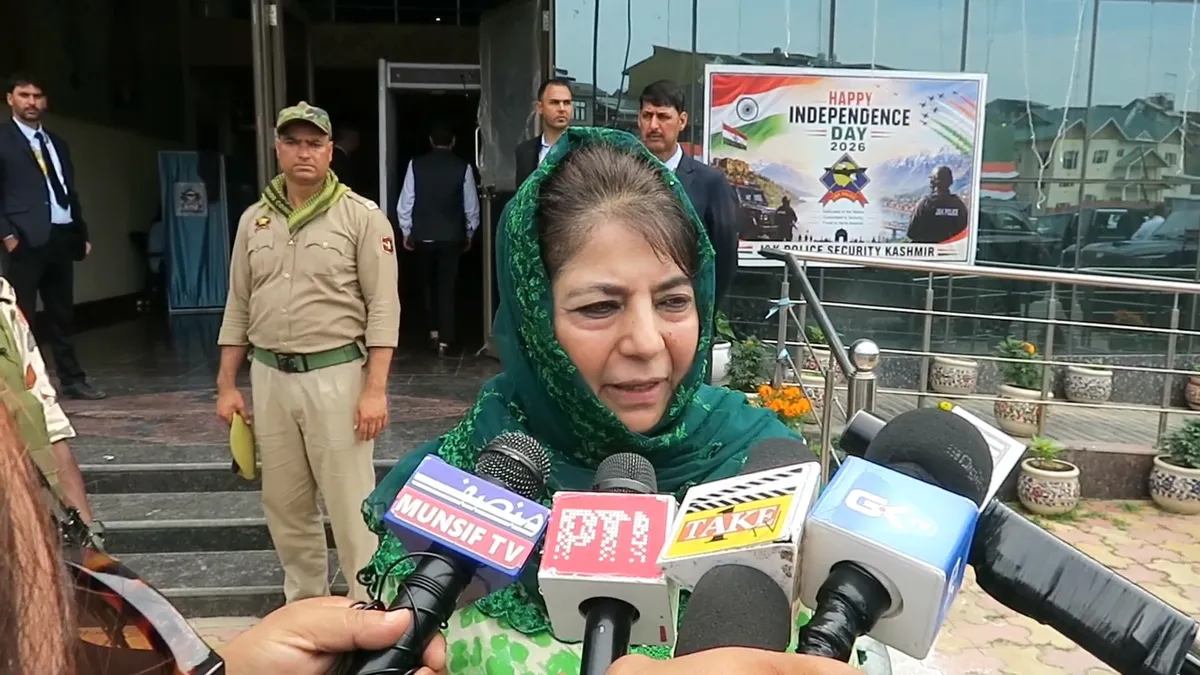
Peoples Democratic Party (PDP) president Mehbooba Mufti on Saturday called upon the Centre to reflect on whether India has truly fulfilled the vision and values laid down in the Constitution, using the occasion of Independence Day to raise broader questions about the country’s democratic journey.
Speaking to reporters after attending the Independence Day function at Bakshi Stadium in Srinagar, Mufti questioned whether the country, eight decades after Independence, has been able to realise the India envisioned by the makers of the Constitution. Her remarks placed constitutional values, democracy and political accountability at the centre of her Independence Day message.
Mufti’s comments came in response to Prime Minister Narendra Modi’s appeal to political parties to cooperate in implementing women’s reservation in Parliament and State legislative assemblies. The Prime Minister had urged parties to ensure that the issue was not turned into a political confrontation.
Rather than focusing only on the question of women’s representation, Mufti broadened the discussion to the larger constitutional framework within which Indian democracy operates. She argued that the country should periodically examine whether its institutions and political practices remain consistent with the ideals set out in the Constitution.
Her intervention comes at a time when debates over constitutional rights, democratic institutions, representation and the relationship between the Centre and the States continue to occupy a prominent place in Indian politics.
Mehbooba Questions Constitutional Journey
Mufti’s central argument was that Independence Day should not only be an occasion for celebrating the country’s achievements but also a moment for introspection. She questioned whether India has been able to live up to the aspirations that accompanied the adoption of the Constitution.
The Constitution establishes a framework built around democracy, equality, justice, liberty and political representation. Mufti’s remarks suggested that these principles should be assessed not merely through laws and institutions but through their impact on citizens and the functioning of democratic governance.
Her statement also reflects the continuing political debate over how constitutional ideals are interpreted and implemented in contemporary India. For opposition parties and regional political organisations, questions concerning federalism, representation and constitutional safeguards remain particularly significant.
Remarks Follow Prime Minister’s Women’s Reservation Appeal
The immediate context of Mufti’s comments was the Prime Minister’s appeal for political parties to support the implementation of women’s reservation in legislatures.
Women’s reservation has been presented as an important step towards increasing the representation of women in India’s elected institutions. The constitutional amendment providing for reservation of seats for women in the Lok Sabha and State legislative assemblies has generated considerable political discussion over its implementation and the processes linked to electoral delimitation.
The Prime Minister’s appeal sought political cooperation on the issue and urged parties to avoid turning the implementation process into a political dispute.
Mufti, however, used the occasion to raise a wider question about the country’s constitutional record. Her response shifted attention from a specific policy measure to the broader issue of whether India’s political system continues to reflect the principles envisioned by the Constitution’s framers.

Independence Day Provides Backdrop for Political Debate
Mufti made the remarks in Srinagar as Jammu and Kashmir marked the 80th Independence Day. Political leaders across the country used the occasion to reflect on India’s independence, democratic institutions and the responsibilities associated with citizenship and governance.
In Jammu and Kashmir, Independence Day speeches also carried a distinct political significance because of the region’s history and its changing constitutional and administrative status.
The political landscape of Jammu and Kashmir has undergone major changes since 2019, when the Centre altered the region’s constitutional position and reorganised the former State into two Union Territories. The issue remains a major point of political disagreement between the Centre and several regional parties.
Mufti, a former Chief Minister of the erstwhile State of Jammu and Kashmir, has remained a prominent critic of several central government policies concerning the region. Her latest remarks therefore come within a wider political discourse over constitutionalism, democratic representation and the future political framework of Jammu and Kashmir.
Focus on Democratic Accountability
At the heart of Mufti’s comments was the question of accountability. Her call for the Centre to reflect on the country’s constitutional journey effectively placed the responsibility of evaluating democratic governance on those currently exercising political power.
Such questions are particularly relevant on Independence Day, when national celebrations are accompanied by discussions about the achievements and shortcomings of the country since 1947.
The Constitution was designed to provide a democratic structure in which institutions, governments and elected representatives operate within established legal and constitutional limits. The effectiveness of that framework depends not only on the existence of constitutional provisions but also on how consistently they are implemented.
Mufti’s statement therefore adds another dimension to the ongoing political conversation about representation and institutional functioning. While the immediate issue was women’s reservation, her remarks focused attention on the larger question of how constitutional principles translate into political practice.
Jammu and Kashmir Remains Central to Mufti’s Politics
For Mufti and the PDP, constitutional questions have long been closely connected with Jammu and Kashmir’s political status and the relationship between the region and the Union government.
The region’s transition from a State to a Union Territory, along with the changes introduced in 2019, continues to influence political debate in Jammu and Kashmir. Regional parties have repeatedly raised issues concerning restoration of statehood, political representation and the restoration of what they describe as the region’s constitutional and political rights.
Against this backdrop, Mufti’s Independence Day comments can be viewed as part of a broader argument about the meaning of constitutional democracy and the manner in which political authority should be exercised.
Her remarks also underline the continuing divide between the Centre’s approach to Jammu and Kashmir and that of several regional political parties. While the Union government has defended its policies as intended to strengthen integration, governance and development, regional parties have continued to raise concerns about political autonomy, representation and constitutional safeguards.
A Broader Debate Over India’s Constitutional Vision
Mufti’s intervention ultimately places a broader question before the political establishment: how should India measure its progress against the ideals that shaped the Constitution?
The question extends beyond any single government or political party. It touches upon the functioning of democratic institutions, protection of rights, equality of citizens, political representation and the balance between national authority and regional interests.
Her remarks also illustrate how Independence Day continues to serve not only as a ceremonial occasion but as a platform for competing political interpretations of India’s democratic journey.
As the country enters another year of its post-Independence history, the debate over constitutional values is likely to remain an important part of political discourse. Mufti’s call for introspection adds to that debate by asking whether the constitutional vision articulated at the founding of the Republic has been fully realised in practice.