
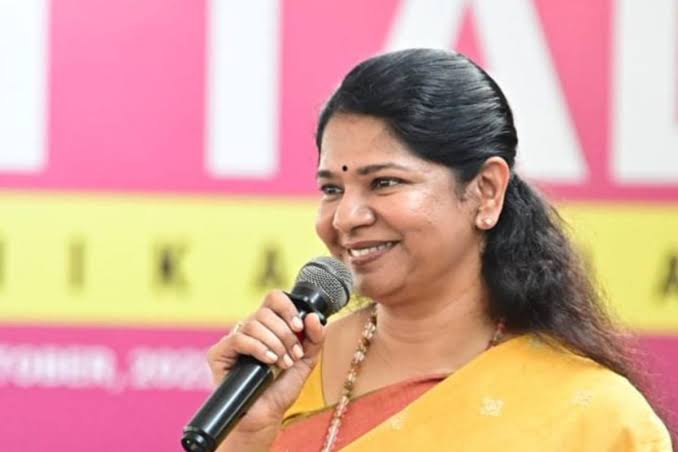
The political debate over possible realignments in Tamil Nadu has intensified after DMK MP Kanimozhi Karunanidhi attended a customary tea gathering hosted by Lok Sabha Speaker Om Birla in New Delhi. Her participation has triggered allegations from a Tamil Nadu minister that the DMK could be moving closer to the Bharatiya Janata Party (BJP), although both the DMK and the BJP have rejected the suggestion.
Kanimozhi attended the Speaker’s tea party on Thursday during the closing phase of Parliament’s Monsoon Session. Her presence drew particular attention because several prominent Opposition parties, including the Congress, Trinamool Congress and Samajwadi Party, stayed away from the gathering.
Tamil Nadu Law Minister R Nirmal Kumar seized on Kanimozhi’s participation to claim that the development indicated a possible political understanding between the DMK and BJP. He alleged that the DMK was moving towards an arrangement with the BJP and suggested that the party’s decision was motivated by political and legal considerations.
The minister’s remarks have added another layer to an already charged political atmosphere in Tamil Nadu, where rival parties are closely watching possible changes in alliances ahead of the state’s next electoral contest.
Minister alleges DMK is moving towards BJP
Nirmal Kumar argued that Kanimozhi’s presence at the Speaker’s event should not be viewed simply as participation in a routine parliamentary function. According to him, the development was evidence of a broader political shift.
He referred to the DMK’s earlier political association with the BJP in Tamil Nadu and claimed that the party could once again be preparing for closer cooperation with the national ruling party.
The minister alleged that the DMK had previously helped give political recognition to the BJP in Tamil Nadu and claimed that a renewed understanding could be aimed at protecting the interests of the party’s leadership.
His remarks were sharply critical and framed the alleged rapprochement as a political arrangement rather than a routine parliamentary interaction. However, the claims were not accompanied by any announcement of an alliance or formal confirmation from either the DMK or BJP.
DMK hits back at criticism
The allegations prompted a response from the DMK, with party MLA Markandayan GV dismissing the minister’s remarks in strong terms.
The DMK leader used a metaphorical comparison to accuse the minister and his political camp of expressing concern over circumstances they had themselves contributed to. His response reflected the broader political hostility between the rival camps in Tamil Nadu.
The DMK has not announced any decision to enter into an alliance with the BJP, and Kanimozhi’s participation in the Speaker’s tea gathering, by itself, does not establish the existence of a political pact.
The BJP’s state spokesperson Narayanan Thirupathy also rejected the interpretation that Kanimozhi’s attendance represented evidence of an emerging alliance. His response further weakened the immediate political basis for treating the tea party appearance as a confirmed sign of a formal realignment.
Why the tea party became politically significant
The controversy stems largely from the political circumstances surrounding the event. A Speaker’s tea party is a customary parliamentary gathering intended to bring members and political leaders together after a parliamentary session. Attendance at such events is not, in itself, an indication of an electoral alliance or political agreement.
However, the timing and political environment have given Kanimozhi’s participation greater significance.
The Monsoon Session has witnessed sharp differences between the ruling coalition and Opposition parties. Several Opposition groups chose to stay away from the Speaker’s gathering, making the presence of a senior DMK leader particularly noticeable.
The contrasting positions have fuelled questions about the DMK’s approach to parliamentary coordination and its relationship with other Opposition parties. The development is also being viewed against the backdrop of growing political competition in Tamil Nadu, where parties are attempting to strengthen their positions ahead of the next major electoral battle.
DMK’s Opposition credentials remain under scrutiny
The DMK remains an important component of the Opposition political space at the national level. Its participation in parliamentary proceedings and its positions on major national and state issues have frequently placed it in confrontation with the BJP-led central government.
At the same time, political parties in Tamil Nadu have historically demonstrated considerable flexibility in forming electoral partnerships. Alliances in the state have changed significantly over different election cycles, making speculation about future political combinations a recurring feature of Tamil Nadu politics.
The DMK and BJP have also shared an alliance in the past, including during the early 2000s. Their political relationship subsequently changed, and the two parties have since occupied opposing positions on several major issues.
That history provides the backdrop against which current claims of a possible rapprochement are being interpreted.
Routine parliamentary event or political signal?
The central question emerging from the controversy is whether Kanimozhi’s attendance should be regarded as a routine parliamentary courtesy or as a political signal.
There is currently no confirmation of a formal DMK-BJP agreement arising from the event. Neither Kanimozhi nor the DMK has announced that the party intends to enter into a new alliance with the BJP. The BJP, too, has not announced any such arrangement.
Consequently, the political interpretation remains speculative.
Nevertheless, the episode demonstrates how even routine parliamentary interactions can acquire political significance when relations between parties are already under intense scrutiny. In a highly competitive political environment, attendance at an official gathering can quickly become the subject of competing narratives.
For the DMK, the controversy also highlights the challenge of maintaining its political positioning while participating in parliamentary events alongside members of the ruling establishment.
Tamil Nadu’s evolving political landscape
The latest exchange comes at a time when Tamil Nadu’s political landscape is becoming increasingly competitive, with established parties and emerging political forces seeking to consolidate their support bases.
Issues involving parliamentary representation, delimitation and the political interests of southern states have become particularly important in recent political debates. The DMK has maintained a strong focus on Tamil Nadu’s interests in such matters, while the BJP has continued efforts to expand its political presence in the state.
Against this backdrop, any suggestion of a change in the DMK’s national political alignment is likely to attract considerable attention.
The latest controversy therefore extends beyond one parliamentary gathering. It reflects the wider uncertainty surrounding future political equations in Tamil Nadu and the continuing efforts of rival parties to interpret one another’s actions.
No confirmed alliance yet
For now, the claim that the DMK and BJP are preparing for a formal alliance remains an allegation rather than an established political development.
Kanimozhi’s attendance at the Speaker’s tea party was a confirmed event, but the conclusions drawn from it differ sharply among political parties. The Tamil Nadu law minister interpreted the appearance as evidence of an emerging understanding, while the DMK rejected the criticism and the BJP’s state unit dismissed the alliance claim.
The episode is likely to keep speculation alive as political parties in Tamil Nadu prepare for future electoral battles. Whether the interaction eventually proves to be merely a parliamentary courtesy or becomes part of a larger political realignment will depend on subsequent statements, negotiations and electoral strategies.